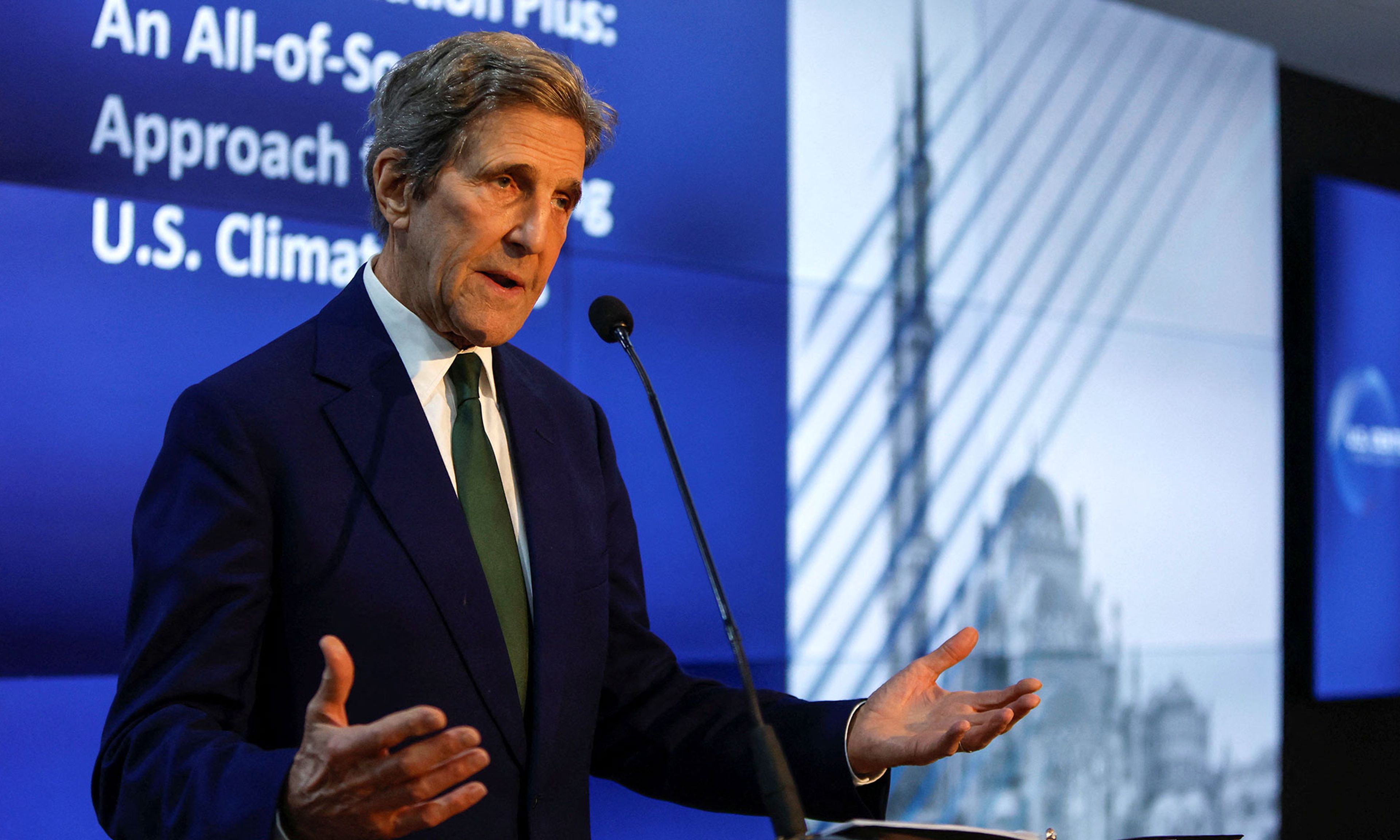
At the COP27 climate summit in Egypt earlier this month, American diplomats appointed by President Biden agreed to pay poor countries for supposed damage caused by America’s emitting carbon dioxide.
This represents a major reversal in U.S. climate policy. Similar agreements had previously been blocked by both the Obama and Trump administrations, and for good reason: The “loss and damage” fund is both incredibly expensive and could be used to create a legal liability for greenhouse-gas emissions.
In short, it is a total shakedown. A major beneficiary of the deal is China, despite the fact that it has much higher emissions than the United States.
Even U.S. Special Climate Envoy John Kerry, a man certainly not reputed for downplaying global warming, recently said that the United States would not sign on to establishing such a fund: “It’s a well-known fact that the United States and many other countries will not establish . . . some sort of legal structure that is tied to compensation or liability. That’s just not happening.”
Environmental activists often refer to this kind of shakedown as “reparations” for developing nations, and according to the Guardian this is now “a central tenet of climate justice.” Essentially, the idea is that that poorer countries contribute less to global warming via emissions and suffer more from the floods, droughts, and severe weather that result from it, so they deserve payback.
But, as the Wall Street Journal’s editorial board eloquently notes, “all of this ignores the benefits for humanity, rich and poor, that economic growth spurred by capitalism have provided. American taxpayers are being asked to pay because the U.S. industrialized first and then lifted billions of people out of poverty via investment and trade.”
Nonetheless, activists and representatives of some poor countries claim that since they allegedly will be the most impacted by rising sea levels and other consequences of global warming, they are entitled to fiscal compensation paid for by wealthier countries. The Associated Press calls it “calamity cash.” Others refer to the idea as paying off “climate debt.” It’s socialism with environmentalist characteristics.
The precise amount to be spent on climate reparations hasn’t been determined yet, but it will likely be enormous, as the fund’s estimates of alleged damages are measured in hundreds of billions of dollars annually. The small island nation of Vanuatu alone has claimed its “starting point” for climate compensation is $177 million. And all of this is on top of the $100 billion that the U.S. and other wealthy countries have already pledged, in a previous agreement, to donate to “developing nations” as compensation for environmental harms. Indeed, one study claimed that “climate finance needs” could reach $290 billion to $580 billion in 2030 and rise to more than $1 trillion per year in 2050.
It is also unclear how Biden expects a Republican-controlled House of Representatives to appropriate the money.
But, China won’t be paying.
That’s because “the United Nations currently classifies China as a developing country. . . . Even though it is now the world’s biggest emitter of greenhouse gasses as well as the second-largest economy,” according to the New York Times. “China has fiercely resisted being treated as a developed nation in global climate talks,” and it makes sense why.
China’s status as a “developing country” is a major distinction that is very beneficial to Beijing, since under the terms of a bedrock 1992 U.N. climate treaty, “developed” countries are supposed to help “developing” ones financially.
So, even though in 2019 China was responsible for more than 27 percent of total global harmful emissions while the U.S. accounted for just 11 percent, the new agreement will be favorable to the Chinese.
That might explain why China’s climate envoy, Xie Zhenhua, called recent talks “very constructive,” while an anonymous delegate told the Times that the talks were “untransparent, chaotic, unpredictable.”
“The recipients should be developing countries,” Xie added. “But provide it first to those who need it the most.” He also noted that the previous Paris Agreement, which former President Trump withdrew the U.S. from, “made it very clear that the responsibility to provide finance lies with developed countries.”
Biden’s diplomats originally demanded that China (which emits three times more carbon dioxide today than it did in 1990, generated more than half of their energy in 2020 using dirty coal power, and has more new coal plants set for approval through the year 2025 than the U.S. has in total) and other large polluters currently classified as developing countries pay their own way, but ultimately gave in when some European countries issued a “final offer” that included reparations to prevent poor countries from walking away from an agreement.
Kerry, who served as the secretary of state under Obama and was touted as an official who reflects Biden’s “commitment to addressing climate change as an urgent national security issue,” ultimately flip-flopped (not for the first time) on his rhetoric from earlier in the month and rolled over on the issue.
This reversal almost certainly means that American taxpayers will be forced to directly or indirectly fund Communist China. . . . Despite emitting far less than our international rival.





Comments