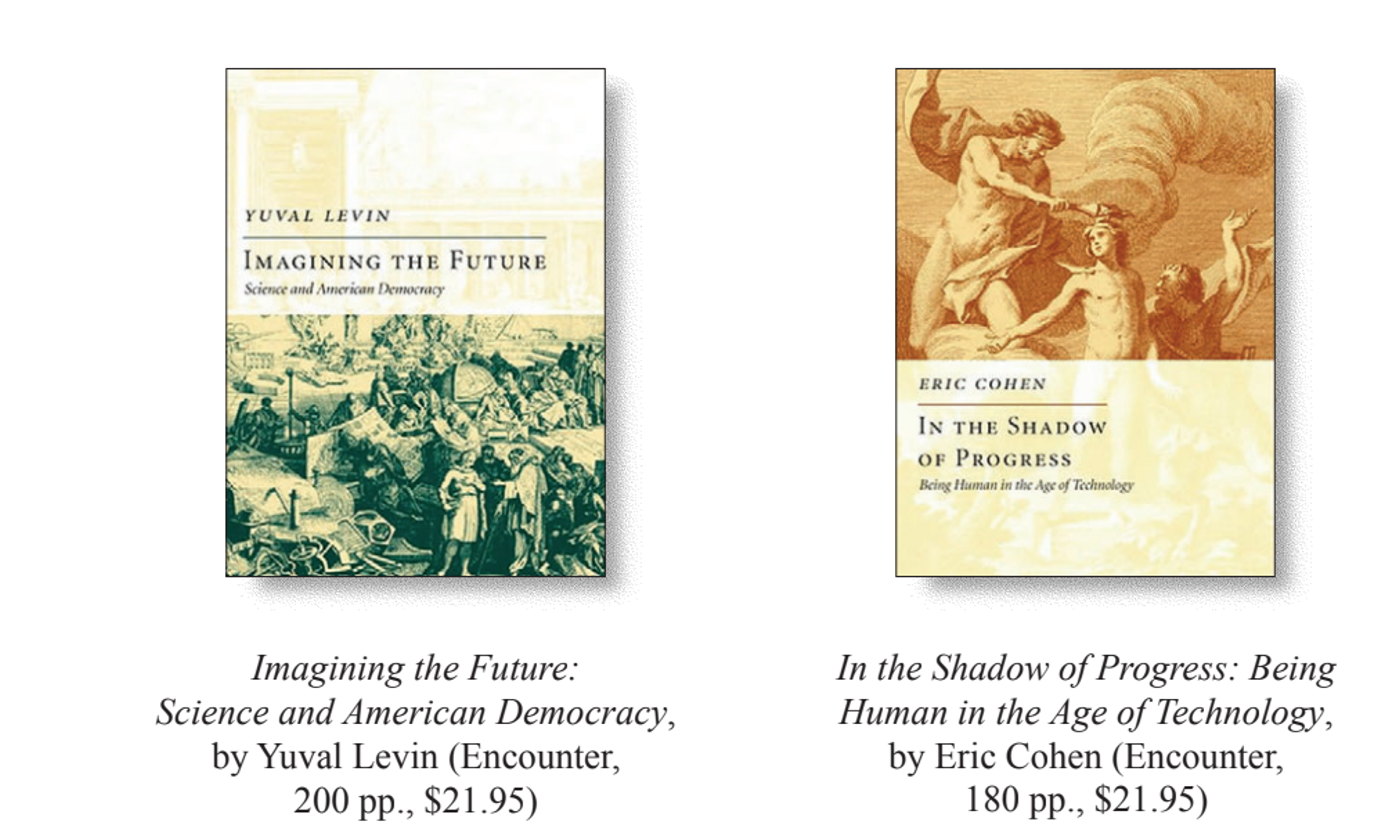
Everything is political today, and science is no exception. The Left is accused of pushing an ethics-be-damned “science über alles”; traditionalists who dare to express even the most reasonable concerns about the awesome powers of biotechnology are dismissed as harbingers of a new Dark Age of superstition. Seeking to pour the water of cool reason on these fires comes a relatively new national voice, Yuval Levin, whose new book, Imagining the Future: Science and American Democracy, analyzes the proper place of science as mediated by politics and morality in a democratic society.
Levin is a political conservative. He served as a White House adviser on scientific issues, and is now a fellow at the Ethics and Public Policy Center and a contributor to National Review Online. Yet, despite being a well-scarred veteran of the stem-cell wars, Levin writes with an admirable lack of rancor as he argues that science is served — rather than hindered — by respectful political debate. For as Levin sees it, science is “neither quite a conservative nor a liberal project. It is the American project.” His book doesn’t attempt to stack the deck in favor of the conservative side. Indeed, if anything, with some significant caveats, liberalism comes across as having the stronger case.
Levin traces the current political zeitgeist to a radical alteration of first principles that began about 300 years ago. He notes that the ultimate purpose of political communities used to be to help citizens live “the virtuous life.” In contrast, today our primary goal is protection, which has come to mean not just keeping the barbarians outside the city gates but also the prevention of suffering, first and foremost by promoting human health.
This focus has, of course, created a better life for people than the world has heretofore known, with longer lifespans and more robust societies. Yet as virtue has received less attention, utilitarianism has risen. Levin writes: “We have begun to see the darker moral consequences of the preeminence of health. The pursuit of health does not necessarily conflict with other virtues and obligations, but in those cases when it does conflict with them it tends to overcome them.”
Levin explores this phenomenon in the stem-cell controversy, with a brief side trip into the Darwin Debates. But unlike previous books written about stem cells — including one by this writer — Levin’s doesn’t seek to convince readers that his side is right. Rather, he hopes to explain us to each other, in the hope that we can restore the civility a democratic society needs.
Levin is generous to those with whom he disagrees, for example in accepting the modern Left’s self-definition as “the party of science.” The Left’s “egalitarian, liberationist, progressive, [and] highly rationalized” mindset that is “always looking forward” is responsible for the birth of modern science — but, Levin warns, the Left’s fervent embrace of scientific rationality has also sometimes taken priority over its oft-stated ideal of universal human equality. This happened with eugenics, and seems to be happening again as the Left adopts a view of science as “the only source of objective knowledge.”
As Levin tries to explain the yearnings of the Left to conservatives, so too he explains to liberals that while conservatives can “sometimes overreact” to the potential abuses of science, the Right’s prime motive is the perfectly respectable one of promoting cultural continuity — which is essential if society is to remain stable enough to foster the very ideals of equality and freedom that the Left champions. This presents a problem, Levin writes, because conservative arguments are founded in the “unspoken wisdom” and awe of the taboo, without which no society can function. Relying on a culture’s unspoken wisdom as a basis for democratic argument is paradoxical: “The very act of defending taboos in the public arena requires us . . . to transgress them — or at least to uncover them in ways that undercut them.”
Perhaps, but I think Levin’s analysis is incomplete. While the worry about lost “awe” may be a prime concern of conservative intellectuals, a far more immediate and practical worry motivates the grassroots activists trying to protect us against Brave New World agendas. Listen to conservative grassroots protests against human cloning, and you will hear clarion calls against a threatened utilitarian hegemony that is using science as a front to promote the concept of human expendability. It is the immediate prospect of the killing of human beings and the harvesting of their organs that has movement conservatives so alarmed. While Levin chews at the edges of this concern — e.g., in his discussion of the threats to human dignity — he does not explore it frontally. And that’s too bad, because it is the realistic observation that the Left is embarking on a new eugenics that liberals most need to “get”: This, and not the mere erosion of taboos, is the real root of the controversy.
Still, Levin’s book is a badly needed tonic to our cultural dyspepsia. By assuming the best about both sides of the debate — and objectively analyzing their strengths and weaknesses — Levin exemplifies a rare and eloquent non-combative public intellectualism that could help lead us to an important compromise, one that promotes the robust pursuit of science without sacrificing the most fundamental precepts of morality.
Eric Cohen, former consultant at the President’s Council on Bioethics and Levin’s colleague at the Ethics and Public Policy Center, has also recently come out with a book on this general subject. In the Shadow of Progress is a sober and deeply spiritual contemplation of “being human in the age of technology.” Cohen and Levin are friends and share a worldview, but their books serve radically different purposes. Where Levin seeks to calm storms, Cohen’s plainspoken advocacy of respecting human dignity at all stages of our existence seems sure to ignite a hurricane of offense among rigid secularists. Cohen’s clearly stated purpose is to “lean against America’s faith in progress . . . by exploring its incompleteness as an answer to man’s deepest longings — the longing to be loved, the longing to be virtuous, the longing to be redeemed.” And while Cohen makes it clear that he is not anti-science — his book begins with a paean to the powers of modern medicine that saved the life of his newborn son — he is unapologetically religious in his Judaism, and profoundly respectful of tradition.
His philosophical stand is decidedly iconoclastic. The key to a good life, he argues, is marriage and fecundity, which he calls “the deepest form of fidelity to one’s civilization.” By having a large family and raising children in the tradition of our forebears, we not only guarantee cultural continuity — Levin’s primary concern — but promote a human happiness that comes from living a truly good life and experiencing a good death. This theme permeates every bioethical issue Cohen explores. He argues that treating nascent life instrumentally is bad for the national soul, and believes that these controversies will determine the future morality of our civilization: “The debate about embryos is the right debate for a mighty nation to have. It is the right test of our character, and the right reminder of the proper limits of our dominion in the world.”
Cohen also worries about the West’s declining demographics. In a chapter titled “Why Have Children?” he grasps for an argument to persuade live-for-today secularists that they are the real losers when they reject bearing large families. But he and his target audience do not share a common frame of reference, and so he struggles: “By seeing the present in light of the past and the future, the happiness-seeking individual will perhaps make room in his home for a new generation to seek happiness after he is gone. . . . In our children the future — our families, our people, and our beliefs — is at least given a chance.” That’s a very noble sentiment. But to accept it, I think, one must at least acknowledge the possibility of a far larger reality than can be observed in the present moment — not God necessarily, but something incorporeally meaningful capable of embracing the importance of posterity. And therein lies the rub: Cohen believes he has found an oasis, but the modernists he seeks to persuade consider the water he offers them to be mere sand. The missing ingredient that distinguishes what his eyes see and theirs don’t is faith. And while that is something that can be sought, it cannot be willed.
Cohen’s final chapter, “In Whose Image Shall We Die,” is his most interesting. In his worldview, the “good death” most worthy of emulation is “the remembered death,” epitomized by that of the Patriarch Jacob. Even here, at life’s end, children and family play the crucial role for Cohen, giving both strength to the dying and meaning to his or her having existed. Thus, Cohen recounts, when Jacob’s children come to his deathbed, he “faces death frontally, manfully, without illusions . . . still in command even as his body shuts down.” Cohen admiringly writes that “Jacob’s death, in the end, is not ultimately about him, but about the way of life that he wishes to persist after he is gone. . . . He addresses each one of his children . . . for he knows that the fate of his divine purpose rests on their shoulders.”
This, for Cohen, is the ultimate wisdom that could stave off the Brave New World: Live life the way God intended, be fruitful and multiply, accept with unconditional love the family you receive, and die when your time has come surrounded by family, willingly forgoing extraordinary medical interventions that may grant extra breaths but not extra meaning. He writes: “We need to recover, as best we can, Jacob’s way of dying well, naturally, without endless machines or swift poisons; surrounded by his children, all assembled at the bedside and prepared to honor the dying patriarch by having children of their own; frail but upright with neither the delusion of endless life nor the burdens of an extended decline into dementia.”
Yes, but . . . there is a distinct danger here. While I don’t think Cohen means it this way, his depiction of the good death could be construed to presume that those who are unable to summon the strength of Jacob, or who become dependent or demented, are somehow less dignified, less worthy of being remembered well, perhaps even less human. That too would be dehumanization. That too would be to sacrifice our culture’s soul.
Nonetheless, In the Shadow of Progress is a rare work. Many readers may not agree with its prescription, but will still have to honor the meticulous thought and care that it embodies.
One last point: Both of these fine books illustrate the importance of the mentor. Levin and Cohen both matured as thinkers in the philosophical shop of Leon Kass, and both gratefully acknowledge his influence. They could be fairly called his philosophical sons, but they are not his clones: The pedigree is clear, but their approaches are not identical to his. The books thus demonstrate that important ideas are, as Cohen wrote about children, filled with the “promise of perpetuation” down the generations.




Comments