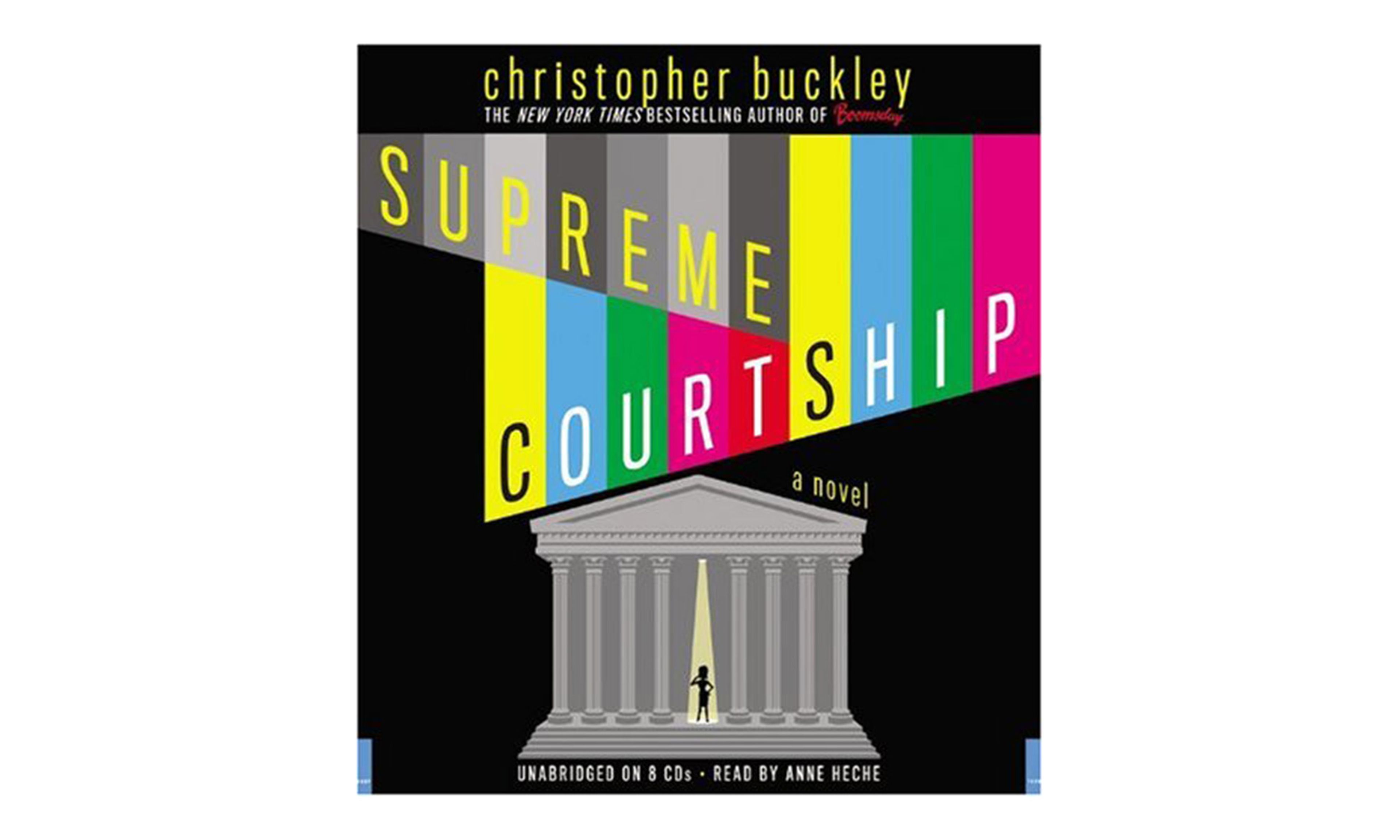
Christopher Buckley doesn’t merely observe the zeitgeist better than anyone else on the planet. He anticipates it — and routinely has a new novel finished at the precise moment when everyone else is about to notice that something is afoot.
Call it premature instinct. Whatever it is, he seems to have intuited that one Sarah Palin — a made-for-TV, gun-totin’, caribou-kickin’ frontier woman — was about to emerge, suddenly and improbably, onto the national political scene. Which is to say, Supreme Courtship’s female protagonist, Perdita “Pepper” Cartwright, is eerily Palinesque, a literary doppelganger so true that you begin to wonder which is the fictional character — Palin or Pepper? Satire doesn’t cut much closer to the bone.
Supreme Courtship focuses primarily on the nation’s judicial rather than executive branch, though the two have been known to commingle during presidential elections. Pepper, a reality-TV judge, is nominated to the U.S. Supreme Court by Pres. Donald P. Vanderdamp as revenge against a Connecticut senator, Dexter Mitchell, who keeps blocking the president’s nominees. In one instance, an exceptionally qualified candidate was rejected for having insufficiently appreciated To Kill a Mockingbird (in high school), which Mitchell construes as proof that the nominee is a racist.
Judge Pepper Cartwright, whom Vanderdamp discovers while channel surfing one night, is a brilliant pick for all the wrong reasons. Sound familiar? She’s a sharp, sassy, salty, sexy, tough-talking, no-nonsense pistol, who knows how to use one and never backs down. She’s also easy on the eyes and otherwise completely unqualified. But never mind. She’s wildly popular among that beleaguered group held alternately in awe and contempt by Beltway insiders — Ordinary Americans.
If you’re not thinking about Sarah Palin within the first 15 pages of this book, you’re not from here.
Christopher Buckley has satirized nearly every facet of Washington life in previous novels that have won him wide recognition as the nation’s premier humorist. But none have provided as rich a vehicle as the Supreme Court for spoofing an array of hypocrisies, foibles, and cultural indelicacies — from abortion and gay marriage to immigration and the intersection of religion and public policy. As a perhaps unintended bonus, we get a glimpse of what may be forthcoming in today’s political swirl.
Other key characters are every bit as colorful as the feisty Supreme Court nominee. Among them are Chief Justice Declan Hardwether, whose wife left him to marry “Doreen” after Hardwether’s tie-breaking vote legalizing gay marriage; Pepper’s soon-to-be-ex-husband/producer, Buddy Bixby, whose other two reality shows feature people who commit suicide by jumping off bridges and people who are grossly obese; Pepper’s father, the Reverend Roscoe, a megachurch televangelist who wears white patent-leather boots with crucifixes. Roscoe became a minister upon the death of his wife (Pepper’s mother), who was struck by lightning while playing golf. On a Sunday. Interpreting his wife’s misfortune as a sign of God’s displeasure, Roscoe rebirthed himself accordingly.
The plot revolves around a presidential election between Vanderdamp, who wants to lose, and his nemesis, Mitchell, who by then has left the U.S. Senate to star in yet another Bixby television production — POTUS. Suffice it to say, the Supremes get involved. Complications include sexual dalliances where you’d least expect them, hastily written e-mails accidentally sent, incriminating leaks to the press, and a sudden, untimely death. All part of a routine day in the nation’s capital.
It is easy — and in my case customary — to read a Christopher Buckley book in one sitting, but I stretched this one out for sheer pleasure. His gimlet eye and swashbuckling style are so much fun, you want to read aloud on street corners. He is at his comic best when justices and lawyers spar in court, lobbing Latinisms and legal arcana like drunken Mensa conventioneers. Or, perhaps, like Buckleys at a family reunion? My only quasi-quibble is that Buckley seems to suffer an affliction common to other members of his family. Call it “Parenthetical Tourette’s” — a tendency to litter prose with footnotes, asterisks, and (parentheticals). When one is very, very clever, it must be very, very difficult to deny even ancillary thoughts a place on the printed page.
I confess to mixed feelings about this Buckley tic. I am annoyed by interruptions that force my eye to the bottom of the page, but ultimately, I land where Buckley did in his foreword to his uncle Reid Buckley’s delightful family biography, An American Family: The Buckleys. He wrote that though he initially found his uncle’s footnoted digressions and clarifications “deflating,” he soon began to look forward to them. After all, he noted, “it was said of Edward Gibbon that he lived out his sex life in his footnotes. Mutatis mutandis — as William F. Buckley Jr. might put it — there is something of that in Reid’s luxuriant footnotes.”
Ahem, yes, well, ditto, ergo, and et cetera. That goes for here, too.
*Footnote: In today’s world — where truth is, indeed, stranger than fiction — it is difficult to know where satire begins and reality ends. That is, of course, Buckley’s point. Art no longer imitates nature, but rather creates it. The TV judge becomes the Supreme; the presidential candidate first has to play one on TV. It is reasonable, therefore, to ask: How does one satirize satire?
The answer is: Like this.





Comments