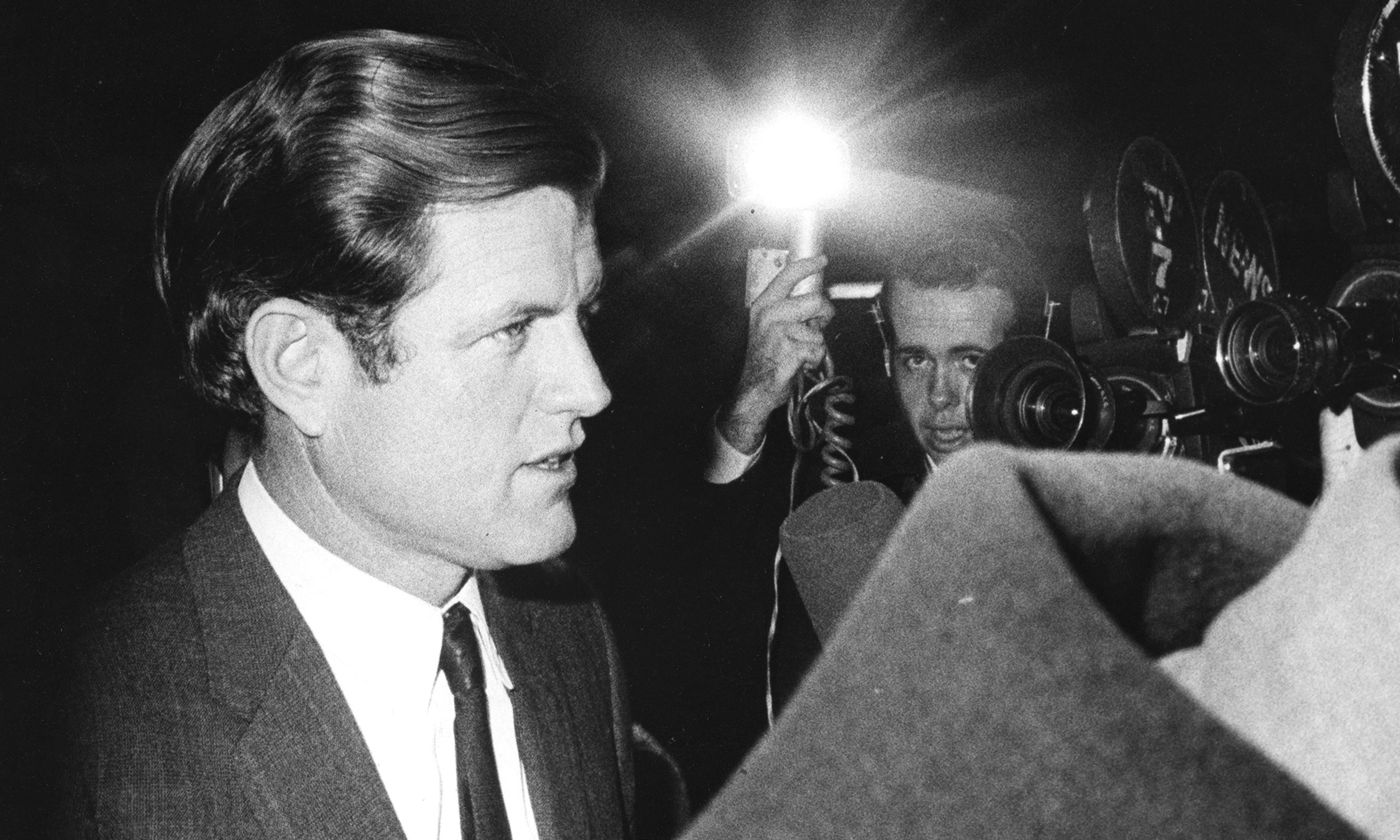
Editor’s Note: The following originally appeared in the August 5, 1969 issue of National Review, as a dispatch from “Winston,” an anonymous Washington correspondent.
They don’t want to say so publicly, but most politicians here believe that Teddy Kennedy’s political career is at the bottom of that pond for good. Their symbiotes, the reporters, are less shy about coming out and saying it: While Teddy and his advisers were huddling in Hyannis Port debating what the hell to do, the papers were full of talk about “political oblivion,” “chaos” in the Democratic party, and possible new standard-bearers like Edmund Muskie (who, after the mishap, said cagily that it would be “premature” to predict his own chances for the nomination in 1972) and even Whobert Humphrey. Perhaps the biggest buzz was caused by Newsweek’s handling of the accident on Chappaquiddick, a surprisingly snide account full of nastily chosen details (the party was held in a “two-bedroom cottage”) that raised every single conceivable unanswered question about the case. Time magazine, though hardly a Kennedy-pusher, trod water and handled the story with white gloves; Newsweek, which has mushed over the Kennedys and all their works for years, pulled out all the stops. The consensus is that Newsweek is leaving the ship, fast, because they believe Teddy is through.
[pullquote align=”left”]The circumstances are, face it, definitely on the sordid side — and all those questions remained too long unanswered. Americans do not like their princes to be party boys, and we are by nature a suspicious people always ready to imagine hanky-panky and low living among the high and mighty.[/pullquote]
Is he? Almost certainly, even though he may get formally off with a suspended sentence on the minor charge of leaving the scene of an accident. True, the wire services’ first sidebar on the story was the routine listing of all the tragedies that have befallen all the Kennedys in the past 30 years. This new story is handled as just another Kennedy tragedy, despite the fact that it was Mary Jo who died and even in the very kindest interpretation Teddy hardly emerges as a fallen hero like his three brothers. The circumstances are, face it, definitely on the sordid side — and all those questions remained too long unanswered. Americans do not like their princes to be party boys, and we are by nature a suspicious people always ready to imagine hanky-panky and low living among the high and mighty.
• So count him out in 1972. But then on most accounts he had already counted himself out of that race. 1976 was to be his year. That means he has only to win reelection to the Senate in 1970, in which effort — if he is saddled with nothing heavier than a minor misdemeanor — he may have a handicap only slightly greater than Connecticut’s Thomas Dodd has in his 1970 reelection bid. Some think that by 1976, the tragedy on Chappaquiddick will have political consequences no greater than Warren Harding’s negro ancestry or Grover Cleveland’s bastard. Just now, the shock hasn’t worn off, rumors are rife, and everyone is in a stew. It is certain, anyway, that the image-makers won’t be able to pass this one off as a PT-109.
• It is also certain what effect the mishap will have on the causes that Teddy has (rather erratically) championed. Of course nobody will vote for ABM just because one of its leading opponents was involved in on automobile accident under peculiar circumstances — but still, Teddy lent the luster of his name to the anti-ABM crusade. Now that name is suddenly short of luster, and thus the whole crusade is a bit tarnished too. Looking to the future, the parallel with Senator Dodd is again instructive. For a while we will not expect to see the Kennedy name attached to any epoch-making legislative proposals, or to find Kennedy in the forefront of any great campaigns In the Senate: He is headed for a period of eclipse (of uncertain duration). That means the opposition to President Nixon has lost one of its biggest guns.
It’s easy to forget that like any freshman senator, Teddy had relatively tittle power among his colleagues. Even as a majority whip, he had few horses to trade. What he lacked in power, however, he more than made up for in prestige; thus the liberal opposition to Nixon relied heavily on him to make the speeches while others did the political grub-work in the cloakrooms. Liberals are seldom happy in cloakrooms; without Teddy’s prestige, they’ll have to work even harder out there.
• The ABM is a case in point. Early on in the Senate debates, the anti-ABMers seemed to be winning the day with their charts, graphs, and parades of scientists. Then there came a subtle change (some date it from Winston Prouty’s speech) and before the antis could say “Jerome Wiesner” the power boys were at work. Senator This was invited to the White House for lunch; Senator That got a phone call from some heavy constituents; right now it looks like ABM will make it. The antis are already whining about arm-twisting and log-rolling; the fact is that on this issue as on others, they showed more skill at argument-marshaling, ad-signing, and earnest oratory than at the grimy old game of political, line-up-the-votes politics. The man in the White House is a past master at that, and so are his friends on the Hill. A few stubbornly believe the eclipse period will give Teddy Kennedy a chance to polish his political (as distinct from oratorical) skills for an eventual contest with Nixon. If that happens, look for the greatest game since the kid from nowhere took on Minnesota Fats.




Comments