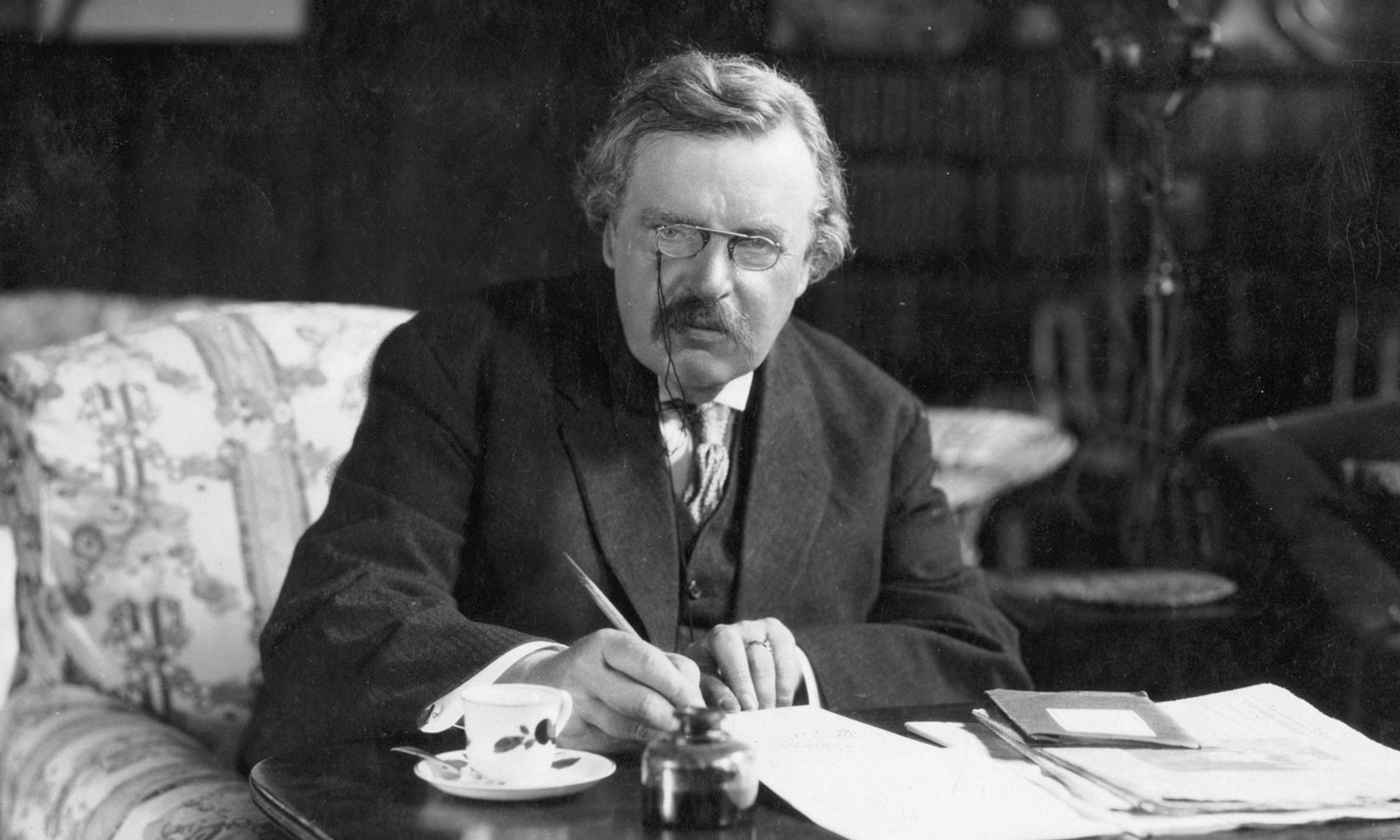
It is just a hundred years ago that one of the noblest and wittiest thinkers ever to write in our language, G. K. Chesterton, burst upon the scene with two masterworks. He is impossible to categorize in our specialized subject-area pigeonholes: He wrote vast amounts across a wide horizon, and must ultimately be categorized simply as a writer. In 1908 Chesterton published, among other things, two of the great works of modern literature, his novel The Man Who Was Thursday and his apologetic credo Orthodoxy. His essays and incidental journalism were also represented in a collection that same year, titled All Things Considered. Those who were already familiar with Chesterton knew him through his regular columns in the London Daily News and The Illustrated London News; in 1909 Mohandas Gandhi read one of his Illustrated London News columns, was deeply affected by it, translated it into Gujarati, and wrote a book based on it, Hind Swaraj, that gave a decisive shape to subsequent Indian national self-determination.
But although Chesterton had already made a literary mark before 1908 — in his journalism, a novel, stories, apologetics, and now-classic studies of Robert Browning and Charles Dickens (“the most en-lightening portrait of Dickens that I have ever read,” wrote V. S. Pritchett) — 1908 was his annus mirabilis. The wise and witty Orthodoxy proved to be not only a classic nonsectarian defense of the Christian religion, and a forerunner to his admirer C. S. Lewis’s Mere Christianity, but also a work for which large philosophical and scientific claims have subsequently been made by highly informed writers, including the physicist-philosopher Stanley L. Jaki and Martin Gardner — a longtime contributor to Scientific American and himself one of America’s “great intellects,” according to Douglas Hofstadter — who reprinted a large selection of Orthodoxy in his Great Essays in Science in 1957 and has since then been one of Chesterton’s chief proponents.
Martin Gardner went on to publish an Annotated Man Who Was Thursday, but this should not be allowed to give the impression that this novel is long, dense, involuted, and in need of a commentary. On the contrary, it is brief, fast-paced, and exuberant. Kingsley Amis called it “the most thrilling book that I have ever read,” and went on to say that he found it “as stunning on a fiftieth reading as on a first.” Anthony Burgess claimed that Chesterton was among the very few 20th-century writers who were able “to teach and please at the same time,” the traditional vocation of the greatest of writers.
The Man Who Was Thursday might at first be mistaken for a jeu d’esprit, a light-hearted lark; and much of its charm does reside in its velocity and cleverness and fantasy. Yet its deeper aims concern the epistemological, ethical, and religious skepticism that issued from the writings of Darwin and Nietzsche and that are with us still in deepened and even more toxic forms, forms that in fact dominate the academy and commercial entertainment culture today. The book takes the form of a fantasy, in the words of the subtitle “a nightmare”; its nightmare looks prescient but mild in comparison with the events of European and world history since 1908. Its assumption is that the Christian, democratic, liberal, and revolutionary hopes of the 1776–1871 period, which overlapped but intermittently battled and battered each other nearly to death, were all idealistic and in some degree noble, but were succeeded by Social Darwinist, Nietzschean, “progressive,” statist, and relativist ideas that were lethal, in the short and long run, to human flourishing and even to human sanity.
Chesterton was a “liberal” in the sense of believing in human liberty in a moral cosmos — as opposed to the context of a subhuman, chaotic, or deterministic interplay of “chance and necessity.” The novel turns on what he called elsewhere “the pivot of the human will,” the desire of each of us to live a purposeful, and morally and intellectually consistent, life. He wrote of his brother, Cecil, a courageous journalist who volunteered for and died in World War I, that “he kept his word” amidst a “diseased and faithless herd” — a comment on the dominant politicians, journalists, intellectuals, and magnates of the age, not the men with whom Cecil died in the ditches of northern France. (The latter men kept their word.)
Chesterton’s admiration of figures such as Jefferson, Cobbett, Dickens, Browning, and Stevenson (a writer who believed in “the ultimate decency of things”) was to be augmented by an increasingly profound understanding and appreciation of St. Thomas Aquinas and St. Francis of Assisi. He wrote books on most of these figures that have elicited the highest praise from specialists on their lives and works; the great French Thomist philosopher Etienne Gilson, for example, characterized Chesterton’s book on St. Thomas as the greatest book ever written on him. William F. Buckley Jr. drew much of his own inspiration and thinking from Chesterton’s conservative democratic populism, trusting, as Chesterton would have, more in the democratic decision-making capacities of the first 2,000 names in the Boston telephone directory than in the common sense of the Harvard faculty. (Chesterton’s mordant critique of the socially elitist, snobbish Oxford of his day: Apparently “the luckiest boys should have the jolliest time.”)
The Man Who Was Thursday turns on the desire of the decent human person to respect himself or herself, “to keep his word,” to be loyal to the true and the good beyond the self that every decent person within historical time inherits from a humanized past if he is blessed enough to be born into it and shaped by it. (The theme recurs in his later novels, including 1914’s The Flying Inn: “For she felt God’s wind from nowhere which is called the Will; and is man’s only excuse upon this earth.”) The novel’s profound insight and wide-ranging scope have not served Chesterton well on academic reading lists, but they show him to be a great wisdom writer, a metaphysical jester with serious intent.
Chesterton and T. S. Eliot were contemporaries in London for the last two decades of Chesterton’s life. They represented not only different generations but different sensibilities, as well as substantially different aesthetic and political orientations, and Eliot’s early comments on the older man were very dismissive. But when Chesterton died, Eliot wrote an obituary in The Tablet that deserves to be quoted at some length. “Even if Chesterton’s social and economic ideas appear to be totally without effect,” Eliot wrote, “even if they should be demonstrated to be wrong — which would perhaps only mean that men have not the good will to carry them out — they were the ideas for his time that were fundamentally Christian and Catholic.” Eliot went on to make a personal and sociological point that might also be made about the late William F. Buckley Jr.: “He did more, I think, than any man of his time — and was able to do more than anyone else, because of his peculiar background, development, and abilities as a public performer — to maintain the existence of the important minority in the modern world.”
But Eliot went farther than this. In his own journal, The Criterion, he praised Chesterton’s extraordinary independence and nobility as what the Bible and Matthew Arnold called a “saving remnant” of civilization: “What matters here is his lonely moral battle against his age, his courage, and his bold combination of genuine conservatism, genuine liberalism, and genuine radicalism.” It was a lonely battle beautifully described and dramatized in that great 1908 novel, The Man Who Was Thursday.
Editor’s note: This article originally appeared in the July 14, 2008, issue of National Review magazine.





Comments