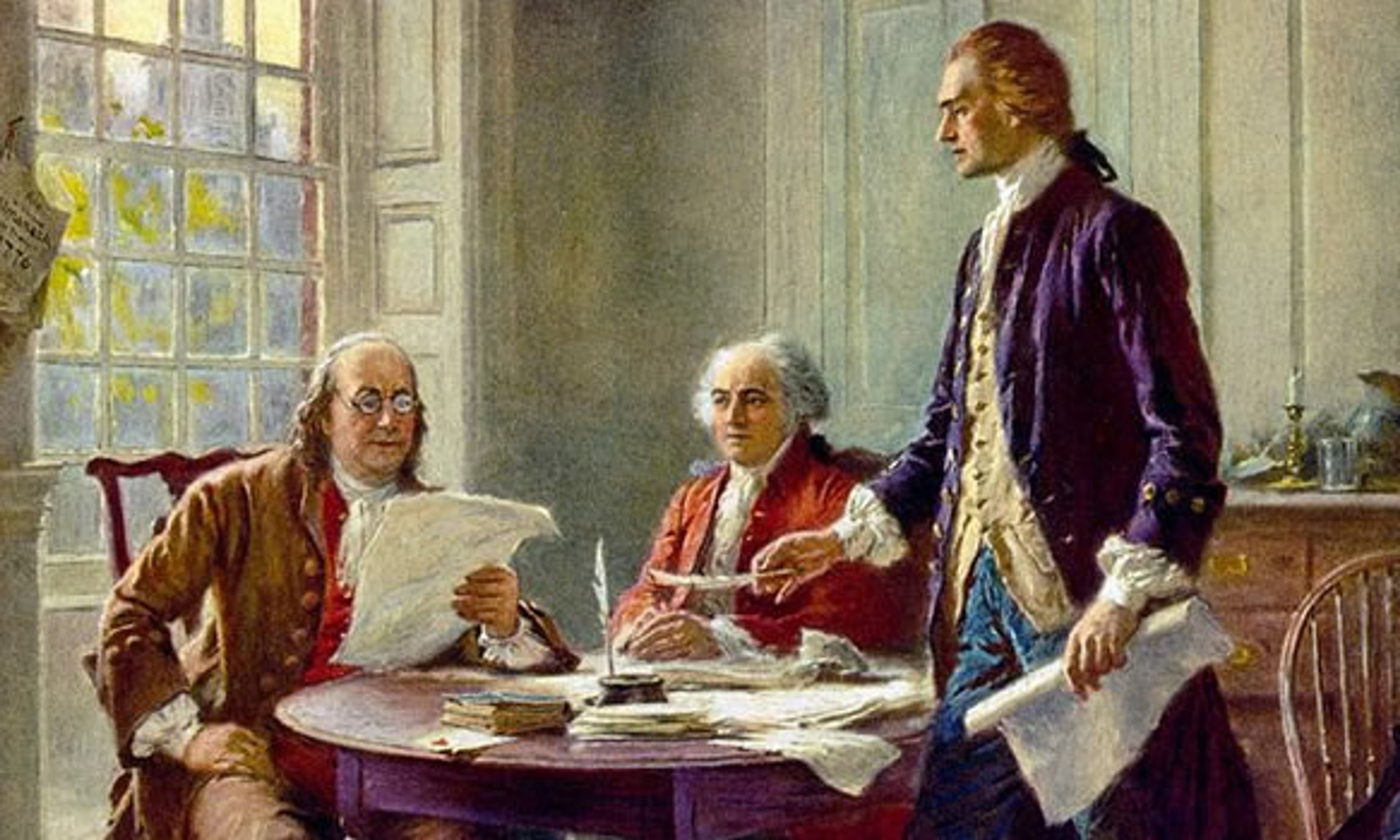
The central question in the history of the English-speaking peoples has been where power is to lie. Is it to be invested in the people and exercised through a parliament, or is it to be enjoyed by kings and emperors? On July 4, we celebrate the efforts of men who steadfastly plumped for the former path.
The “long train of abuses and usurpations” that the Declaration of Independence served to enumerate relate to more than merely the balance of power: among other things, the discontents of the 13 colonies objected loudly to the violation of individual rights to which British subjects had become happily accustomed, and they were greatly vexed by the unwillingness of administrators in England to arrive at political outcomes with which they were willing to comply. Nevertheless, the document’s hottest fire is directed without apology at the monarchy, which was perceived to be undermining the sacred autonomy that its signatories considered their birthright. Diverse as they were, the colonial “Systems of Government” that Thomas Jefferson regretted were being “altered” by British intrusion were steeped in that country’s parliamentary tradition, many territories having used the opportunity afforded to them by London’s long period of “wise and salutary neglect” to institute a form of self-government that, for its day, was extraordinarily advanced. As we have learned from antiquity, men will fight more fiercely for the preservation of what they have known than they will for the acquisition of something new. The British in America were apparently willing to tolerate a good deal of arrogation. Their assemblies, however, were off-limits.
The Crown was a favorite target of the colonies’ dismayed. In their estimations, the most egregious of the “repeated injuries and usurpations” had been driven by “the present King of Great Britain,” who had contrived to refuse his assent to the popular will, to impose taxation without the permission of the local “Representative Houses,” and to seek either to rule alone by decree or to permit the British legislature to override the wishes of those for whom their policy was intended. Each one of the first six “Facts” that Jefferson’s sharp pen “submitted to a candid world” related not to the undermining of individual rights but to the usurpation of parliaments, a message that the instrument hammers home another half-dozen times. Its primary theme is abundantly clear: “Legislative powers,” it contends, are “incapable of Annihilation,” “Representation” being “a right . . . formidable to tyrants only.” King George III, it charges, had tried every trick in the book to avoid accountability: dissolving representative bodies when they posed a threat to his rule; calling “together legislative bodies at places unusual, uncomfortable, and distant”; and refusing to acquiesce to “Laws for the accommodation of large districts of people, unless those people would relinquish the right of Representation in the Legislature.” For the high crime of “suspending our own Legislatures, and declaring themselves invested with power to legislate for us in all cases whatsoever,” the Declaration concludes, the doyens of the British state had forced their American subjects to “dissolve the political bands which have connected them.”
It is fashionable today to view the Revolution as one might a traditional war between foreign powers, but, in truth, the break of 1776 was the latest in a series of fallings out between brothers — a civil war fought by men who were separated by an ocean but not by a history. Reading through the extraordinary profusion of pamphlets and gripes that the crisis produced, one cannot help but be impressed by how keenly the revolutionaries hewed to existing principle. Thomas Paine, perhaps the most radical of the agitators, may have believed that he could start the world all over again, but the colonists who marched with him mostly definitely did not. Instead, they sought a restoration of their inheritance, the Constitutional Congress asserting in 1774 that British subjects in America were “entitled to all the rights, liberties, and immunities of free and natural- born subjects, within the realm of England.” In the same year, William Henry Drayton, a lawyer from South Carolina who later served as a delegate to the Congress, fleshed out the claim, establishing in a tract of his own that he and his countrymen were “entitled to the common law of England formed by their common ancestors; and to all and singular the benefits, rights, liberties and claims specified in Magna Charta, in the petition of Rights, in the Bill of Rights, and in the Act of Settlement.” With this popular sentiment, Drayton and his acolytes set themselves up as the Roundheads of the New World, linking spiritual arms with the parliamentarians of the English civil war, with the seditious architects of the Glorious Revolution, and with all who had established colonial outposts in the name of English freedom.
These invocations struck a chord across the Atlantic. Speaking of those “Englishmen in this island” who were not “enemies to their own blood on the American continent,” Edmund Burke conceded that the entreaties to the British tradition were appropriate:
We also reason and feel as you do on the invasion of your charters. Because the charters comprehend the essential forms by which you enjoy your liberties, we regard them as most sacred, and by no means to be taken away or altered without process, without examination, and without hearing, as they have lately been.
Burke stopped short of endorsing radical change. Others, however, were more than happy to do so. Charles James Fox, a playboy parliamentarian who lacked Burke’s respect for that which has “anciently stood” — and who most expressly did concern himself with “metaphysical abstractions” that Burke professed to disdain — made a point of loudly supporting the Americans in public, expressly setting the revolutionaries’ struggle as a moral fight against an all-powerful executive that was analogous to the Glorious Revolution and to the English Civil War. In speech after speech, Fox worried aloud that George III did not only aspire to ignore the representative bodies of the British in America but wished also to rule without parliament as the Stuarts had before him. “I say,” Fox maintained in a famous speech, “that the people of England have a right to control the executive power, by the interference of their representatives in this House of parliament.” So too, the recalcitrant rebels. Much to the chagrin of many of his peers, Fox was such a partisan for the American side that he laughed publicly at the news of British defeats and took to wearing the buff and blue colors of Washington’s army in the House of Commons.
Fear of potentates ran deep within the Anglo-American tradition. When the mutinous Immortal Seven ushered in the Glorious Revolution of 1688, their invitation to William of Orange related that the people were “generally dissatisfied with the present conduct of the government, in relation to their religion, liberties and properties (all which have been greatly invaded).” As Daniel Hannan observes in Inventing Freedom, these three objects were philosophically inextricable. Protestantism, Hannan notes, was seen by the architects of English liberty in “political rather than theological terms, as guarantor of free speech, free conscience, and free parliament”; Catholicism, by contrast, was held to consume those virtues and to lead, inexorably, to monarchy. The fear of “popery” that helped to usher in the Glorious Revolution was certainly more pronounced in England that it was in America. But the concerns that motivated it were not, being instead inseparable from the fundamental political question, which was, “are we to rule ourselves or are we to be ruled by Kings and by Popes?” It stood to reason then that those who had become accustomed to expecting to enjoy a relationship with God that was not refereed by a host of spiritual bureaucrats would be able to more easily imagine governing their own worldly affairs, as it made sense that a culture in which the laity was encouraged to read Scripture for itself would be one in which subjects would more quickly rush to the defense of parliaments against the King. As ever, the instinct was toward the fragmentation of power.
With its attestation that all men are created equal, the Declaration of Independence represented a glorious break with all that had gone before. Thomas Jefferson, in Abraham Lincoln’s sparkling phrase, managed to weather “the concrete pressure of a struggle for national independence by a single people,” and “to introduce into a merely revolutionary document, an abstract truth, applicable to all men and all times,” ensuring thereby that a nation that had started as a series of ad-hoc imperial outputs would forever have about it the quality of the mission. In toto, though, it is a reflective, rather than a subversive document — one that is predicated upon ancient principle and marinated in a wisdom that had taken centuries to accrue. That wisdom is timeless and, if it is observed, timely. Modish figures such as Barack Obama may have snazzy websites, killer Hollywood cachets, and a few million Twitter followers, but they possess human hearts still. By threatening Congress and insinuating that its prerogatives are less important than his agenda, our 44th president is not liberating himself from ancient restraints but playing the villain’s role in a musty power play that has been running for more than a millennium. July 4 is a day for celebrating the words that gave teeth to the Enlightenment. But it is also an opportunity to reaffirm the acumen acquired by the men who came before, and who urged us vigilantly to look around us for stray Cavaliers.
— Charles C. W. Cooke is a staff writer at National Review.





Comments