How exactly did the Left romanticize the Lost Cause Confederacy, and by extension its secession and efforts to preserve slavery?
To use a shopworn phrase, “It’s complicated.”
Good Ol’ Rebels
Well before the end of Jim Crow, post-war leftist Hollywood still largely continued its soft mythologies of the Confederate Lost Cause. Perhaps the cinematic romance arose because of the lucrative fumes of earlier Gone with the Wind fantasies, which themselves might’ve come from an understandable desire to play a part in “binding up the nation’s wounds.”
In George Stevens’s mythic Shane (1953), the tragedy of the post–Civil War heroic gunslinger seems eerily tied to his past as an against-the-odds ex-Reb. In contrast, the movie’s odious villain, Unionist Jack Wilson, is a hired gun and company man (brilliantly portrayed by then newcomer Jack Palance).
Wilson shows off his bought cred by gunning down a naïve southern sodbuster, “Stonewall” Torrey (played by Elisha Cook Jr.), accompanied by slurs about the Confederacy. (“I’m saying that Stonewall Jackson was trash himself. Him and Lee and all the rest of them Rebs. You too.”)
In the movie’s final shootout, replaying the Civil War provides the catalyst for more violence. This time Shane — and the heroic South — wins for good, with a payback Civil War exchange with Wilson:
Shane: I’ve heard about you, Jack Wilson.
Wilson: What have you heard, Shane?
Shane: I’ve heard that you’re a low-down Yankee liar.
Wilson: Prove it.
Wilson is then blown back across the barroom under a hail of bullets. Even out on the Wyoming range, the Hollywood subtext is that sodbuster homesteaders can find a former Confederate loser to protect them, with courage and chivalry, against the northern corporatists trying to steamroll them. The noble savior Shane, we are assumed to believe, had no part in slavery or insurrection but was fighting for his southern soil in service to the Confederacy.
Part of the dark mystery and tragedy of John Ford’s anti-hero Ethan Edwards in The Searchers originates in Edwards’s edgy Lost Cause mettle — and acts of bravery that never seem to result in his own positive outcome. His prior stint with the Confederacy is alluded to not just to remind the audience of his unrepentant side but also to emphasize the origins of Edwards’s formidable skills, doggedness, and principles — especially valuable in times (and only during such times) when frontier law fails and such assets are necessary, even if acquired in nihilist service to the losing side.
John Ford drew on that Confederate romance of noble opponents in several films, from Stagecoach (1939) to The Horse Soldiers (1959). A common theme is audacity fueled by admirable past loyalty to a bad cause, a key ingredient in classic portraits of the tragic hero from Homer to Erwin Rommel.
Hollywood Westerns — often in the 1950s and early 1960s — increasingly saw in the Confederate romance a way of reuniting the country, and they partook of the leftist pushback against a federal establishment. Indeed, it is hard to watch a Western in which a southern officer is portrayed purely negatively. At worst, they are daydreamers plotting to rebuild a western confederacy (Rio Conchos). At best, they play into the stereotypes that the better fighters of the South lost the war only because of overwhelming industrial output and manpower of the North — and thus former Confederates are especially valuable Indian fighters on the frontier, a safe space for them that is the United States but not the North.
The True Grit movies have a larger-than-life Rooster Cogburn character, an anti-hero and former member of the Quantrill Raiders, the pro-Confederate rangers’ gang that included Jesse and Frank James. John Wayne first portrayed Cogburn in 1969, in a finale to his earlier southern roles in John Ford’s cavalry movies.
In 1969’s The Good, The Bad and The Ugly, Clint Eastwood mastered the art of portraying Confederates as noble opponents, especially in a haunting scene of an oppressive Union POW camp overseen by a psychopathic criminal commandant, set to the moving lyrics of Ennio Morricone’s “Story of a Soldier.”
Eastwood later went the full Confederate, in The Outlaw Josey Wales (1976). The former son of the South, Wales becomes a 1970s cowboy version of Dirty Harry, serving as a jack-of-all-trades multiculturalist equalizer — fighting back against vicious northern red-leg marauders and in behalf of abandoned women, the poor, and Native Americans.
The supposedly left-wing 1960s and 1970s, in fact, were the heyday of Confederate Chic. True, there were plenty of In the Heat of the Night portraits of the now-familiar racist white Neanderthals, but with the passage of the Voting Rights Act and the end of Jim Crow segregation, the romance of the Old South reappeared, updated and tweaked for the era of counterculture protest.
The hippie style of long hair, beards and mustaches, resistance to government authority, twangy folk-song strains, and hard-edged metal all fed into the rural, down-home Confederate romance.
The contemporary hippie style of long hair, beards and mustaches, resistance to government authority, twangy folk-song strains, and hard-edged metal all fed into the rural, down-home Confederate romance. Notions of slavery, segregation, and secession mysteriously disappeared. Southern attitude was no longer Bull Connor but airbrushed Sixties-era resistance, at least at the superficial level of pop culture.
In Walter Hill’s post-Vietnam The Long Riders (1980), the murderous Jesse James gang morphs into a sort of mix of Lynyrd Skynyrd with Bonnie and Clyde — noble outlaws fighting the grasping northern banks and the railroad companies’ “Pinkerton Men.” David Carradine and his siblings, playing members of the gang, appear like Woodstock rockers, with exaggerated southern accents, long unkempt hair, hippie buckskin, and a don’t-give-a-damn Bay Area resistance attitude.
When a clueless Unionist musician is caught in a cathouse playing “The Battle Cry of Freedom” (“Rally Round the Flag, boys”), a Younger brother (Randy Quaid) in the gang forces him to substitute “I’m a Good Old Rebel,” sung by no less than California hipster Ry Cooder. The lyrics are unabashedly treasonous:
I hate the Yankee nation
And everything they do.
I hates the Declaration of Independence too.
I hates the glorious Union
’Tis dripping with our blood.
And I hates their striped banner.
I fought it all I could.
The tough verses today might earn a Southern Poverty Law Center–driven boycott of the film’s soundtrack, or a visit from Antifa.
Hipster Confederates
An earlier melodic and hit rendition of Robbie Robertson’s (of The Band) “The Night They Drove Old Dixie Down,” sung by civil-rights activist Joan Baez, helped resurrect and mainstream Baez’s folk career. But Robertson’s song is about the Union’s slashing and burning its way through the sacred ground of the empathetic and slave-owning South — it’s an unapologetic and romantic defense of Confederate rebellion:
Like my father before me, I will work the land
And like my brother above me, who took a Rebel stand.
He was just 18, proud and brave, but a Yankee laid him in his grave.
I swear by the mud below my feet,
You can’t raise a Caine back up when he’s in defeat.
The night they drove old Dixie down, and the bells were ringing
The night they drove old Dixie down, and all the people were singing
They went, “Na, la, na, la, na, na, na, na, na, na, na, na, na, na.”
The unlikely common denominator that brought together left-wing Sixties popular culture with Confederate cool was a mutual hatred of a supposedly big, square, soulless, and powerful Washington, hated for its insolence in Vietnam and for stifling the individual — as if the poor lost South had been once as defenseless as the Vietnamese in the face of such a godless steamroller, or as if the Carradine clan were like the Allman Brothers with six-shooters.
Southern pop-music angst, hard metal, and crossover country and western channeled southern and Confederate themes, supposedly adding authenticity to mostly mainstream northern suburban American pop. Were rockers from the South popular versions of the 1920s and ’30s Southern Agrarians (“I’ll take my stand”) critics?
Few pop icons (but see Neil Young’s “Southern Man”) dared in the 1980s to suggest that southern chic was somehow blind to the racism of the Confederacy rather than just defiant and anti-government. The Allman Brothers, Lynyrd Skynyrd (“Sweet Home Alabama”), the Marshall Tucker Band, Charlie Daniels (“The South’s Gonna Do It”), Confederate Railroad (“Summer in Dixie”), and even REM squared the circle of grafting old-style Confederate attitudes with hip counterculture, even if superficially and often nonsensically.
In other words, Confederate Chic escaped the modern odium that often had been accorded the Lost Cause revisionism sweeping the country from 1890 to 1920, in part fueled by rising nativism and renewed commitment to Jim Crow.
A southern accent brought a little gravitas to the hippie’s marijuana-laced nasal drawl.
Instead, Southern rurality, agrarianism, traditionalism, independence, autonomy, anti-federal-government animus, and poverty all conveniently resonated with the alternative cultures that reappeared in the 1960s and that remain with us to this day. Apparently, a southern accent brought a little gravitas to the hippie’s marijuana-laced nasal drawl, the same way that the working white man’s “take this job and shove it” was an earthier version of People’s Park resistance.
Folksy Racists
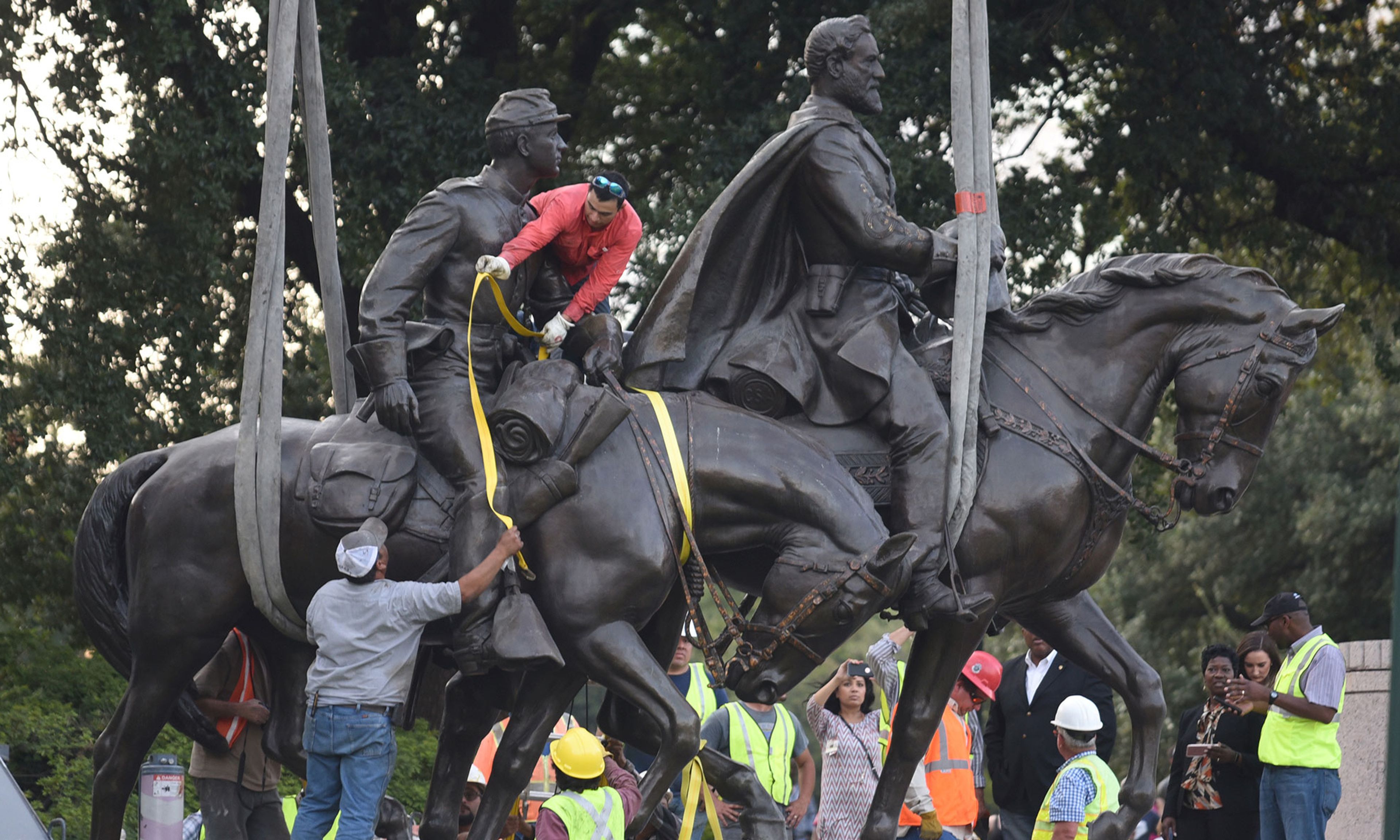
But in 2017, there still remains a disconnect: If stone-dead Confederate generals are now fair game for nocturnal sledgehammers, sandblasters, and cranes 150 years after the end of the Civil War, why haven’t the thought police, on campus and off, Trotskyized Civil War chic, erasing its counterculture symbols?
Is Ry Cooder’s music apolitical the same way that a dead Robert E. Lee is just a stone? Or does his romantic rendition of Confederate-cause music (even within the fictional framework of cinema) condemn him — for the same reason that it is now a sin even to allow a bronze simulacrum of Lee to keep growing verdigris?
Can Shane and Ethan Edwards remain our heroes? How did the Carradines and the Keaches (who played Jesse and Frank James) survive in Hollywood after turning former Confederates into modern resisters of the Deep State?
The answer is a familiar with the Left: The sin is not the crime of romanticizing the Confederacy or turning a blind eye to slavery and secession per se. Instead what matters more is the ideology of the sinner who commits the thought crime. And how much will it cost the thought police to virtue-signal a remedy?
Folksy Confederates still have their charms for the Left. All was forgiven Senator Robert Byrd, a former Klansman. He transmogrified from a racist reprobate who uttered the N-word on national television into a down-home violinist and liberal icon. A smiling and avuncular Senator Sam Ervin, of Watergate fame, who quoted the Constitution with a syrupy drawl, helped bring down Nixon; that heroic service evidently washed away his earlier segregationist sin of helping to write the Southern Manifesto.
Progressives always have had a soft spot for drawling (former) racists whose charms in their twilight years were at last put to noble use to advance liberal causes — as if the powers of progressivism alone can use the kick-ass means of the Old Confederacy for exalted ends.
Dixie Down or Up?
How strange in 2017 that establishment universities, and city councils and mayors, are found guilty of racism for allowing century-old icons of Southern Lost Cause pride to stand. They seek atonement by offering politically correct pieties, while they order their work crews out to the parks at midnight.
Shouldn’t civil-rights activist Joan Baez be condemned retroactively for the thought crimes evident in ‘The Night They Drove Old Dixie Down’?
But in such a Jacobin climate, shouldn’t civil-rights activist Joan Baez, for example, be condemned retroactively for her thought crimes?
She jump-started a second career in 1971 with her rendition of “The Night They Drove Old Dixie Down.” Her likely motivation for redoing the tune, aside from natural career concerns, was that it’s a powerful lyric piece and a magnanimous expression of empathy for the South’s post-war poverty and humiliation. But for anyone else, romancing slavery and racism would still be a felony in the eyes of the Orwellian thought police.
Instead Baez’s perennial exemption is simply because she is, after all, Joan Baez.
Apparently, it would be a lot creepier (and more work) to ban “The Night They Drove Old Dixie Down” from the airwaves and downloads than to put on a black mask and chip off Stonewall’s nose, winning applause from CNN and MSNBC.
For progressives, there are two Confederacies: the benign, hip mythology that channels counterculture defiance and that has been conveniently cleansed of slavery and secession, and the pernicious sort that imputes racism to its supposedly white-trash adherents.
In other words, all Confederate romantics are bad, but some are not so bad after all.
READ MORE:
How to Understand the Confederacy





Comments