My five-year-old daughter sits at a desk, leaning on her elbow. She is asked which digraph appears in the word “lunch.” She thinks for a second, half-raises her hand, and when called on she responds “C-H.” The teacher asks, “Can you unmute?” The faintest flash of embarrassment crosses my daughter’s face. She reaches for my laptop, clicks on the microphone icon. “C-H,” she says again, winning approval and getting back her sense of confidence.
In the corner of the room, I’m eating lunch. I’m there ready to solve any WiFi problem, or to type in a password to reconnect my daughter to her kindergarten class, which is conducted on precisely the same software I used earlier for National Review Online’s morning conference call. The whole spectacle makes me proud of her — she seems surprisingly mature handling her own conference call — but sad. The charisma of her kindergarten teacher is almost fatally diminished by this medium. And everyone seems to know this isn’t “the real thing.”
That was the scene a few minutes ago. Now I’m trying to finish this piece of writing before my two sons (ages three-and-a-half and one-and-a-half-ish) wake up from their naps. I probably won’t finish it until the middle of the night, long after they’ve gone to bed.
Just a few weeks ago my wife and I used to have a full-time babysitter coming to the house. We used to have the support of a functioning public-school district and a pre-school. We used to be able to call on more than half a dozen in-laws in the area. For a little relief from each other we could call on any number of friends locally or from our church. Now we are juggling two full-time jobs and three full-time little kids, and the help comes from Jeff Bezos, CEO of Amazon, and our local grocers.
But at least we have the kids and they are young, and we can convince ourselves that quarantine time is quality time. And at least the trials of New York’s “pause” make some sense to us. There are over a hundred cases of COVID-19 in our small town, and over 2 percent of this county’s population are confirmed infected. Someone on our street’s Facebook group is mourning the COVID death of her best friend. The hospital around the corner from us has set up a tent outside for triage.
The measures of lockdown make sense too. Closing schools was obvious. My three-year-old can’t govern his hands and hygiene like an experienced Japanese business traveler. He and his sister brought home every cough, sniffle, and stomach bug from September through January, infecting everyone in the house. It was just earlier this year, Super Bowl weekend, that one bug passed through all five of us, hitting the last three at various points during the big game.
But it has costs. The institutions that were part of my children’s lives — their pre-school and school — are now trying to survive virtually. There were days when merely handling the amount of email from the schools felt like a part-time job on top of the part-time job of sudden-onset homeschooling. Were we going through these exertions for our children’s education, or to make teachers and schools feel less useless?
For other parents it is much worse. These days, early-intervention development “therapy” is a hot commodity for young boys and girls, with parents trying to gain spots with time-limited occupational and speech therapists. In lockdown, one can’t simply transfer the ball-pits and swings used in occupational therapy to a FaceTime call.
My wife and I create ad hoc schedules: snatching 90 minutes to work here or there while the other watches the kids, conducts class, puts them down for a nap, or makes lunch. Weekends are spent trying to catch up on chores and cleanup.
American government seems to have grasped that there is a dilemma. Part of the CARES Act relief package is dedicated to preserving child-care facilities through the shutdown and providing some relief for families. If you’ve been employed for at least 30 days and belong to a firm of fewer than 500 but more than 50 employees, there may be an additional ten weeks of paid family leave available, at two-thirds of employees’ regular rate of pay, “where an employee is unable to work due to a bona fide need for leave to care for a child whose school or child care provider is closed or unavailable.”
Although, given how quickly all this was implemented, my guess is that contacting Human Resources to inquire about the availability of that relief is a hazard. They don’t have guidance, likely don’t have systems in place to implement it, probably think you should be grateful to be working from home anyway, and will likely treat you as a potential lawsuit risk just for asking. So I don’t think we will ask or advise anyone else to do so.
Do the kids know what is happening? They accept it rather easily. Too easily. There is no protest in our house to reopen the economy. My daughter understands that she can’t have a sleepover with friends “until the virus goes away.” She is starting to video-conference with friends. But mostly the children want to play with their toys, watch cartoons, and work us over for their favorite snack foods.
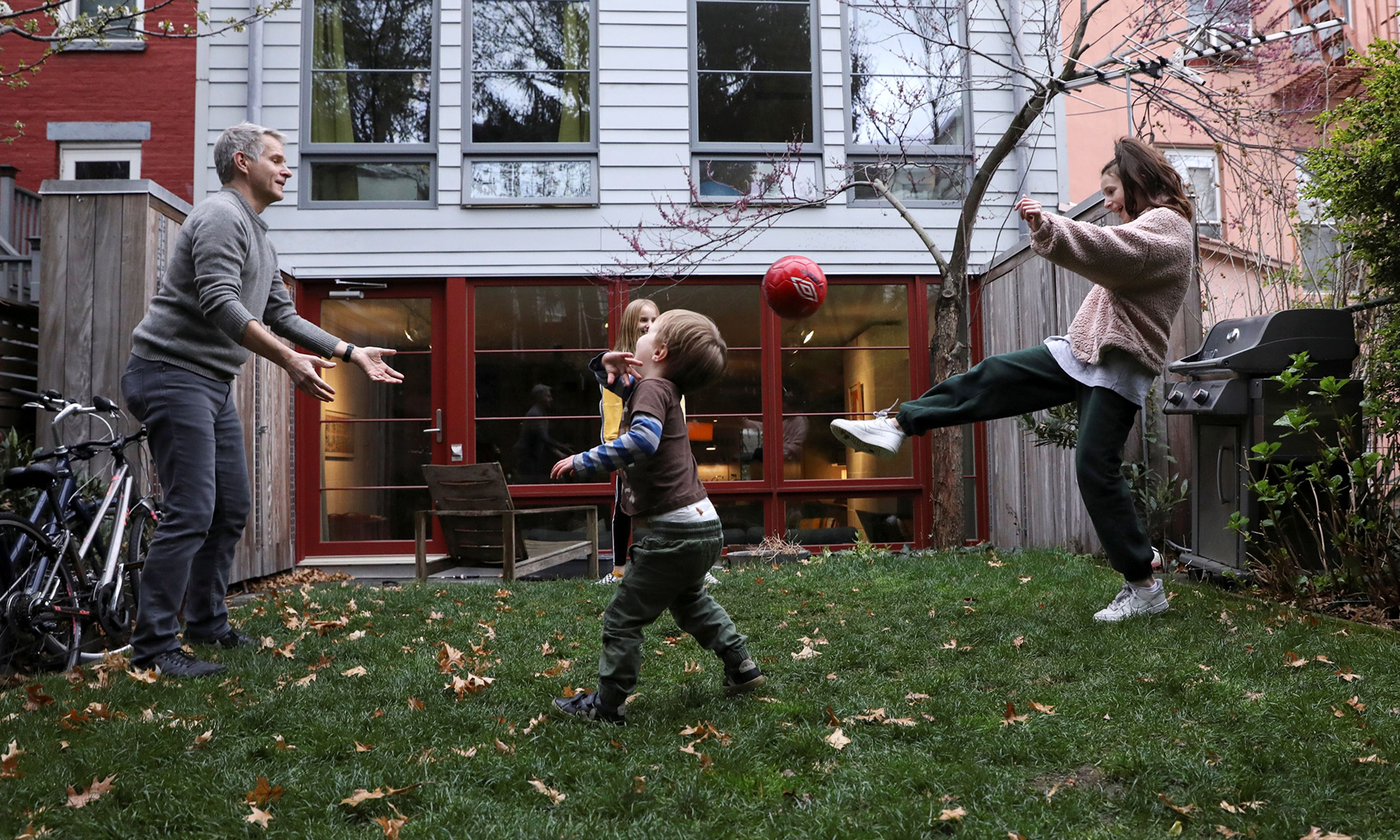
And they keep us from brooding too long on the horrid health and economic news. Our friends who don’t have kids have fewer distractions from the news of death stalking nursing homes. Some are wrecks from it all, thinking they are watching their country fall apart. We, as parents, may not get regular sleep. But our kids get to watch us soldier through difficulty. And we get to watch them grow up. My youngest is climbing up onto the kitchen table now, giggling and throwing anything we’ve left on it overboard. We’ll probably get around to vacuuming tomorrow. In the meantime, spring is peeking through, and the two older ones are busy naming the bugs, the fox, and the woodpecker that can be seen through our windows.






Comments