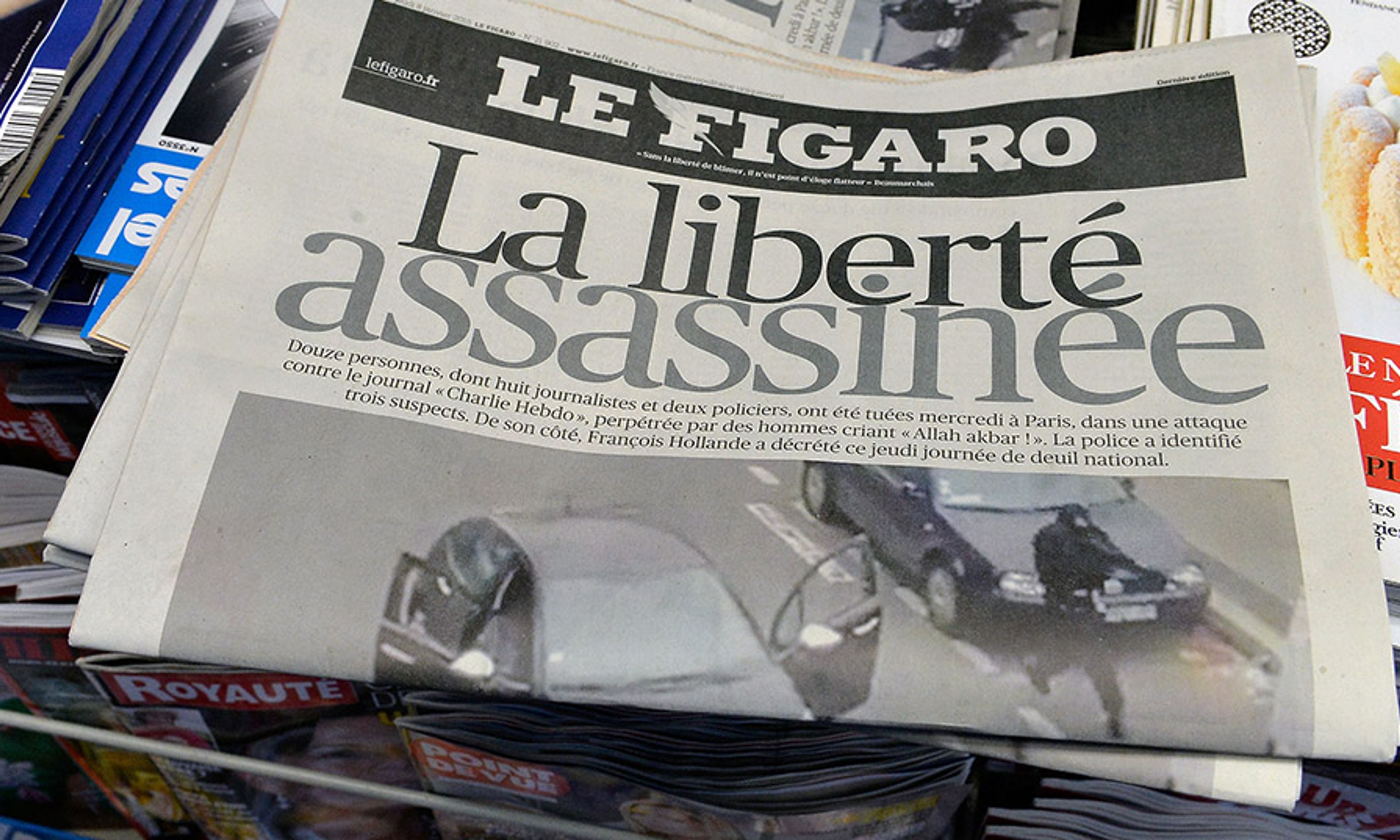
The message of the Paris terrorists couldn’t have been clearer. They didn’t target the instruments of state power, the military or the police. They didn’t target the representatives of the state, its elected officials. They targeted cartoonists.
They targeted, in other words, some of the most physically harmless people on Earth. Cartoonists don’t carry guns for a living, or command armies. They are formally powerless. They are people whose influence is entirely dependent on free expression.
That’s why the attack on Charlie Hebdo was not just an attack on an institution but on a value. The terrorists wanted to bring a taste of Mosul to the 11th arrondissement of Paris, and they succeeded in ghoulish fashion. Their goal was to undercut free speech itself, and thus the power of people who operate in the realm of images, words and ideas.
In the fight over free expression, the editors and cartoonists of Charlie Hebdo occupied the most forward and exposed position. They lit a flare over their own parapet every night and said to the enemy that you may bring your worst, but you can’t make us afraid.
That their craft required such bravery in perhaps the most cosmopolitan city in the world is a testament to the embattled state of free speech in the West.
The sad fact is that physical intimidation works. Some press outlets pixilated or cropped out the covers of Charlie Hebdo in their coverage of the Paris attacks, as if they were the works of obscenity that the attackers consider them.
One line of argument is, in effect, that Charlie Hebdo had it coming. A writer for the Financial Times scored the publication in the wake of the attacks for lacking “common sense.” Back in 2012, then-White House spokesman Jay Carney questioned the magazine’s “judgment” for publishing cartoons mocking Mohammed, and rued its “potential to be inflammatory.”
But we don’t usually look to satirical magazines for “judgment.” Besides, no one ever has to question anyone’s death-defying lack of “common sense” for mocking Christians.
After the Benghazi attack in 2012, which the administration pretended was the result of an anti-Islam YouTube video, President Barack Obama said, “We reject all efforts to denigrate the religious beliefs of others.”
Since when? Thomas Paine, a quasi-Founding Father, excoriated Christianity. Thomas Jefferson chopped up the Bible to leave in what he considered only the properly enlightened parts. It is true that the U.S. government doesn’t denigrate religions. But it is constitutionally obligated to protect the freedom of those who do.
The president said at the United Nations after Benghazi that “the future must not belong to those who slander the prophet of Islam.” He did not add that the future must have a place for those who slander Islam.
It is that aspect of the future that the Islamists hope to snuff out. There has been a calculated and growing threat to free speech in the West emanating from the Muslim world since the Ayatollah Khomeini’s fatwa against Salman Rushdie.
This offensive has long relied on violence, as well as a noxious campaign of international diplomacy, to export the Muslim world’s anti-blasphemy laws to the West. The diplomatic campaign has met with partial success in Europe, where “hate speech” can be prosecuted, and the Obama administration has had a shamefully accommodating attitude to it.
Now, it should be met with the official contempt that it deserves. And, domestically, we should foster a robust culture of free speech that forswears the insidious logic of “your right to free speech ends where my right not to be offended begins.”
We all love the cliché that the pen is mightier than the sword. But it hasn’t been true through most of human history and isn’t true in many places — especially in the Muslim world — even today. The pen is an instrument that needs constant protection and the enlivening spirit of satirists of all sorts.
The cartoonists of Charlie Hebdo understood that. Does the West?
— Rich Lowry is the editor of National Review. He can be reached via e-mail:[email protected]. © 2015 King Features Syndicate






Comments