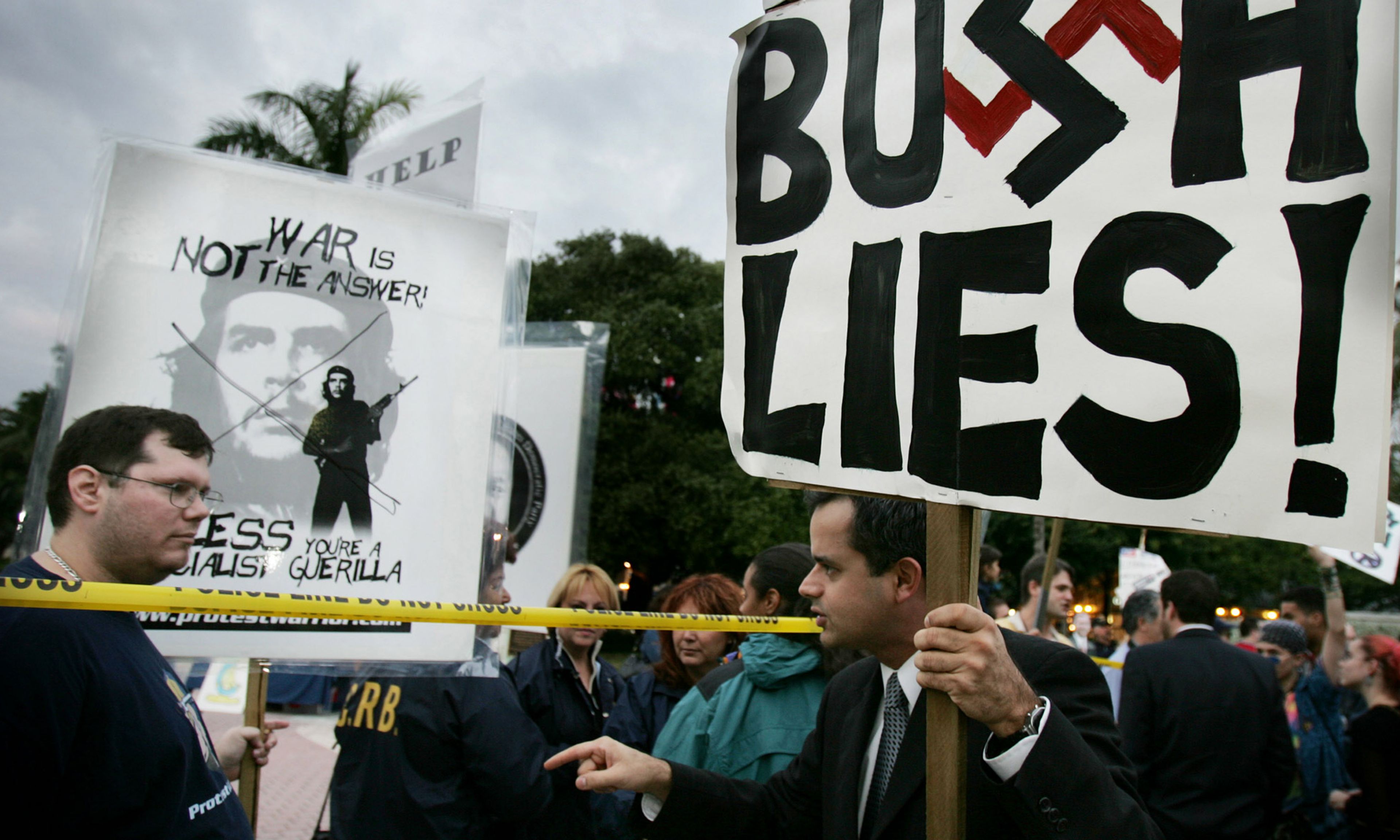
If there’s one thing everyone knows, it’s this: America’s alliances are in tatters and the American image abroad is terrible. George W. Bush has eschewed diplomacy and sacrificed the good name of the United States. Our alliances, our image, and our name need to be “restored.”
When President-elect Obama chose Hillary Clinton as secretary of state, she vowed to “reach out to the world again.” Obama spoke of his “commitment to renew American diplomacy and restore our alliances.” Bill Clinton chimed in that his wife was “the right person for the job of helping to restore America’s image abroad.” And Democrats aren’t the only ones who talk this way. Some Republicans are in on this act too (e.g., John McCain, late of the presidential campaign).
So, everyone “knows” that our alliances are tattered, etc. But is it true? When people talk to you about these suffering alliances, you might ask them to go country by country. That could embarrass them. And in a recent meeting with National Review writers in the Oval Office, President Bush said, “All I ask is that people analyze our alliances around the world” before they come to any conclusions. In that spirit, shall we have a quick tour d’horizon?
Let’s start with Western Europe, the region that so many Americans think of when they think of “the world.” Those relations wax and wane, as all international relations do, but American alliances with Western European governments are in good shape. Anyone doubting this can ask such people as Brown, Sarkozy, Merkel, and Berlusconi. And that is not to forget the Dutch, the Danes, and others who are often forgotten about. One should not forget the Eastern Europeans, either.
There is one European government with which American relations are now difficult: that of Spain. That’s because Prime Minister Zapatero is determined to be a thorn in the American side (unlike his predecessor, Aznar). One might wish the Obama administration luck with him.
Inconveniently for Bush-bashers, the American image in Africa is quite good. This is in part because of Bush’s programs on AIDS and malaria — and because of his attention to the continent generally. But the idea of Bush as a popular leader among black peoples is just too much for many folks to swallow.
Relations between India and the U.S. are at an all-time high. And Bush himself makes the point that this has occurred while the U.S. has “kept influence” in Pakistan. Moving east, he says that it’s hard for any president to say that he and America have good relations with Japan, South Korea, and China at the same time — but he can say that. Others point out that our relations with Japan have been complicated by our relative softness on North Korea. But Bush’s critics, most of them, do not fault him for softness on North Korea, or any other country.
There are Chinese democracy activists who are disappointed in Bush for not doing more to prod China. Some of them even talk of “betrayal” — a betrayal of such promises as those made in the second inaugural address. Why did Bush go to the Beijing Olympics without the release of even one political prisoner? But, again, the average Bush critic does not condemn him for being too accommodating.
Relations with Latin American countries are good — and the U.S. enjoys especially warm relations with Mexico, Colombia, and Brazil. In our Oval Office visit, Bush recounted how he, a Texas conservative, found common ground with Lula da Silva, a Brazilian socialist. (They are both democrats, for one thing.) And will relations with Colombia get even better under Obama, given his opposition to a free-trade agreement with that country? How will his protectionist leanings affect our alliances in general?
There are Latin American countries with which relations are strained — notably Venezuela (Chávez), Bolivia (Morales), and Nicaragua (Ortega). But that has to do with the anti-democratic personalities involved. There is the Castros’ Cuba too — against which Bush has done relatively little, save award a political prisoner (Oscar Biscet) the Presidential Medal of Freedom (in absentia). Can you fault him for belligerence toward the Cuban regime?
The Middle East has consumed the lion’s share of Bush’s time. And he contends that he has achieved something difficult there: promoting a two-state solution, where Israelis and Palestinians are concerned, while at the same time “vowing to defend Israel and keeping strong relations with Saudi Arabia and Jordan and Egypt and the U.A.E.” The U.S. now has an ally in Iraq (ahem). And Bush has even made an ally, or semi-ally, of Moammar Qaddafi, in a most unusual twist of history. Some fault Bush for not doing more to change American allies such as Egypt and Saudi Arabia, or to change foes such as Syria. But that is not the point of the “Bush ruined our alliances” crowd.
Russia is an interesting case: Bush has been far from confrontational with Putin, even as Russia has become more problematic. Will relations with Russia be friendlier over the next four years? It seems doubtful, unless Obama pulls missile defense from Eastern European countries, or turns a blind eye generally. Sticking with this part of the world, Bush has wanted Ukraine and Georgia in NATO, while our traditional European allies have not. Who’s the more alliance-minded now?
Then there’s the nettlesome case of Iran. Just before the U.S. election, I participated in a debate at Yale. The moderator said that Bush had been acting “Mr. Tough Guy” toward Iran. Oh? How? By letting Europeans negotiate — and negotiate — and refraining from attack? Hawkish critics slam Bush for too great a tolerance toward Iran and North Korea; others slam him for swaggering around, wreaking havoc. The person of Bush sets loose an odd variety of perceptions.
Finally, Australia, Canada, Turkey, Israel (can we count Israel?) — relations with them all are good. Those who talk about the need to “restore” U.S. alliances might want to specify which ones need to be restored.
A senior administration official (not the president!) makes a shrewd point, in an entertaining way: “It all comes down to style and attitude. Our alliances are fine. It’s just that global elites, including American elites, hate Bush and hate conservatives and hate those who favor a forward American policy. In this administration, we think the worst of the Iranians, but we haven’t been belligerent toward them. Same with Chávez. We obviously think the U.N. is basically useless, but our policies haven’t reflected that. One of the things I guess people say is, ‘Yeah, despite what you do, we know what you really think,’ and, in a way, that’s right!”
Needless to say, Bush has made mistakes, and at times could have used more finesse. But, in every dispute between America and an ally, or any other foreign power, is America at fault? And do we not subscribe to the Palmerstonian notion that we have, not permanent allies, but permanent interests?
Bush, personally, is unpopular for sure — especially at the Guardian, Le Monde, and Der Spiegel. Iraqis and Afghans might give you a different opinion (as they have me). And if, or when, President Obama acts to protect American interests — will he remain a darling, among chattering classes? Resentment of America, or mixed feelings about us, did not begin with George W. Bush’s presidency, and such feelings will not end there.
Bush himself has thought about the question of popularity. “I’d rather be respected than liked,” he says. And he expands in this manner: “You can get short-term popularity in the Middle East if you want, by blaming all problems on Israel. That’ll make you popular. You can be popular in certain salons of Europe if you say, ‘Okay, we’ll join the International Criminal Court.’ I could have been popular if I’d said, ‘Oh, Kyoto is the way to deal with the environmental problem.’ That would have made me liked. It would have made me wrong, however. And, ultimately, you earn people’s respect by articulating a set of principles and standing by them.”
Besides which, “popularity comes and goes. It just does. It comes and goes for an individual or a nation — but principles are enduring.”
Paul Johnson, who may be Britain’s foremost intellectual, says that he’ll start to worry about America’s standing in the world when people from all corners of the earth cease to want to come here. Bush (who is a fan of Johnson’s, as Johnson is of his) has the same thought: “We are respected, our values are cherished, and the lines are long to come to America.”




Comments