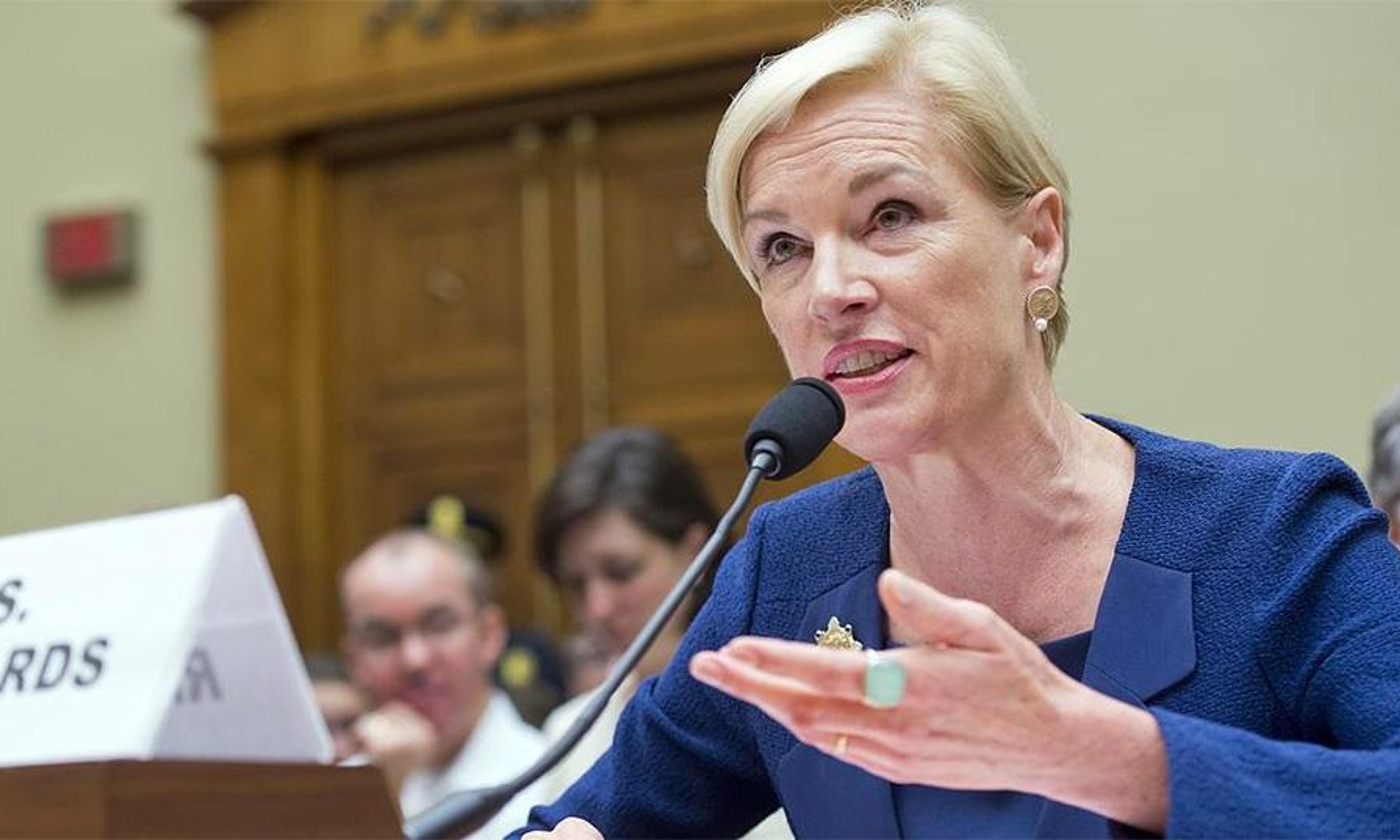
Planned Parenthood president Cecile Richards on Wednesday dismissed Donald Trump’s maternity-leave plan as a “half-baked” empty gesture, ignoring the plan’s substance and attacking Trump for his “narrow version of what makes a family” and opposition to “women’s constitutional right to abortion.” Her op-ed in Cosmopolitan — a great place to reach swaths of young to middle-aged women, the vast majority of whom likely already agree with her — goes on to malign Trump and his running mate Mike Pence for proposing an agenda so dangerous that it is “literally killing” women. Leaving aside the possibility that Trump isn’t nearly as radically pro-life as Richards portrays him — a possibility that David French has outlined eloquently at National Review Online — she also misses the mark substantively in her critiques of his supposed positions.
Richards misrepresents both the goal and the effects of the Hyde Amendment, which has been added to federal appropriations bills since 1973 to prevent taxpayer funding from going toward the provision of abortion. At various points, without openly naming Hyde as the problem, Richards reprises the common tactic of abortion-rights groups: pretending that the amendment exists solely to prevent low-income women from accessing their “reproductive rights.”
According to Richards, Trump will “block patients who rely on public health programs from going to Planned Parenthood,” and she later reiterates this point with regard to Pence’s record as governor of Indiana. (The fact that she levels the exact same charge against one of the most conservative governors in recent history and against a man who says Planned Parenthood helps millions of women shows that it is not made in good faith.)
But Richards is wrong about how Hyde works. First of all, the pro-abortion crusade against the Hyde Amendment is a sham, because it ignores the fungibility of money. As long as Planned Parenthood continues to receive even one cent of federal money, and as long as its clinics continue to perform even one abortion, taxpayer money is indeed funding abortions. That’s simple math.
On top of that, even if Hyde functioned the way it was supposed to, neither the intention nor the effect of the amendment is to prevent low-income women from receiving necessary care. Setting aside the plausible argument that abortion is never medically necessary, the purpose of Hyde has always been to protect citizens with conscientious objections to abortion. President Obama himself acknowledged as much in a speech at Notre Dame, saying, “Let’s honor the conscience of those who disagree with abortion and draft a sensible conscience clause” to his signature Obamacare legislation. It is only in very recent months that Democrats have, as a party and as individual politicians, become so strongly opposed to conscience protections such as the Hyde Amendment.
Furthermore, there is little evidence that the protections granted in the amendment actually deprive women of “reproductive services.” Despite Hyde, Planned Parenthood alone receives $5 million each year from the federal government, which the organization could easily use to subsidize abortion or contraception for low-income women. Besides, if Richards is so concerned about the women who can’t afford abortion, she’s welcome to lower the cost; no one is forcing Planned Parenthood to charge $350-plus per procedure.
Richards also uses Texas as a primary example of the way in which state-imposed abortion restrictions supposedly cause maternal deaths. But according to Michael J. New’s assessment on NRO, the study Richards uses to make this argument — and the corresponding attempts by the liberal media and abortion activists to wield the results as a cudgel against the pro-life movement — is highly misleading and disregards several key data points that might’ve led to a different conclusion.
On top of that, Richards and her fellow pro-abortion activists led the charge to defeat Texas abortion-clinic laws and to cheer the Supreme Court decision in Whole Woman’s Health v. Hellerstedt. But, rather than limit women’s access to “reproductive services” as Planned Parenthood claimed, the Texas restrictions overturned by the ruling sought to decrease maternal deaths associated with abortion by requiring physicians who perform abortions to have admitting privileges at a nearby hospital and requiring abortion clinics to have facilities comparable to an ambulatory surgical center. These don’t sound like laws that disregard the health of mothers. In fact, opposing these laws as strongly as Richards has done seems to be much less defensible.
Richards’s response to Trump’s maternal-leave plan is entirely predictable. It ignores the plan itself — which moves much more in the direction of a Democratic agenda than any Republican plan yet — in favor of empty pronouncements about how much Republicans hate low-income women. But at least Richards is honest about one thing. No politicians, no matter how liberal their family policy might become, will be acceptable until they embrace Planned Parenthood’s sacrament: abortion on-demand.




Comments