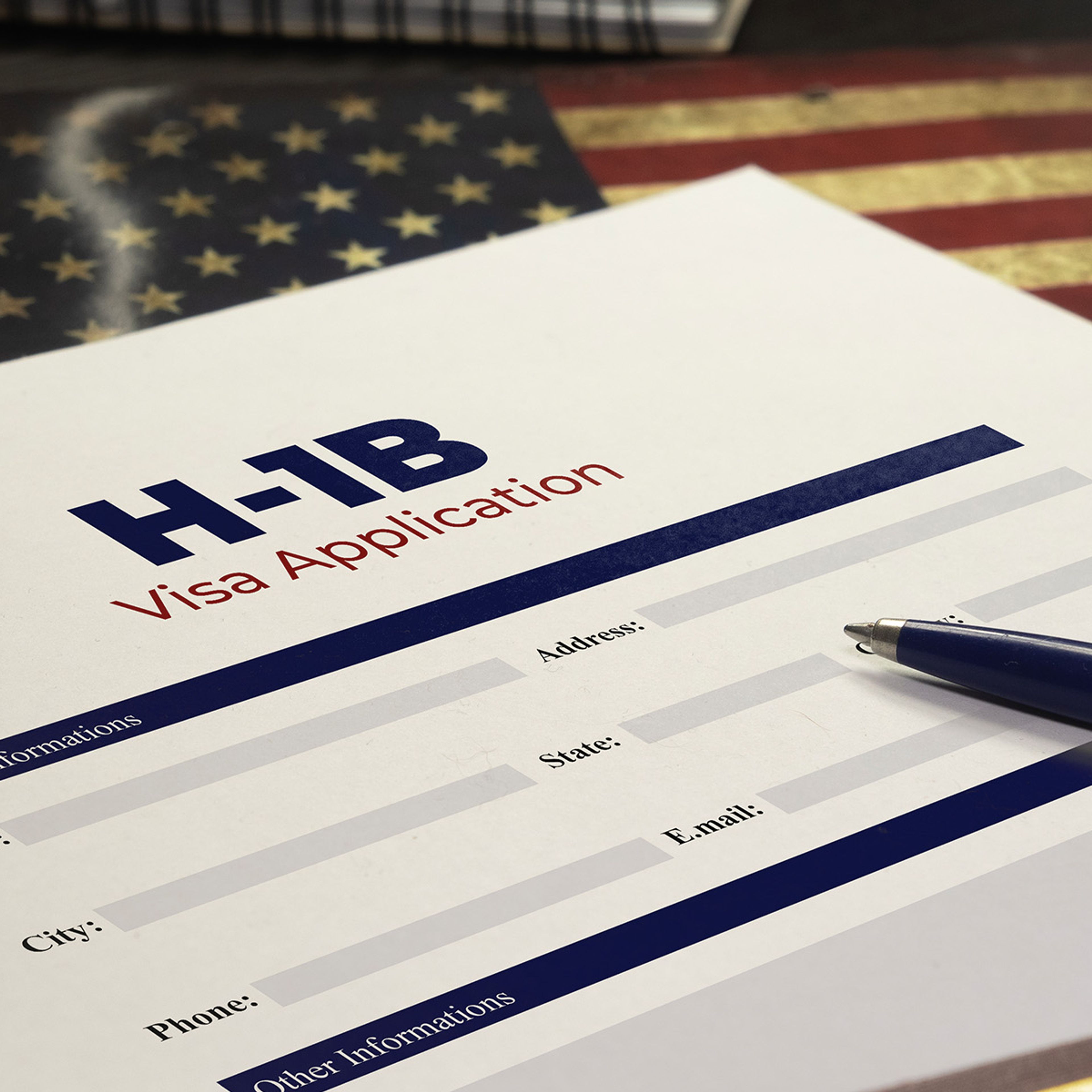
Writing to Scottish relatives about prospects in the United States in the late 19th century, industrialist Andrew Carnegie stated: “If I had been at Dumferline [Scotland] working at the loom it’s very likely I would have been a poor weaver all my days, but here, I can surely do something better than that, and if I don’t it will be my own fault, for anyone can get along in this country.” Carnegie’s words still ring true today, and come into greater focus given the small yearly allotment of H1-B visas to foreign nationals with advanced degrees in science, engineering, and technology.
A simple contemporary reality is that U.S. companies go wanting for skilled workers on a yearly basis due to congressional limits on the number of skilled foreign workers allowed into the country. At present, there aren’t enough domestically trained U.S. citizens available to fill crucial positions at American companies.
One argument in favor of the existing visa caps is that an influx of foreign workers will drive down U.S. wages in the engineering and technology space. Aside from the supply constraints mentioned above, this is zero-sum thinking. Workers are in the end capital, and along the lines of the pin factory Adam Smith described in the Wealth of Nations, an increase in the number of skilled workers will increase output, and make all of us wealthier in the end.
Notably, some in favor of increasing H1-B caps engage in zero-sum thinking of a different kind. Their view is that if we refuse skilled foreign workers, we’ll fall behind countries such as China and India, which already possess high numbers of scientists and engineers. The flaw here is in the assumption that the U.S. economy is a closed one, and that innovations in other countries will make us less well off at home. If this were true, California and New York, not to mention Europe and the rest of the world, would have been impoverished for the fact that Microsoft was founded in Seattle. More realistically, Microsoft’s innovations made workers around the world more productive.
Economic advances, be they scientific or technological, are almost by definition worldwide advances to the extent that countries keep their markets open and free. If a cure for cancer is found in India, we’ll all be better off. Country origin, in a free global market, is irrelevant.
The H1-B program thus should not be expanded with nationalistic concerns in mind, but for the simple fact that the U.S. remains the single best place for entrepreneurs to achieve their goals. The U.S. is a magnet for capital, perhaps because of the enlightened thinking of the average American. As John D. Gartner pointed out in his 2005 book, The Hypomanic Edge, a 1999 poll found that while 91 percent of Americans viewed starting a business to be a respectable career path, only 28 percent of British and 8 percent of Japanese respondents felt the same way.
From a purely business perspective, various studies of economic freedom still indicate that the U.S. possesses one of the freest economies in the world, with a recent World Bank study (“Doing Business”) showing the U.S. to be one of the easiest global locales in which to start a business. It can be argued that Bill Gates would not be one of the world’s richest men if he had been born in France, Germany, or Italy.
More practically, it has to be remembered that while Henry Bessemer’s discoveries in England made steelmaking more efficient, it was Andrew Carnegie who perfected the process in the United States. Similarly, while France’s Lumiere brothers developed the first movie projector, it was eastern European immigrants who created the U.S. film industry (one in which U.S.-based companies account for 80 percent of profits to this day). Henry Ford did not invent the assembly line, but he did perfect the process.
As Gartner noted, “entrepreneurs often do not create original ideas — they grasp the significance of an idea, wherever it comes from.” The U.S. remains the best country for entrepreneurs to grasp ideas, and once having done so, create wealth-enhancing innovations that the whole world can enjoy.
The H1-B visa program should be greatly expanded with this in mind.
– John Tamny is a writer in Washington, D.C. He can be reached at [email protected].



Comments