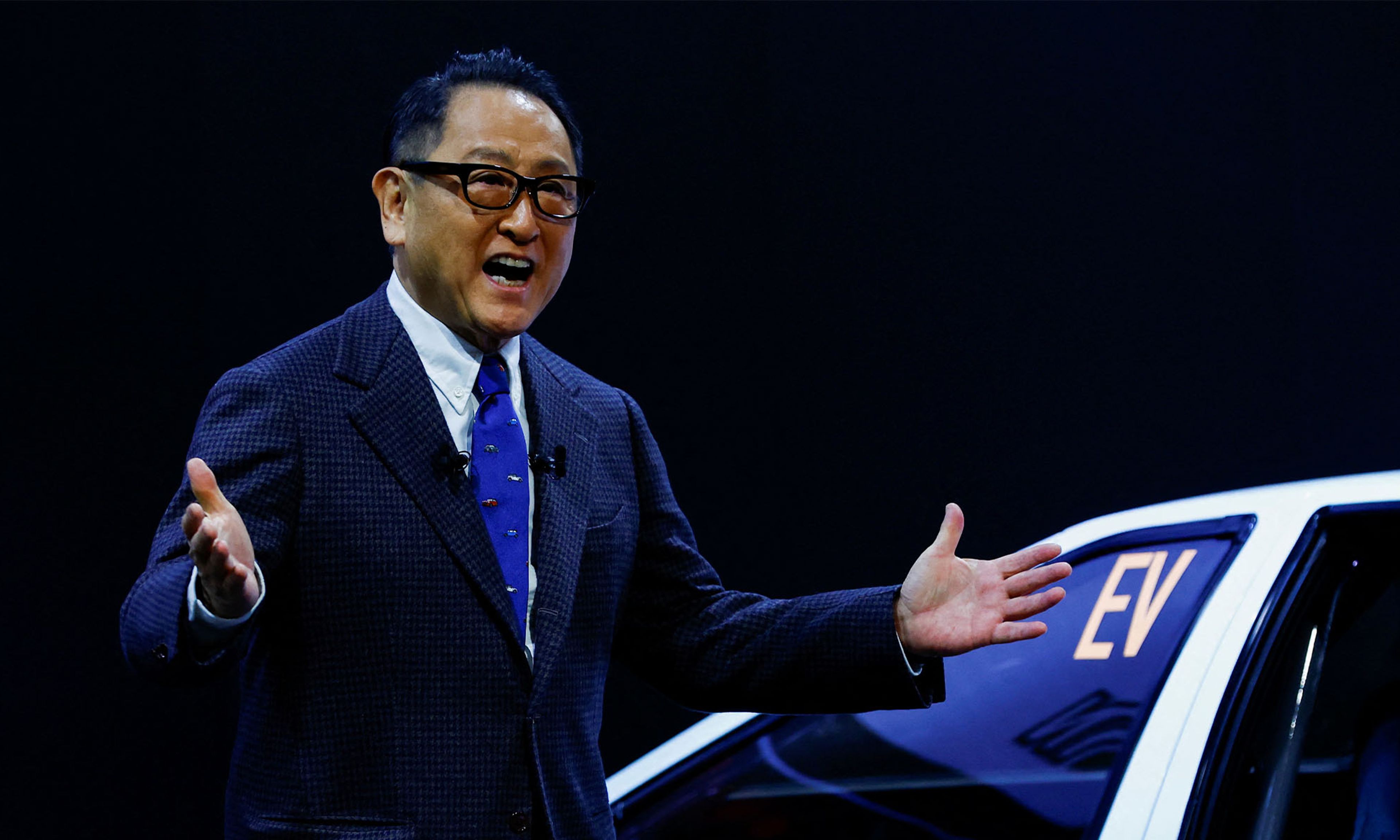
Akio Toyoda is the grandson of Kiichiro Toyoda, a man who started an auto division within his family’s business. That division, it must be said, came to enjoy a fair degree of success (those who want to know why the company is called Toyota, not Toyoda, can find out here). Akio Toyoda joined Toyota in the 1980s, eventually becoming its CEO in 2009. He knows a bit about cars. He also speaks his mind.
I wrote about Toyoda in a Capital Letter at the beginning of the year. He has been something of a skeptic about electric vehicles (EVs) for some years, wondering aloud whether they were quite so environmentally friendly as claimed and highlighting the cost of the rush to decarbonization to the auto industry and the consumer.
The Wall Street Journal (December 17, 2020):
[Toyoda] said if Japan is too hasty in banning gasoline-powered cars, “the current business model of the car industry is going to collapse,” causing the loss of millions of jobs.
Advocates of EVs say they can be charged at night when electricity demand is low and, over time, can grow in tandem with other green technologies such as solar power.
Solar power is, of course, at its best at night, when the sun is at its brightest.
A year later, the Journal again reported on Toyoda’s doubts, and, indeed, “his claim that he was among the auto industry’s silent majority in questioning whether electric vehicles should be pursued exclusively” (to be fair, it should be noted that Toyota is a leading manufacturer of hybrids).
Writing in the Capital Letter, I questioned whether there was a silent majority who shared his views about the wisdom of pursuing a “single option” (EVs), but added:
…his claim that many are reluctant to “speak out loudly” because they think this pursuit is “the trend” rings true.
At a guess, Toyoda diplomatically chose the word “trend” for its blandness, but what he is talking about is the pressure being put on automakers to go exclusively electric (and to do so very quickly) from major institutional investors playing the ESG game: from climate activists and rent-seeking consultants to regulators and, of course, governments. That’s how today’s corporatism works. Observant readers will note that car buyers are not included in that list, and that their absence counts for nothing. To climate policymakers, car owners and car buyers are at best nuisances, and at worst enemies.
Since then, the pressures to shut up have only increased. Many carmakers have invested even more in EVs, and many governments are throwing money at the sector. Criticizing the switch to EVs would be career-ending for many in the industry.
As for Toyoda, well, here’s an extract from a New York Times story from January 26:
Akio Toyoda, the scion chief of the Japanese automotive giant Toyota, will make way for a younger successor as the company struggles to adapt to the world’s growing demand for electric vehicles.
Mr. Toyoda, who has been a vocal skeptic of the global efforts to shift to battery-powered electric cars, will step down as chief executive and become the company’s chairman on April 1, Toyota said Thursday. He will be succeeded by Koji Sato, a top executive at Toyota’s luxury subsidiary, Lexus.
Over more than 13 years, Mr. Toyoda, a grandson of the company’s founder, turned around Toyota’s finances and helped it maintain its position as one of the world’s largest and most important automakers through crises both external and internal. But his reluctance to embrace the auto industry’s turn toward electrification has made him the subject of fierce criticism and raised concerns among some shareholders that the company, which once led the world in the development of eco-friendly cars, could be left behind…
As competitors in the United States and elsewhere embraced all electric vehicles and as governments and automakers revealed plans to phase out combustion engines, Mr. Toyoda insisted that the world wasn’t yet ready to make the leap, arguing that many of the company’s customers, particularly in the developing world, would continue to rely on fossil fuels. Toyota, he insisted, would continue to manufacture its pioneering hybrid vehicles, combining electric motors and internal combustion engines, for decades to come.
In an interview published by Toyota this month, Mr. Toyoda said his views on battery vehicles had been misrepresented by reporters hungry for conflict.
“I’ve never said B.E.V.s are wrong,” he said, using an abbreviation for battery-electric vehicles. “B.E.V.s are an important option. However, they may not be the only option. That point just didn’t get across.”
No, but good for him for trying.
Still, at least he became chairman, but for some that’s not enough punishment.
The Wall Street Journal:
[P]rogressive investors are seeking to oust Chairman Akio Toyoda and are pushing a resolution at its June 14 shareholder meeting to make the world’s largest auto maker disclose its climate-related lobbying.
News reports say the California Public Employees’ Retirement System (Calpers) and New York City’s public-worker pension funds have voted against Mr. Toyoda’s re-election, and the proxy advisory firm Glass Lewis has recommended that shareholders do so as well. They say Mr. Toyoda deserves the boot because Toyota’s board isn’t sufficiently independent of management.
Ah, Glass Lewis, half of the proxy advisory “duopoly” alongside ISS (there are other firms in this business, but between them, ISS and Glass Lewis have a market share that runs well over 90 percent).
Writing about Glass Lewis earlier this year for Forbes, Wayne Winegarden had this to say:
Institutional investors are required (or believe they are required) to vote on all proxy measures at shareholder meetings and rely on proxy advisory firms to manage this herculean task.
The problem arises because ESG proxy measures often have adverse impacts on companies’ operations. Nevertheless, ISS’ and Glass Lewis’ recommendations support ESG proxy measures most of the time—and much more often than the largest asset managers.
There are times when both firms show clear signs of progressive bias, and when it comes to the E of ESG (an investment discipline in which the assessment of an actual or potential portfolio company will include how it measures up to various—and varying—environmental, social, or governance standards), there can be no doubt that Glass Lewis is on the side of the climate warriors. This may well not be good news for underlying “shareholders” (namely those who have invested in the investment funds that become the actual shareholders in a company) simply hoping that their money would be invested in a way solely focused on return.
This matters because, although asset managers don’t always follow the proxy advisors’ recommendations, they often will.
Winegarden:
According to a 2021 Harvard Law School publication, institutional investors who managed more than $5 trillion in assets automatically voted the ISS or Glass Lewis recommendations without any further scrutiny (a practice referred to as robovoting).
It should be noted that, notionally, Glass Lewis is going after Toyoda on governance grounds—the G, not the E (allegedly the board isn’t sufficiently independent of management)—but who believes that? Certainly not the Wall Street Journal:
Toyota’s corporate governance model is old news. The sudden concern suggests it is merely a pretext for punishing Mr. Toyoda for the heresy of doubting the West’s hell-bent EV transition…
The Journal notes that “Toyota is promoting its hybrids and plug-in hybrids as alternatives to battery-powered EVs. Plug-in hybrids contain an internal combustion engine that can kick in when the battery runs low, which alleviates range anxiety. They are also cheaper than EVs.” At the same time, it should be noted that Toyota does manufacture EVs (although they have made a slow start), and will be expanding its EV line in the next two to three years. Reuters reports that the company has set a sales target of 1.5 million EVs by 2026, a target that has (according to S&P Global Mobility) recently increased by 25 percent.
That said, Toyota is still going to stick with offering a genuine consumer choice (remember that?). Its customers will be able to choose how far they want to go down the electric highway. Click on the company’s website to find this:
Our lineup brings you more than just your choice of electrified powertrains: Hybrid (HEV), Plug-In Hybrid (PHEV), All-Electric (BEV), and Fuel Cell Electric (FCEV) *. Whatever you’re looking for in a ride – size, style, efficiency, speed – there’s a vehicle to suit your lifestyle that allows you to put more electrified miles on the road.
And the Journal quotes from a memorandum the company sent to its dealers in April (trigger warning: heresy ahead):
“The amount of raw materials in one long-range battery electric vehicle could instead be used to make 6 plug-in hybrid electric vehicles or 90 hybrid electric vehicles…The overall carbon reduction of those 90 hybrids over their lifetimes is 37 times as much as a single battery electric vehicle.”
Such talk will not do. No wonder there’s a push to see Toyoda deposed from his new chair.
The Wall Street Journal:
The shareholder campaign against Toyota shows how public pension funds and the proxy advisory duopoly of Glass Lewis and Institutional Shareholder Services (ISS) work in concert to exploit corporate governance to push progressive political goals. ISS, Calpers and New York city’s pension funds have all backed the shareholder resolution calling on Toyota to disclose its climate-related lobbying.
New York City’s pension funds?
Yes, these people.
In a new attack against ESG investing, three New York City pension funds were sued for allegedly breaching their fiduciary duty by selling billions of dollars of fossil-fuel assets.
The plaintiffs, represented by Donald Trump’s former Labor Secretary Eugene Scalia, claim the retirement plans’ decision to divest roughly $4 billion in fossil fuel investments is “a misguided and ineffectual gesture to address climate change,” according to the complaint filed in New York state court. They said the plans have “a duty to act prudently in making investment decisions.”
The move to exclude fossil-fuel investments was made in 2021. Then last year, oil and gas stocks soared following Russia’s unprovoked invasion of Ukraine, with the MSCI World Energy Index rising more than 40%.
For some mysterious reason, I trust Toyoda’s judgment more. Whether those running climate policy will feel the same way is an entirely different question, one to which we already, unfortunately, know the answer. Meanwhile, Toyota’s AGM will be on June 14.
The Capital Record
We released the latest of our series of podcasts, the Capital Record. Follow the link to see how to subscribe (it’s free!). The Capital Record, which appears weekly, is designed to make use of another medium to deliver Capital Matters’ defense of free markets. Financier and NRI trustee David L. Bahnsen hosts discussions on economics and finance in this National Review Capital Matters podcast, sponsored by the National Review Institute. Episodes feature interviews with the nation’s top business leaders, entrepreneurs, investment professionals, and financial commentators.
In the 122nd episode, David is joined by our own Dominic Pino. They continue the dialogue David started last week with Mark Skousen, really unpacking our modern understanding of and appreciation for Adam Smith. Once again, moral philosophy and classical economics are shown as going hand-in-hand, not pitted one against the other, and the result is what Smith himself produced: a legacy of freedom and virtue.
Capital Writing
As part of a project for Capital Matters, called Capital Writing, Dominic Pino is interviewing authors of economics books for the National Review Institute’s YouTube channel. This time, he talked to Philip Howard of Common Good about his book, Not Accountable: Rethinking the Constitutionality of Public Employee Unions. Here you will find an edited transcript of a few key parts of our conversation, as well as the full video of our interview.
No Free Lunch
Earlier this year, David Bahnsen launched a new six-part digital video series, No Free Lunch, here at National Review. In it, we bring the debate over free markets back to “first things” — emphatically arguing that only by beginning our study of economics with the human person can we obtain a properly ordered vision for a market economy. . . .
The series began with a discussion with Fr. Robert Sirico of the Acton Institute. Later guests include Larry Kudlow, Dennis Prager, Dr. Hunter Baker, Ryan Anderson, Pastor Doug Wilson, and Senator Ted Cruz.
Yes, the six-part series now has seven parts.
Enjoy.
The Capital Matters week that was . . .
Healthcare
On May 24, the Congressional Budget Office released estimates that 15.5 million people will lose Medicaid over the next two years. The reason: Twenty percent of Medicaid enrollees are ineligible for the program because states have not conducted eligibility reviews for more than three years…
Unions
In the March 20 issue of National Review, Philip Howard wrote a piece adapted from his book, Not Accountable, about how public-sector unions cause basic governance problems. (I’ll have a Capital Writing interview with Howard coming out soon.)
“Accountability is basically nonexistent in American government today,” Howard began that piece. “Blatant misconduct rarely leads to speedy dismissal; instead it is just the starting point for negotiation,” he said.
One recent example of this phenomenon came from New York’s state prisons…
ESG
On the merits, the Friedman doctrine retains its clarity and essential logic. Though it has been mischaracterized as antithetical to stakeholder and ESG concerns, the opposite is true: Managers seeking to maximize profitability must serve numerous groups that produce and purchase the company’s output. By emphasizing shareholder value—i.e., the discounted present value of future earnings—corporate executives nurture not only stockholders but all parties with a stake in the solidity of the enterprise. That’s why executives are often compensated based on stock-market performance—a manifestation of profit-maximization objectives.
Such arrangements, however, have been roundly criticized by mainstream media and the academic establishment. In response, some Friedman devotees—myself included—suggest that a more nuanced, updated framework might be appropriate, one that highlights long-term value for shareholders…
Thrift
I wrote last month about the myriad private-debt problems facing Americans, both as a matter of financial reality and on cultural grounds. At the time, the national focus with regard to “debt” was on the debt-ceiling debate. Now that the debt-ceiling crisis is resolved, for the time being, it’s worth revisiting the other debt crisis.
In a poll conducted by CNBC at the end of March, 70 percent of Americans reported feeling stressed about their financial situation…
Electric Vehicles
Decarbonization is, in many respects, a massive exercise in central planning, and that includes the decision to “encourage” the switch to EVs, not least by using the power of the state to squeeze out or shut down rival technologies (including the internal-combustion engine), leaving car companies little choice other than to go electric. As a way of discouraging innovation that takes some beating.
Regulation
One of the supposed benefits of Brexit was that Britain would once again become “Global Britain,” able to adjust its regulatory approaches to one more suited to an advancing world rather than a sclerotic corner like the European Union. Unfortunately for the citizens of the U.K., Brexit coincided with a growing consensus among politicians and the public that the best way to deal with any contentious political issue was to “depoliticize” it by appointing an independent body to look after the issue, free from ministerial or parliamentary control.
In practice, of course, this has led to the “independent” regulators doing exactly what public-choice theory would predict and expanding their powers…
I was reading this piece last night, which, contrary to what its title promised, only seemed to focus on the passage of the Rail Safety Act. The bill was praised in the media for its bipartisanship: There’s notable harmony on this issue between Ohio Senators Sherrod Brown (D.) and J. D. Vance (R.). It got me thinking about the politics of how this bill came about.
Tax
For years, the Washington State Department of Commerce ran a “Choose Washington” webpage encouraging businesses and entrepreneurs to locate in the Evergreen State. From 2012 to 2015, the page highlighted Washington’s “competitive advantages” and included “no taxes on capital gains or personal or corporate income taxes.” In May of 2015, that language was changed to highlight “no personal or corporate income tax” in the state. By 2021, the language citing no income taxes as an advantage was gone.
And then on March 24, 2023, the state supreme court ruled that the state’s new capital-gains tax was not an unconstitutional income tax as the state superior court had ruled, but a constitutional “excise tax” as advocates, including the governor, claimed…
Energy
North Dakota governor Doug Burgum entered the race for the GOP presidential nomination today. He has been extremely popular in his state, boasts a strong conservative policy record, and was a very successful businessman before entering politics.
It’s unlikely that he will end up with the nomination, since most Americans do not know who he is. But now that he’s in the race, one thing he could do that would be beneficial to the country is talk about pipelines. A lot…
Inequality
Chelsea Follett & Vincent Geloso:
Belief in widening inequality has inspired several policy proposals. A 2023 Oxfam report proposes fighting “rising global inequality” with a 5 percent tax on the world’s multi-millionaires. Other proposals in the same vein include the implementation of, or increases in, inheritance taxes and the establishment of a global registry of financial-asset ownership.
Yet the narrative of rising inequality is false. Though the worldwide inequality gap certainly still exists, it is shrinking.
Climate Change
The apocalypticism that runs through current climate policy is just another example of the millenarian thinking that has bedeviled humanity over the centuries. And the relentless insistence that we must all make do with less “to save the planet” is just another example of the pointless asceticism that has been a feature of countless philosophies, religious or otherwise, for a long, long time. I had not, however, expected animal sacrifice to have made its way into climate fundamentalism, but here we are—old habits and all that.
Debt Ceiling
In a more cynical sense, the process also worked: Politicians successfully avoided having to make any hard decisions that could have been unpopular. Both parties promised they would not touch entitlements at all, in keeping with a promise they had made in a grotesque display at the State of the Union address earlier this year. Entitlements are the primary driver of America’s debt problem, and as long as politicians refuse to reform them, the problem will remain.
Medicare
Congress has finally concluded its monthslong saga to raise the debt ceiling. Whatever one thinks of the deal struck, the overall outlook for our nation’s fiscal health remains grim. Lawmakers explicitly took the most expensive items—federal health and entitlement programs—off the table. At some point, Congress will be forced to deal with this core problem. When it does, it should look to reducing overpayments in the Medicare program. Taxpayers and seniors would both benefit…
Environmentalism
From its headwaters in southern Oregon, the Klamath runs south through high desert before bending west to traverse deep canyons in California’s coast ranges, eventually finding the ocean just south of Eureka. Historically, millions of salmon ran up the Klamath each year to spawn in the cool gravel beds of its upstream tributaries. Today these salmon populations are reduced to a small fraction of their historical numbers, and attempts to revive salmon populations on the Klamath have triggered a war for the watershed’s future.
On one side are environmentalists and state bureaucrats, who have brought to the battle unlimited funds for lawfare and punitive regulations. On the other side are farmers and ranchers who have operated for over a century in the region, attempting to survive on thin profit margins in an era of increased costs and the relentless regulatory assault on their ability to subsist.
To sign up for The Capital Letter, please follow this link.






Comments