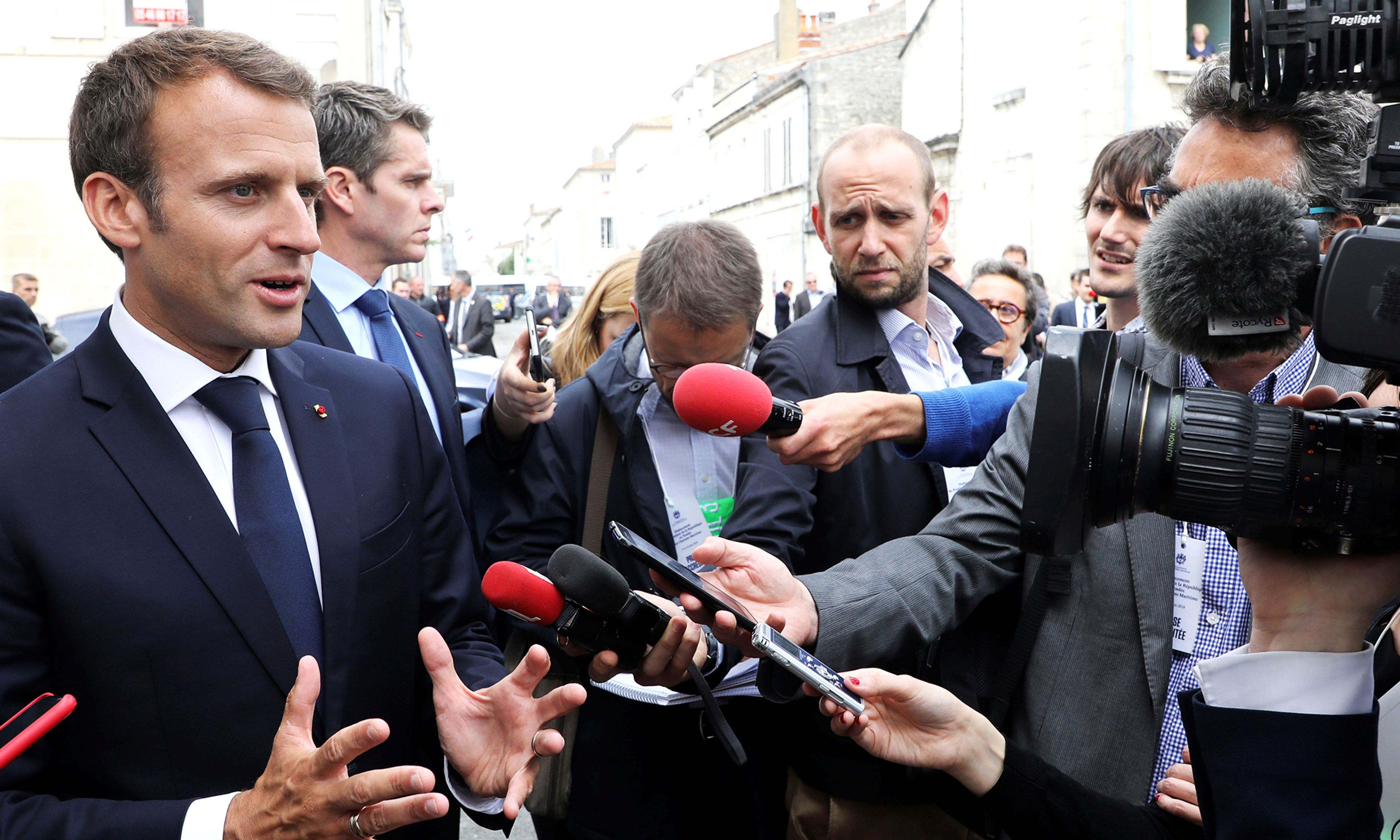
French president Emmanuel Macron recently proposed clamping down on “the manipulation of information,” which is to say, fake news. He may not have authoritarian intentions, but this measure is one of a few potentially disastrous moves that the French government is considering as a way of restricting the flow of false information.
Last week, France’s parliament considered Macron’s legislation, in a sharp debate that ran until the early morning, by which time lawmakers had introduced 216 amendments (fewer than half of them were debated). They punted further consideration of the bill to July. As one would imagine, the measure has elicited contentious discussion, with figures from many of France’s political parties, the media, and civil society warning of its potentially dangerous effects.
The law, which defines fake news as “every allegation or imputation devoid of verifiable elements of a nature to render it plausible,” aims to mitigate the impact of the spread of false information in the period leading up to elections. Petitioned by political parties and candidates, courts would have 48 hours to act on instances of online information alleged to be false, and judges could rule to retract such articles from the Web or to block access to them. Another provision would allow France’s broadcast authority to shut down TV stations operated “by a foreign state or under the influence of that state.”
It’s not difficult to appreciate where Macron, a target of state-sponsored disinformation efforts during the most recent presidential election, is coming from. His campaign was beset by attempts at spreading falsehoods; rumors held that Macron had an offshore bank account in the Canary Islands (his opponent Marine Le Pen parroted this story during a televised debate) and a secret boyfriend. But a last-ditch effort to torpedo Macron’s chances, on the eve of France’s second run-off vote, was far more troubling.
One of the idiosyncrasies of French political campaigns is the “silence républicain,” a 48-hour period before national elections during which candidates must cease all electioneering: no rallies, no media appearances; nothing. News outlets are banned from publishing about the election during this pause. The Friday afternoon before the Sunday vote, news emerged that the email accounts of Macron-campaign staffers had been hacked, and internal campaign messages, authentic or not, were released to the public. This was the perfect time to strike: The Macron campaign would be legally barred from responding to bombshell emails found in the trove, and outlets would have just enough time to report on some of content in the emails. The Kremlin was not directly implicated in this incident, but hackers thought to be linked to Russia were involved in phishing attempts that targeted Macron’s party throughout the campaign, and Sputnik, a Russian news agency, advanced the fake story about the candidate’s gay affair when it published an interview with a member of parliament who alleged that Macron was backed by a “very wealthy gay lobby.”
[pullquote align=”left”]The actions undertaken by Russian news organizations are no justification for legislation that could expose the press to future authoritarian assaults.[/pullquote]
In turn, Macron blacklisted RT and Sputnik from his rallies in late April, and standing next to Vladimir Putin during a press conference at the Palace of Versailles in May 2017, the French president thrashed the Russian outlets as “agents of influence and propaganda”— reasonable enough.
Nevertheless, the actions undertaken by these organizations are no justification for legislation that could expose the press to future authoritarian assaults. Passing these measures could lead to the shuttering of RT and Sputnik in France. Press-freedom advocates must ask whether it would be wiser to take a softer approach, such as that in the United States, where RT must register as a foreign agent. The Kremlin’s disinformation efforts are an attempt to sow chaos in Western democracies, and abandoning a core pillar of liberal democratic doctrine, even though foreign powers abuse that liberty, only advances Russia’s interests.
The draft text proposed also relies on a misunderstanding of what journalism is. Christophe Deloire, secretary general of Reporters Without Borders, argues that serious journalism often lacks elements of verification. Moreover, the short, 48-hour period specified in the bill doesn’t give judges enough time to confirm whether an article is truthful, and anonymous sources could be outed in the process.
The French daily Le Monde implies that the bill was written by members of the president’s political party in parliament to be ineffective so as to limit the potential dangers that it poses. This view, though conjectural, highlights the unease that even Macron’s allies have toward the proposal. At best, the law would be ineffective: Between the time an article was flagged and a petition was lodged with a court, the story could achieve a wide circulation. The law would also be redundant: Laws passed in 1881 and 2004 already lay the legal foundation for fighting fake news stories. At worst, the measure would hand future governments a dangerous amount of power to suppress important news stories.
One of those future governments could be led by one of Macron’s populist rivals, who are no friends of press freedom. While Macron’s relations with journalists could be considered almost Obama-esque — condescending and aloof — the French president doesn’t seem to harbor intense contempt for them. By contrast, Le Pen’s party has been beset by allegations that it has harassed and intimidated the press, and Jean-Luc Mélenchon, leader of the far-left-wing populist-socialist party La France Insoumise (France Unbowed), has characterized the press as “the primary enemy of the freedom of expression.”
Mélenchon, who dismisses Russian interference in Western elections as part of a “battle for soft power,” has his own proposal to deal with misinformation: He wants to create a “Council of Journalistic Deontology” that would be tasked with holding journalists and publications to account for running flawed stories. This idea is inspired by the creation of a similar body in Belgium designed to ensure the professional conduct of the press. If such a council were created in France, it would include media professionals acting under guidelines set by the nation’s major editors and publications. Anyone, including public figures and politicians, could approach the council and request that a news outlet be subjected to arbitration over a contested story, which could lead to a correction or a retraction.
[pullquote align=”left”]Politicians should focus on governing, not on harassing journalists.[/pullquote]
Never mind that Mélenchon proposed this idea only after an embarrassing TV appearance in November where his defense of the Venezuelan dictatorship was picked apart by his interviewers, whom he later accused of bias; he’s now pushing this council as an alternative to Macron’s proposed fake-news law. There are certainly merits to industry-wide standards that journalists must reflect in their work; journalism is an imperfect human activity. But such a council could be abused by the powerful to mar the reputations of their political opponents. Politicians should focus on governing, not on harassing journalists.
In the end, French members of parliament, the vast majority of whom come from the president’s party, will probably pass some version of the fake-news law. The essence of this effort, protecting democratic processes from the saboteurs of reasoned discourse, is worth supporting. But France has made missteps in its effort to find a workable model for protecting the truth. Americans should appraise them so we can better understand the range of options that exist and identify those that threaten freedom.






Comments