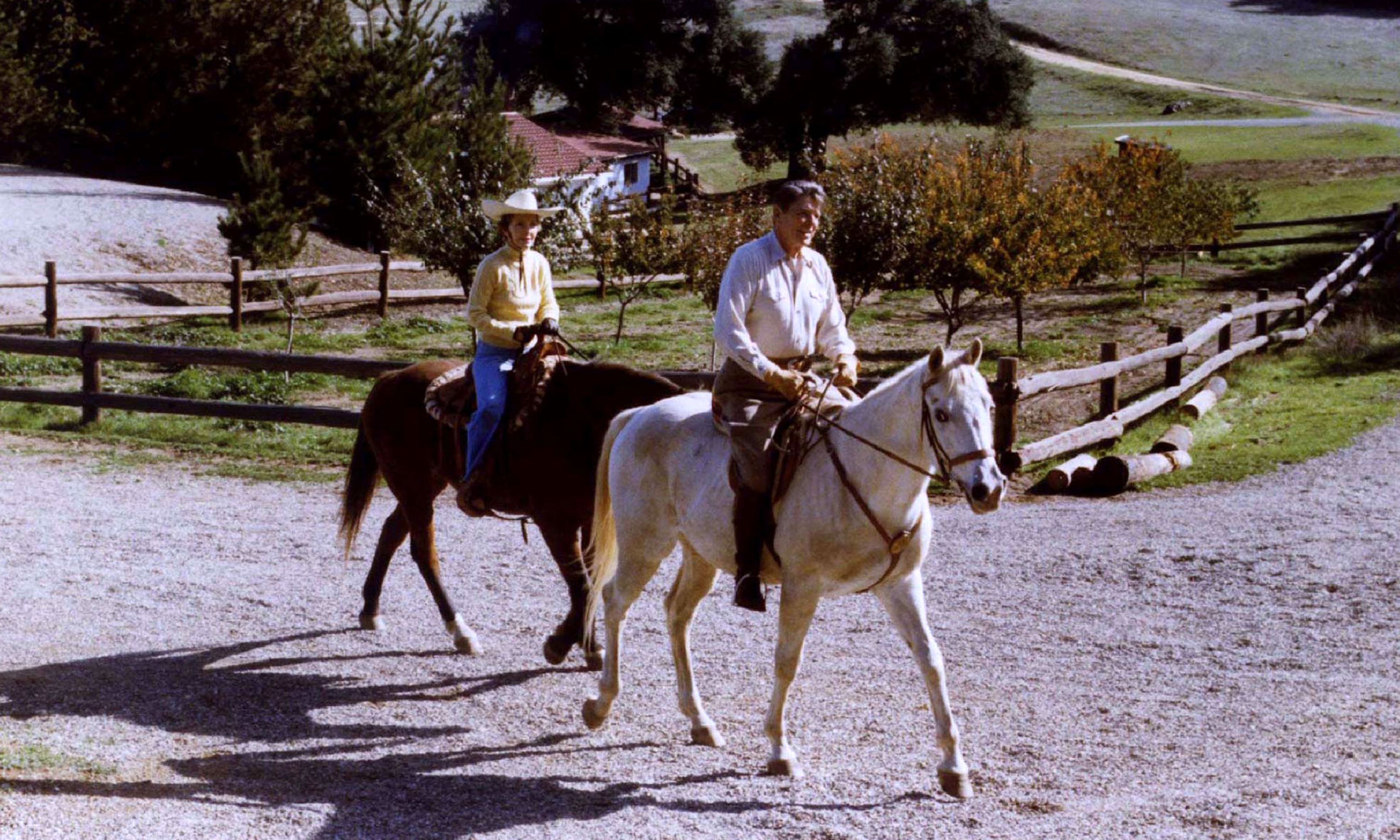
The sun shone brightly on the mountains overlooking Santa Barbara, Calif., as 100 college students, myself included, stepped off five shuttles to tour President Ronald Reagan’s Rancho del Cielo. To enter Reagan’s personal retreat, we trod on the path of wooden steps the president himself had laid for us decades before our visit. At the ranch, we learned about the work ethic that drove America’s 40th president to bolster the country’s system of free enterprise, which allows each person to control his own destiny. This same system was also celebrated at the recent National Review Institute Buckley Dinner at the nearby Reagan Presidential Library, which honored Reaganaut free-marketeer Larry Kudlow as well as Scott Walker and Ron Robinson of Young America’s Foundation.
The students at the Reagan Ranch were part of YAF’s Road to Freedom Seminar, which took place at the ranch last weekend and taught attendees about Reaganomics. Many were supposed to tour the grounds at a conference last fall, but a wildfire made that impossible. Though the flames never reached the ranch, the winding mountain road leading up to it was damaged. Ten months later, however, the road, though scarred, was fixed, and our path up to the summit was clear.
While the destination was worth the visit, it required quite the journey. The Santa Barbara airport is small, and only a handful of airlines service it. Though those studying at California universities could relax on a leisurely ride via Amtrak, most of us had to devote an entire day of traveling to attend, taking multiple flights or sitting on a bus for two hours after arriving at nearby LAX. Still, we young conservatives were willing to sacrifice a weekend we could have spent going to football games, bars, or parties to see this hallowed ground of the conservative movement and to learn why the free market has served America well in the past and will continue to do so in the future.
In addition to touring the ranch, the students heard from a number of the conservative movement’s thought leaders and elected officials who spoke about the Reagan legacy. The chief components of that legacy are his affirmation of what one might call the “pieties,” cutting taxes, and fighting communism.
From the very beginning of his presidency, Reagan emphasized the pieties: those ritual observances by which Americans show love for our country. The materials in the ranch itself and in the Reagan Ranch Center, a building a few miles away that functions as a museum, are decked out in red, white, and blue. They reflect a deep appreciation for America, an appreciation Reagan’s presidency also demonstrated. When he first took office in 1981, he began the tradition of saluting back to the military personnel who stood by the entrance to Air Force One. The commander-in-chief is technically supposed to be the one saluted, but Regan’s appreciation for those who put their lives on the line to defend America led him to set the precedent for each succeeding president to perform this act of humility. That reverence for the country allowed him to become a unifying force when the country needed it most, according to Antony Davies and James Harrigan, who recorded an episode of their Words and Numbers podcast for the attendees. Reagan’s unifying power was so great that he defied polling trends. In 1979, pollsters at Gallup began asking Americans whether they thought the country was moving in the right or wrong direction. Since the poll’s creation, an average of only 34 percent of people have believed the country is going in the right direction. When Reagan took office, the failures of President Jimmy Carter’s administration dragged that number down to 17 percent. Reagan lifted it up to almost 70 percent.
That approval was borne out in his reelection, which he famously won in a landslide, carrying 49 states over his opponent, Walter Mondale. He won such a resounding victory because he instituted economically sound policies that made people’s lives better, chief among them his massive 1981 tax cuts. Preserved in the ranch center’s galleries is the very table on which Reagan signed that pivotal piece of legislation. Students stood where the president sat at the ranch as he signed the legislation. Through these artifacts, they learned that “true freedom and prosperity do not come from the clumsy hand of the government” but rather “from empowering people to pursue their own dreams,” as YAF president Scott Walker put it. Students also learned that they could apply these lessons today. Representative Lisa McClain (R., Mich.) outlined a Republican agenda, for after the midterm elections, that focused on economic prosperity. “If you don’t have a strong economy, it’s really tough for everything else to follow,” she said. The first thing she pledged to do in the next Congress was to strengthen the American economy, as Reagan did, by alleviating inflation through spending cuts and making it easier for people to put the money they earn back into the economy.
That type of economic freedom was Reagan’s counter to totalitarianism around the world. We should not discount his other achievements. But his greatest victory was that over communism in Eastern Europe. When students entered the Reagan Ranch Center, they saw a slab of the Berlin Wall that the president demanded Mikhail Gorbachev tear down. They also had the privilege of hearing firsthand how thoroughly Marxist economics could corrupt a country. Daniel Di Martino, a survivor of the crisis in Venezuela, recounted how the socialist government, which was democratically elected, transformed his home country from a jewel of Latin America into a “humanitarian disaster.” The high point of the conference, however, was the speech from Yeonmi Park, a defector from North Korea. One could hear a pin drop as she recounted her own experiences under — and then escaping from — the world’s worst tyranny. At only 13, Park became a victim of human trafficking, which brought her over the border to China. There she met missionaries from South Korea, who helped her traverse the Gobi Desert. She braved temperatures of −40 degrees Celsius before reaching freedom. Students remained awed into silence as she recounted the human suffering she witnessed in North Korea, such as seeing rats eat the eyes out of executed dissidents, then watching starving citizens catch those same rats to eat for dinner.
It has become an inside joke among YAF conference-goers that a speaker will never fail to quote Reagan’s famous aphorism that “freedom is never more than one generation away from extinction,” and to follow it up by imploring them to defend America, “the last best hope of men on earth.” Regular attendees have heard it a million times. But Park brought those words out of the abstract and into the material. Hearing her experiences galvanized students to keep America from succumbing to tyranny. Our experience taught us that it was our duty to preserve our exceptional country by continuing on the path that Reagan set for us, learning from his legacy of devotion to free markets. If those of us fortunate enough to have visited the Reagan Ranch do what we can to uphold this legacy, then its future will be bright enough to shine through any clouds, right or left, that might pass by.




Comments