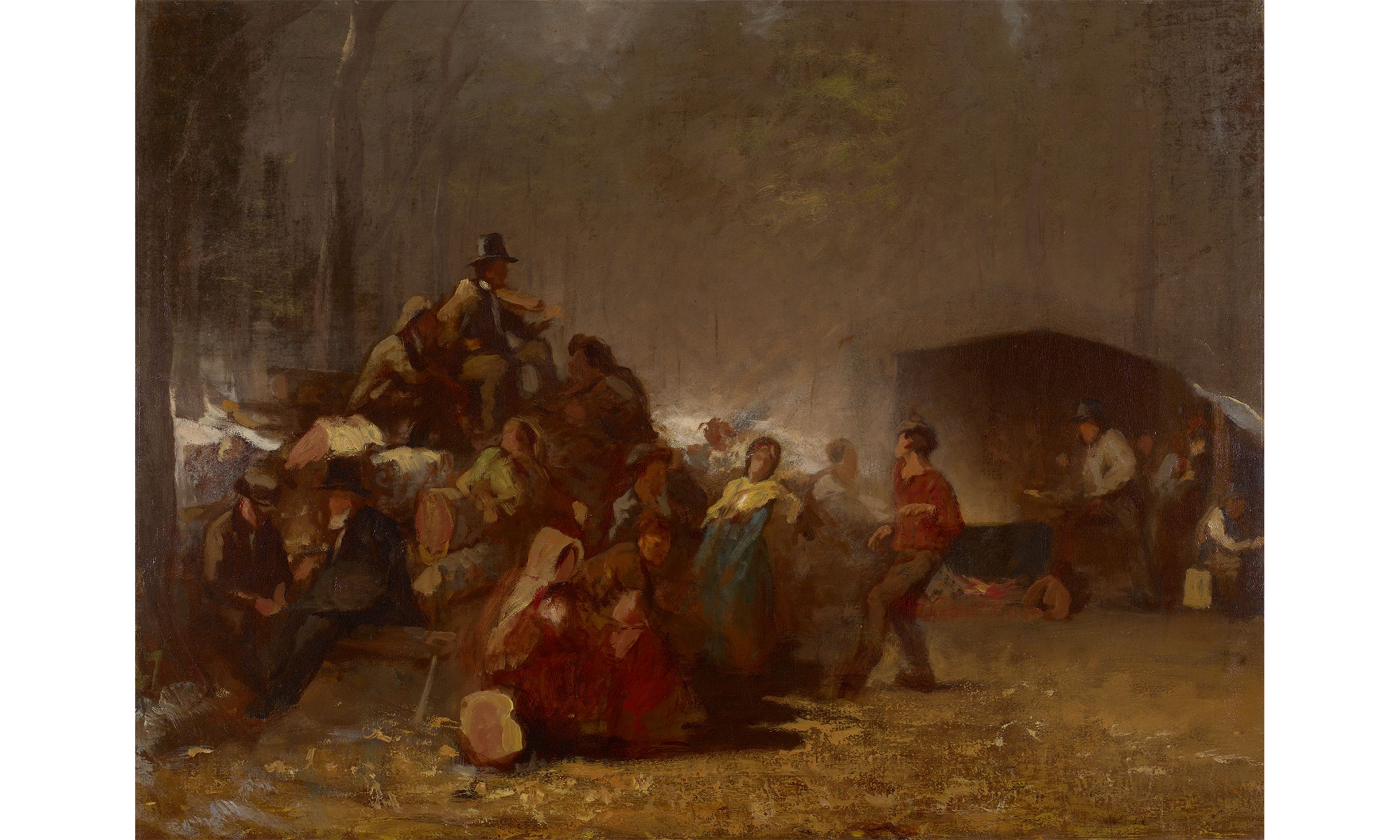
Enough of Cassatt, Degas, and Impressionist Paris already. What was happening in Fryeburg, Maine, you’re asking. In the 1860s and 1870s. There, neither a boulevard stroll nor a chanteuse warble nor a swig of absinthe was to be had. Early in Eastman Johnson’s life, rural, tiny Fryeburg, in western Maine, and Augusta, the capital, were his frame of reference. Johnson (1824–1906), born near Fryeburg, was the portraitist and great painter of scenes of everyday life once known as America’s Rembrandt for the composure of his figures and his muted palette of sienna, vermillion, yellow ochre, and cobalt.
Johnson is best known to American art-history buffs, but in that confined realm, he’s as essential as Homer, Whistler, and Eakins. In his many hundreds of portraits and genre pictures, Johnson visualized a national zeitgeist starting in the days before the Civil War and going through the Gilded Age. Most of the sensate among us know his Cranberry Harvest, from 1880, a Nantucket scene and hard to beat as a tribute to rural life.

Comments