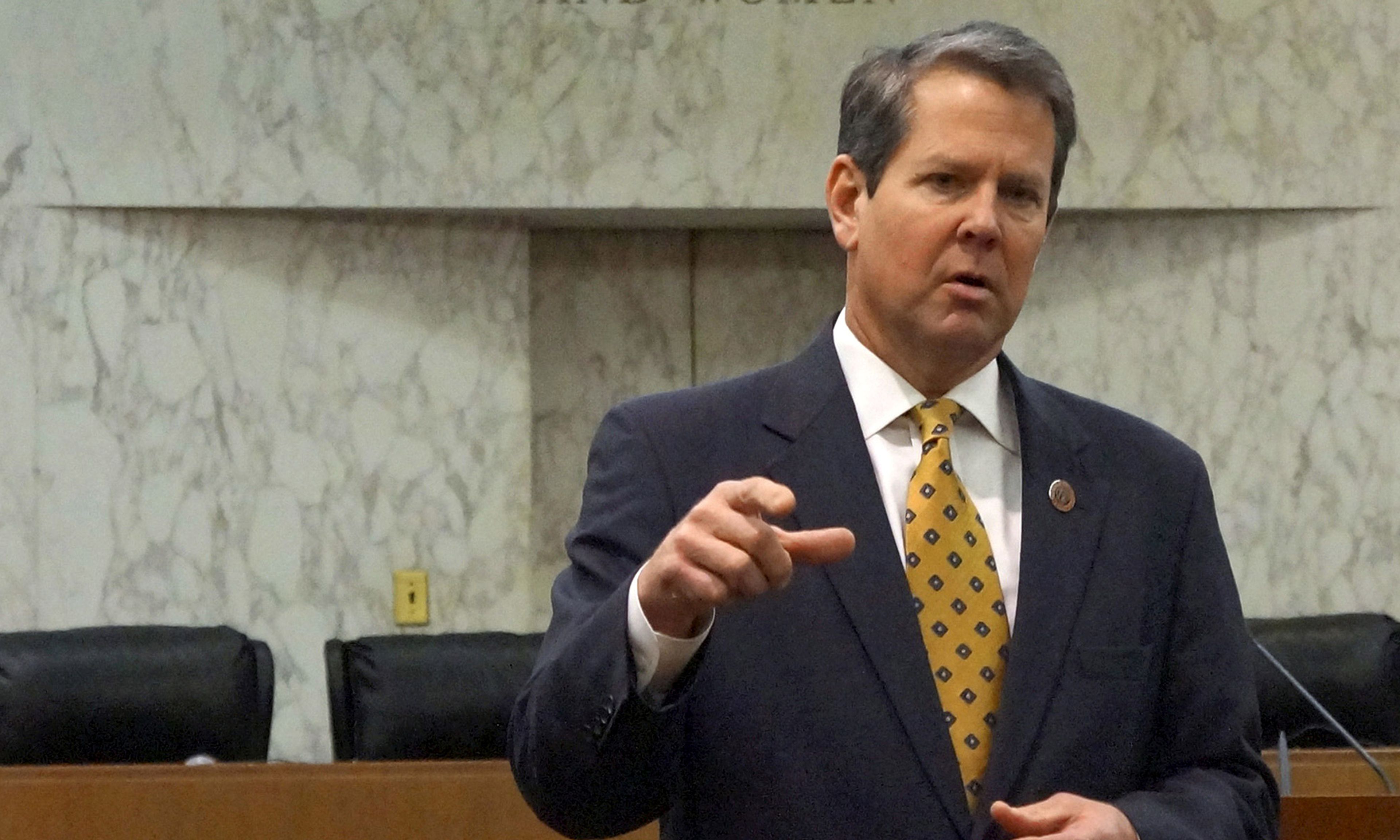
In another year, in another state, against a different general-election opponent, the primary victory of a candidate who boasted of using his pickup truck to round up illegal immigrants and seemed to threaten one of his daughter’s suitors with a firearm in a television commercial might be a harbinger of defeat for the Republican party. But in 2018, with Georgia Democrats having already nominated a down-the-line liberal, no one is writing off Brian Kemp’s chances.
In contrast to his strong showing the rest of the region, Donald Trump won Georgia in 2016 by only a 51–46 percent margin over Hillary Clinton. And although Republican Karen Handel won a suburban-Atlanta seat in a much-hyped June 2017 special election, most pundits assume that Georgia is trending away from the Republicans.
That might lead some observers to conclude that Kemp falls into the same category as Sharron Angle or Christine O’Donnell in 2010: candidates who played to the GOP base during the primary but then lost Senate seats that had been considered safe. Unlike Angle or O’Donnell, Kemp has a record of holding political office; he is currently serving as Georgia’s secretary of state. But his close identification with President Trump and a campaign that, in the words of his defeated opponent, Lieutenant Governor Casey Cagle, seemed to be about “who had the biggest gun, who had the biggest truck, and who could be the craziest,” might tip the governor’s race to the Democrats for the first time in 20 years.
The GOP primary demonstrated Trump’s ironclad grip on the loyalty of Republican voters when he tipped the race against Cagle, who had the endorsement of the National Rifle Association and incumbent GOP governor Nathan Deal. In the first round, with six candidates competing, Cagle topped Kemp by a 39–25 percent margin. But after the president tweeted his support for the Kemp, an uphill climb turned into a 70–30 percent landslide. What isn’t clear is whether — in a general election — Kemp’s homespun “politically incorrect extreme Trump supporter” image will play in a state that is no longer dominated by rural voters.
Kemp will face liberal Democrat Stacey Abrams, who is hoping to become the state’s first African-American governor. Abrams has raised a formidable campaign war chest and will no doubt get considerable assistance from the national party and its leading figures, including former President Obama, who could be key in helping to generate the kind of massive African-American turnout she needs to win.
Unlike other members of her party who have won statewide races in southern states in recent years, Abrams is no blue-dog Democrat. She will likely try to pivot to the center in the general election — especially now that she’s up against Kemp, who may turn off some suburban and moderate Republicans — but her politics are in tune with a national Democratic party that is obsessed with “resisting” Trump and shifting to the left. Her platform is reliably progressive, focusing on children and “economic fairness.” That will allow Kemp to label her a leftist and a tool of outside funders such as George Soros, a charge that he has already voiced in the aftermath of the primary runoff.
If Kemp’s appeal is solely to the conservative base, that gives Abrams a fighting chance in a state that is far from reliably Republican due to demographic changes as the electorate has become more diverse as well as more urban. A statewide poll of a Kemp–Abrams matchup published earlier this month showed the Republican with a slim 46–44 percent lead. While that margin might get a boost not only from Trump’s subsequent ardent support but also from the fact that Cagle has rallied behind his primary opponent, this is clearly anyone’s race.
Yet there may be more at stake in Georgia than the political fortunes of Kemp and Abrams. The race foreshadows a national contest two years from now that will probably pit Trump against a liberal Democrat, possibly a woman and/or a minority.
[pullquote align=”left”]Suffice it to say that if Georgia has tilted enough to the Democrats to allow Abrams to beat Kemp, Trump could lose there in 2020.[/pullquote]
It’s too early to handicap the Democrats’ 2020 presidential field, but the shock of Clinton’s loss, the Democrats’ recent rule change eliminating superdelegates, and the rise of the “resistance” would seem to dictate that a liberal — or even a full-blown progressive such as Elizabeth Warren or Bernie Sanders — will win their nomination. If the Democrats choose one of their younger contenders, be it Kirsten Gillibrand, Cory Booker, or especially Kamala Harris, rather than one of their veterans, then the matchup will very much mimic the Georgia governor’s race.
Of course, Georgia is not entirely representative of the national electorate, but as a state that is trending purple, it may be as good a test as anything we’ll to get before 2020. Though Trump and the Republicans might think running against left-leaning minority Democrat will play into his strengths, they must also remember that poor turnout numbers among minorities ensured Clinton’s defeat in 2016. That is something that might be rectified if the Democrats follow their 2008 and 2012 pattern and nominate an African American.
Suffice it to say that if Georgia has tilted enough to the Democrats to allow Abrams to beat Kemp, Trump could lose there in 2020. Even by itself, a loss in Georgia could signal an end to the president’s reelection hopes. By the opposite token, if even a Trump wannabe like Kemp can hold Georgia, it might indicate that Trump can repeat his 2016 triumph nationwide.
Georgia doesn’t merely provide an interesting gubernatorial matchup this year, but might actually give us a firmer idea of whether the Democratic party, while lurching to the left and increasingly focused on the interests of minority voters, can make Trump a one-term president.



Comments