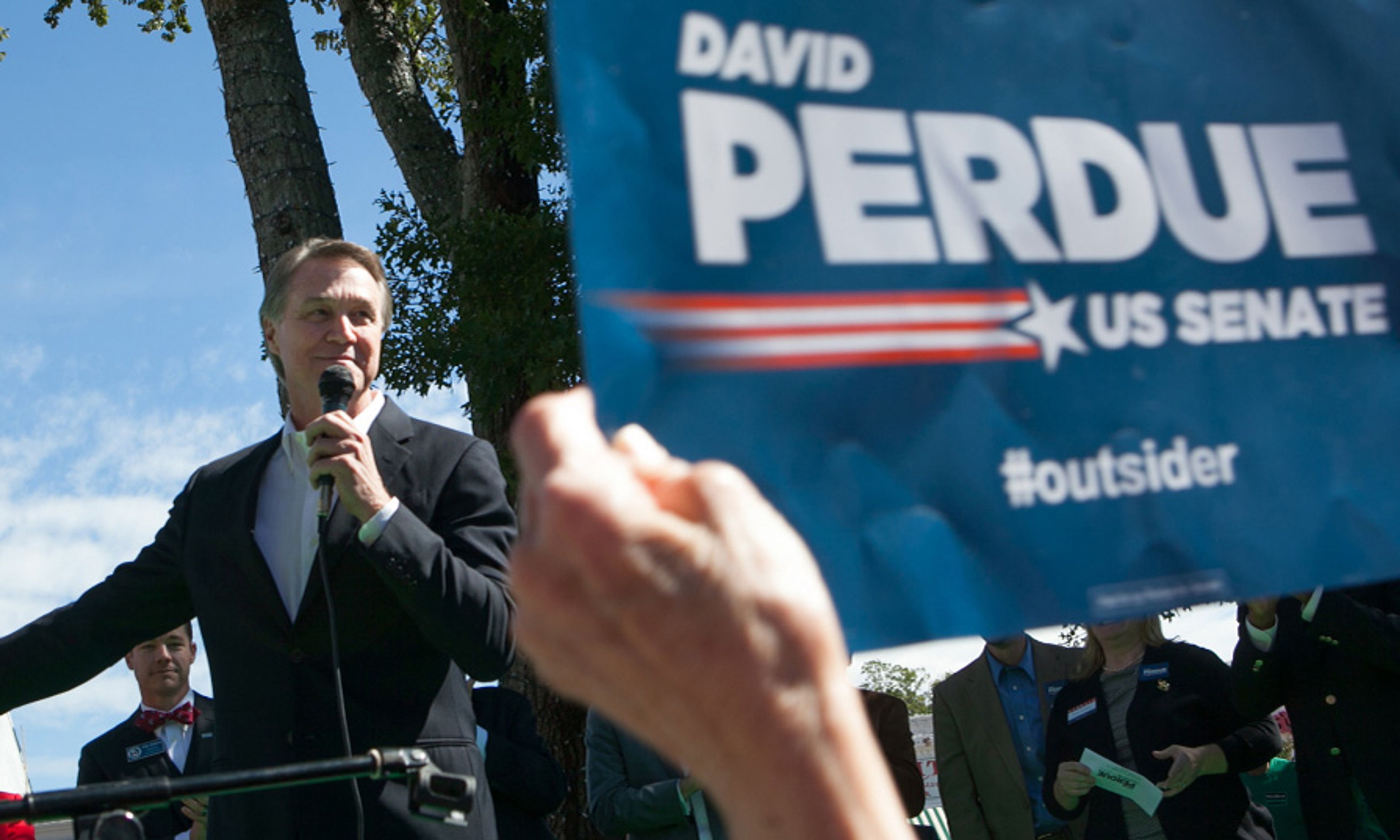
Savannah, Ga. — A crowd of about 60 is gathered outside the dilapidated offices of the Chatham County Republican Party headquarters awaiting the arrival of their Senate candidate, David Perdue. Across the street, what looks like an abandoned garage houses a business that promises to let you “show off your ride” by outfitting your car with spinning rims.
Eventually, the Perdue campaign’s RV pulls into the parking lot. Aides stream off single file, but not the candidate. Perdue, the 64-year-old businessman, steps out of a shiny black SUV. Throughout the race, he has called himself “the outsider,” and the term is emblazoned across the side of his RV. Seeing him, though, it seems an odd label. Tall, tanned, and spry, Perdue is a political candidate from Central Casting. The millionaire first cousin of former Georgia governor Sonny Perdue, he has sat atop corporations from Reebok to Sara Lee to the discount chain Dollar General.
The Senate race here, where Perdue seems to have a slim lead over Democrat Michelle Nunn, the daughter of the state’s beloved former senator, Sam Nunn, is in many ways reflective of the broader political landscape: Even as polls suggest that trust in politicians and institutions is dropping to historic lows, voters are choosing among candidates to the manor born.
Such politicians are everywhere this year, and they aren’t generating much enthusiasm. In Alaska, Senator Mark Begich, son of a former congressman, is fighting for reelection. In Arkansas, Senator Mark Pryor is trying to hold the seat long occupied by his father. In Colorado and New Mexico, first cousins Mark and Tom Udall, the Democratic cousins of former Republican Oregon senator Gordon Smith and of current Republican Utah senator Mike Lee, are running for reelection. In Louisiana, Mary Landrieu, daughter of former New Orleans mayor Moon Landrieu, is gunning for a fourth term. Shelley Moore Capito, a West Virginia congresswoman, Republican Senate candidate, and daughter of the state’s former governor, Arch Moore, is the only one of the lot who seems to be inspiring much confidence.
In Georgia, the race, once considered something of a lock for the GOP, has narrowed dramatically in recent weeks. If Perdue fails to win 50 percent of the vote on Tuesday, he will face Nunn in a January 6 runoff election that will for two months become the center of the political universe. The race has been so tight that one top Republican tells me that Democrats made a mistake spending money in states such as Kentucky and South Dakota, where they have little chance of eking out a victory. Had they poured it into Georgia, he says, they could’ve emerged victorious. The trouble is, while a relatively boring legacy candidate such as Mitt Romney didn’t pass electoral muster in 2012, in 2014, if he’s a Republican, he just might.
Perdue hasn’t hit the 50 percent mark in any survey in over six weeks, but Republicans remain hopeful he can do so on Election Day. And if Tuesday’s election doesn’t decide things, the GOP still is optimistic: Republicans have won eight of the last eight general-election runoffs in Georgia. In 2008, the most recent Senate runoff, Republican incumbent Saxby Chambliss finished just three points ahead on Election Day but expanded his margin of victory to 15 points in the runoff.
This year, neither candidate has inspired much enthusiasm. The campaign has proved a push-and-pull between the environmental factors that favor the GOP and the candidates themselves, where the matchup favors the Democrats. Perdue’s business record, in particular — he’s been accused of outsourcing jobs — has given Democrats ample material to pick through.
Nunn is a plain Jane with qualities that, in the words of a top GOP strategist, “make her appear more centrist” than she is. Chief among them is her last name. Nunn, who went by her married name for most of her adult life, quickly reverted to her maiden name to run for office. She’s proved to be a good fundraiser, and she lacks the liabilities of other Democrats. As an East Coast girl who returned to Georgia to be handed control of a nonprofit, she has no voting record and no business record to attack. “She actually never voted for Obamacare and any of the other junk in Washington,” says the strategist.
On the campaign trail, Perdue has sold himself as a Fortune 500 CEO who can make Washington work. He hammers away at President Obama and homes in on economic issues.
Back at the offices of the Chatham County GOP, it feels . . . fine. Perdue is well-spoken but vanilla — at times, nearly soporific. President Obama, he says, “sold a bill of goods in 2008” and has been “one of the most divisive presidents in our time.” Were audience members aware that the national debt has skyrocketed on Obama’s watch? Now they are.
On the wall behind him hang portraits of George W. Bush and Dick Cheney that have faded in their frames. Adjacent to them, a life-sized cardboard cutout of a grinning Bush bears a sash that reads, “Miss me yet?”
Perdue, too, feels like something of a throwback. Standing there in his crisp jeans, white shirt, and navy blazer, hammering the president relentlessly for his failure to revive a sagging economy, it’s hard not to think of Mitt Romney on the stump in 2012. “Barack Obama wants Michelle Nunn to go to Washington and fight for him,” he says. “I want to go to Washington and fight for you.”
Perdue has had to reckon with some of the same attacks Romney did, including, at times, his attitudes toward business that don’t sit well in working-class Georgia. Asked to defend his remark, in a 2005 deposition, that he had spent “most of his career” outsourcing, he said: “Defend it? I’m proud of it.” “This is a part of American business, part of any business. Outsourcing is the procurement of products and services to help your business run. People do that all day.” His outsourcing past has been the subject of several attack ads.
But as with Romney, one gets the sense that there’s more humor, more edge, and more resolve beneath the surface than the candidate, under the tight control of political advisers, reveals on the stump. When I asked him if he blamed Republicans such as Newt Gingrich and Rick Perry for first leveling the outsourcing argument — against Romney in 2012 before the Obama campaign had — he says he doesn’t, and he offers a gracious smile. Then, as he walks toward his campaign bus, he turns around. “You know, the thing about,” he says — but he stops himself short.
The trouble for Democrats, both in Georgia and across the country, is that Romney’s personal discipline and boring competence are looking much better to a lot of voters right now.
— Eliana Johnson is Washington editor of National Review.






Comments