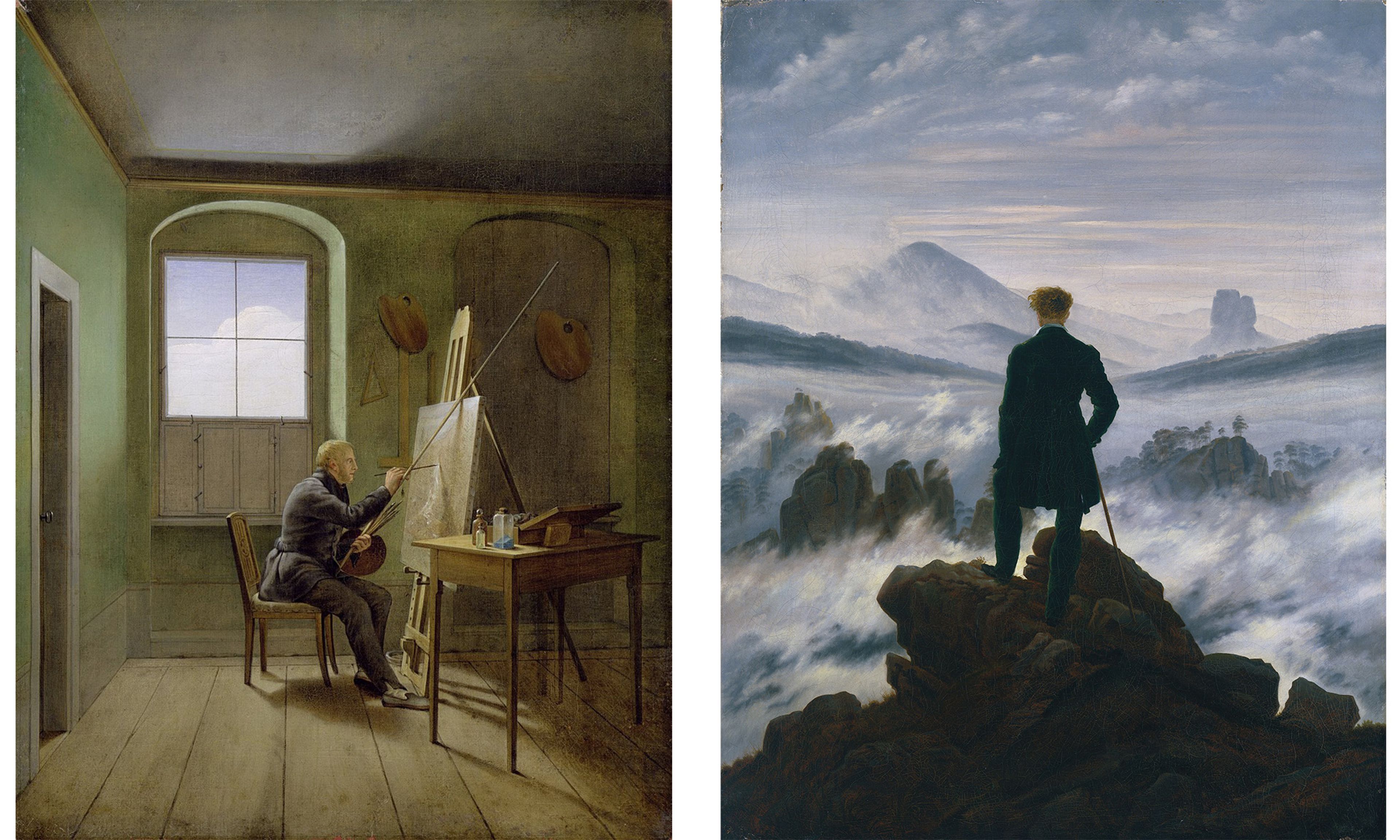
Caspar David Friedrich’s Wanderer Above the Sea of Fog is an entire epoch in a moment — a single figure, anonymous and back to us so he’s every one of us, his thoughts his own, on top of a world swathed in fog and clouds. He’s a man as well as a monument. Nature seems to defer to him, at least compositionally, with the peaks, slopes, and mist oriented around him, but nature’s doing a striptease, too, hiding more than it shows. He’s big but finite. The sky is vast and fathomless. Defer as it might for picture-making purposes, nature has the last say in the matter of life. It doesn’t really seem to need us. Friedrich (1774–1840) painted it in 1817, while he was living and teaching in Dresden, and though the picture’s now famous, it, Friedrich, and the rest of his work were forgotten for years.
Though Two Men Contemplating the Moon and Monk by the Sea are also part of most art lovers’ visual stock, and they’re in the Met show, Friedrich is neither well known nor well understood in America, or outside Germany. Caspar David Friedrich: The Soul of Nature, the Met’s new Friedrich survey, is the revelation we need on the 250th anniversary of the artist’s birth. He’s unique and unforgettable. His work is also moody, provincial, and religious, intractable and inscrutable at the same time.




Comments