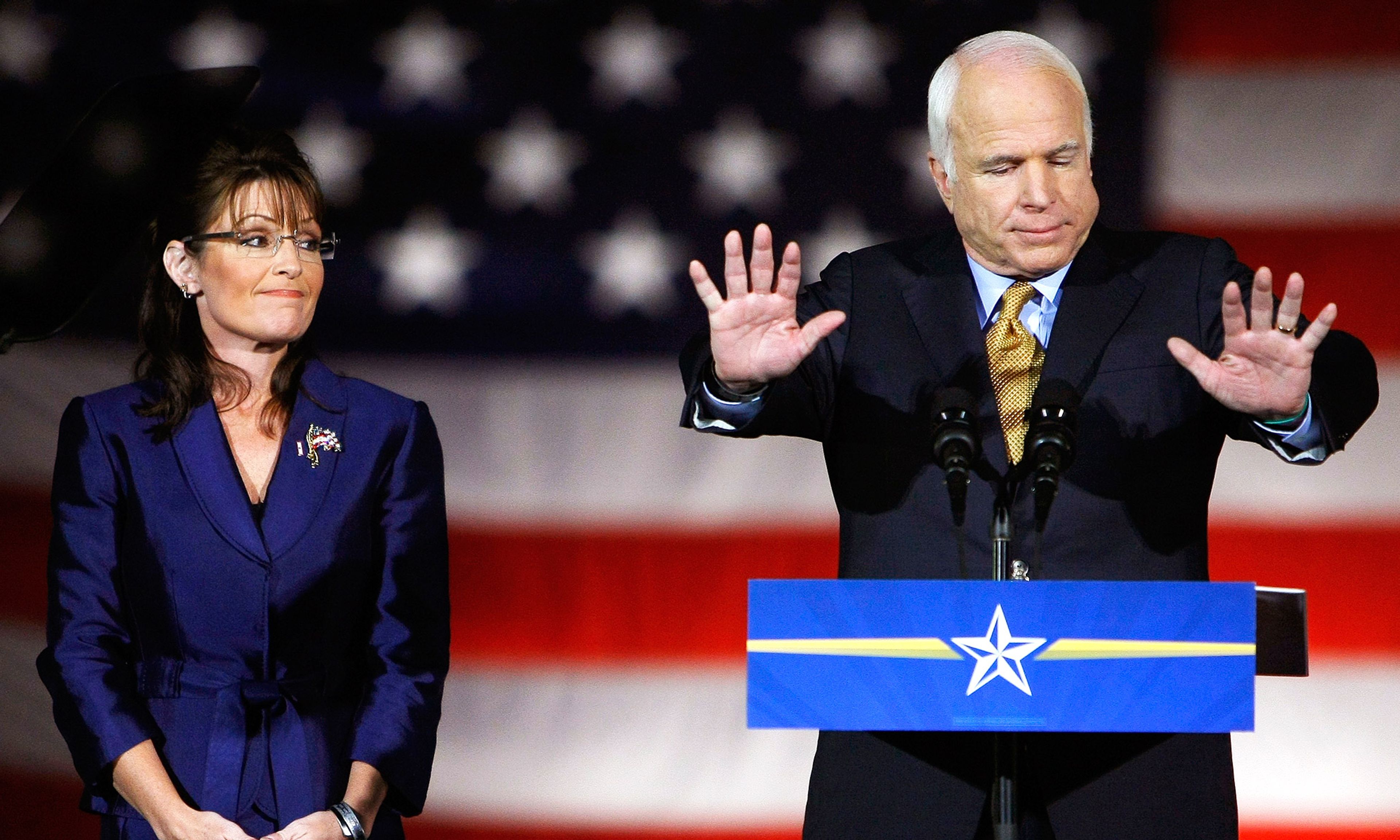
Every losing presidential campaign is, to paraphrase Tolstoy, unhappy in its own way. But the McCain campaign in its final days risked descending into political opera buffa. A few days after the election, McCain aides were telling reporters different things about whether longtime McCain foreign-policy adviser Randy Scheunemann had been fired in the campaign’s final week.
Thus was the sad, sloppy end of the McCain campaign. It had punched above its weight in August and into early September. Then the financial crisis hit, and it spent a dreary month and a half slogging toward an almost inevitable defeat made all the more inglorious by the incredible acrimony around vice-presidential nominee Sarah Palin.
Talking to former aides about basic events surrounding Palin, you’re struck by how often people contradict one another and say, “That’s a lie” or “That’s bullsh**.” The other phrase you’ll hear frequently about the end of the campaign is “I am just trying to keep my head down.” The old joke about the Democrats is that they form a circular firing squad after losing elections. The McCain campaign may have formed a circular firing squad, but can’t agree on who fired first, where the guns came from, and who should or shouldn’t have paid for them.
The campaign won the Republican nomination with a minimal operation not up to the rigors of a general election but in keeping with McCain’s ramshackle style. It wasn’t until July, when former Bush aide Steve Schmidt took over daily operations at headquarters, that the campaign tightened up. “We couldn’t operate a TelePrompTer properly,” one aide recalls. “There was no message. It was technically incompetent. We had just 35 people on staff, facing a juggernaut, with the feeling that it was a virtue that we had only 35 people.”
Things got better, but the campaign was always run by committee. “McCain made all the decisions,” says strategist Charlie Black, “and there were four, five, six people he wanted to hear from.” Those included Schmidt, Black, campaign manager Rick Davis, longtime McCain speechwriter Mark Salter, and McCain’s two amigos from the Senate, Lindsey Graham and Joe Lieberman.
This decision-making structure could never achieve the status of the well-oiled machinery of, say, Bush ’04 or Obama this year. “There’s not a lot of strong management in McCain World,” says one experienced McCain hand, “and there never has been.” Most McCain staff seemed to accept logistical snafus and organizational dysfunction as a given.
The campaign made a few key decisions. It decided to keep McCain away from a press that turned hostile once he became the Republican nominee. In the media’s telling, this is one of the reasons the campaign was unworthy of McCain and made him an uncharacteristically unhappy warrior. Not so, say McCain’s aides.
“I don’t think he was unhappy because he was not talking to the media,” says Salter. “Everyone, including the candidate, knew there were two standards in the press.” Another top aide agrees: “He knew it. He read everything. I told him, ‘Go to your room at night and watch ESPN. Don’t watch MSNBC. Why are you watching Keith Olbermann’s show?’”
A McCain interview with James Carney and Michael Scherer of Time magazine in August, in which McCain barely responded to the questions, has been widely interpreted as a sign of his distress at being separated from his former buds. Rick Davis says it is nonsense: “He didn’t want to do that interview — he thought they were being jerks.”
In August, the campaign hit Obama with the famous celebrity ads that were panned in the press but were, according to Davis, the only thing that ever dented Obama’s favorable ratings. In retrospect, the celeb spots were relatively gentle. The natural follow-on, once they established doubt about Obama, would have been hits on his associations with Bill Ayers and the Rev. Jeremiah Wright.
“We absolutely should have done that,” says one top aide, “but there was no appetite to do that. McCain gave Obama the biggest pass in the history of politics. The Reverend Wright was delegitimized as an issue because of McCain’s actions” — i.e., condemning the North Carolina Republican party in April for running an ad using Wright.
With the selection of Palin, brilliantly rolled out the day after the Democratic convention, and the Republican convention, which Bush addressed by satellite and Cheney not at all, the McCain campaign felt it had achieved three goals that were in tension: creating distance from Bush, exciting the base, and reestablishing McCain’s maverick brand. The aftermath would turn out to be the Indian summer of the McCain campaign, when it briefly led Obama. Until September 15.
Lehman Brothers went down, the financial system began to tank, and Paulson asked for his $700 billion. The package’s prospects were uncertain in Congress, and Harry Reid said McCain had to deliver Republicans. “All the economic advisers and Mitt Romney said something had to pass or people wouldn’t be able to get money out of their ATMs,” Salter recalls. The high command decided to suspend the campaign and send McCain to Washington.
It wasn’t clear what he would do there. “We were marching into a lion’s den in Washington,” says one McCain aide, “and the generals didn’t consider how calamitous the situation was. No two days were more important than those two days, and we lost them.”
“We didn’t do our homework with House Republicans, who didn’t want to support the bill,” says another aide. “Originally McCain was against it,” one top aide explains of the bailout. “But he didn’t want to tank the markets. In retrospect, he probably should have voted against it.”
Steve Schmidt remembers flying on Palin’s plane watching the bill go down to defeat while Republicans implausibly blamed their votes on a Nancy Pelosi speech as “the most surreal moment of my political career.” In an understatement, Salter concludes of the suspension gambit: “As it turned out, it didn’t work too well.”
The week after the Lehman collapse, the campaign suffered another disaster: Palin’s cringe-makingly bad Katie Couric interview, which was worse than her barely adequate Charlie Gibson interview. Her performance stoked the dissension over her, and her handling, that would later burst embarrassingly into the open.
“From the beginning, it was dysfunctional,” one McCain aide says of the campaign’s Palin operation. Palin was handed a bunch of advisers who had no connection to her, very little connection to McCain World, and, in the case of her new chief-of-staff (a friend of Schmidt’s), no experience in national politics. Another McCain adviser remembers being unable from the outset to get a straight answer from the staff on whether Palin had gone into Iraq when she visited the Alaska National Guard on deployment.
Palin’s defenders within the campaign blame the media strategy for her interview troubles: Why were two skeptical-to-hostile network anchors given hours with Palin in interviews that were high-stakes affairs where every word mattered because she was basically doing no other media? “Do you remember how many days we spent parsing her answers on Charlie Gibson?” asks one aide.
But a defender of the rollout strategy counters, “They were standard long-form network interviews. We gave 60 Minutes two hours with McCain.” This aide claims that prior to the Couric interview, “She would not prepare, she didn’t want to.” Other aides dispute that. What Rick Davis says is: “She was under the impression the Couric thing was going to be easier than it was,” expecting a softer interview from a woman journalist. She also had a hectic schedule in New York, packed with meetings with foreign leaders at the U.N., making intense preparation impossible.
Two things aren’t in doubt. One, she showed up as the VP nominee with minimal knowledge of national and international affairs, making her introduction on the national stage tricky business. “We were dumping an awful lot on her in a very short period of time,” says the foreign-policy aide assigned to her, Steve Biegun. The first day Biegun and Randy Scheunemann briefed her at the convention, they spent eleven hours with her. And two, she lost confidence in her media handlers.
Of the Couric interview, in which Palin muffed even easy questions, a pro-Palin aide says, “Look, she choked,” attributing it to her communications team’s undermining her confidence. “The Couric interview destroyed her. Did she stop listening to us? Of course she did.”
There had been a dispute over how to prepare Palin, at least in the telling of McCain aides sympathetic to her. The communications staff wanted to push the policy staff out of the way and brief her with talking points. The policy people wanted to explain to her McCain’s positions on the issues so that she’d come to understand them and then let her come up with the language to explain them on her own.
The communications team seemed to consider her uneducable, while the policy team — aides like Biegun and Scheunemann — was impressed by her. “It’s the difference between considering her someone who lacks knowledge and someone who is incompetent, and they treated her as the latter,” says an internal critic of her handling.
Palin’s fans back at headquarters thought she should have taken control of her own destiny much sooner. “She would have been better served,” says a McCain aide impressed with Palin, “if she had asked for a couple of people to be removed from her traveling staff.”
The clothes fiasco blew everything up. The Politico reported that the campaign had spent $150,000 on clothes. Aides close to Palin say she was mortified and had no idea how much the bill for her clothes had been. Fred Barnes reported on Fox (before retracting the next day) that Nicolle Wallace, a senior aide assigned to Palin, had bought the clothes on her own credit card. McCain aides close to Wallace said it was a bum rap and Wallace was getting thrown under the bus for Palin’s profligacy.
What happened with the clothes? “We flew her out from Alaska to Arizona to Ohio to introduce her to the world and take control of her life,” says Rick Davis. “She didn’t think ‘Dress for the convention,’ because it might have just been a nice daytrip to Arizona if she didn’t click with John. We got her a gal from New York and we thought, ‘Let’s get some clothes for her and the family.’ It was a failure of management not to get better control and keep track of that. The right hand didn’t know what the left hand was doing, what it was worth, or where it was going. It was more our responsibility than hers.”
She was sequestered at her hotel during the convention and couldn’t have gone out to buy clothes if she had wanted to. One Palin aide recalls going into her suite and seeing a seamstress clattering away on a sewing machine and people walking around with racks of clothes.
“She was under the impression she was supposed to do what the campaign told her to do,” says the pro-Palin aide. “They brought in the clothes and told her, ‘Money is no object.’ She had serious concerns about wearing such expensive clothes. She was told, ‘It’s fine. It’s fine.’ Her mistake was she didn’t stand up to the people around her.”
Newsweek’s post-election story had Palin herself allegedly buying clothes from Saks Fifth Avenue and Neiman Marcus. “Everything is going to come out,” says a Wallace defender cryptically, adding that the hostile stories on the clothes are “more true than not.”
Around this time, quotes showed up calling Palin a “diva” and a “whack job,” which the pro-Palin faction attributed to the pro-Wallace faction. The pro-Wallace faction, on the other hand, thought the campaign was being undermined by Palin defenders questioning the campaign’s workings. It got so poisonous that the top echelon of the campaign searched through internal e-mails the last week of the election. Randy Scheunemann was discovered to have sent an e-mail to Bill Kristol defending Palin and complaining about her handling.
Schmidt subsequently told people Scheunemann had been fired. But Scheunemann maintains he was never fired. “If you’re fired, it’s common to have someone say, ‘You’re fired.’ No one told me that,” he says. A sympathizer agrees: “Schmidt was overruled by Rick Davis.” Whatever happened, Scheunemann continued to work in the office and help put out foreign-policy statements. Then Schmidt took another run at him, and his e-mail was cut off.
Rick Davis says, “Schmidt never fired anybody and there was no overruling. He never spoke to Randy in that period of time. Randy Scheunemann was not fired. His e-mail was cut off and put back on.”
Randy Scheunemann is a veteran McCainiac who had stuck with the campaign through its near-death experience in 2007. His ouster would have been extraordinary. “Steve decided he was going to be loyal to Nicolle Wallace no matter what,” says the pro-Palin aide, who saw the campaign dividing between Bush hands like Schmidt and Wallace, looking out for their own reputations above all, and the true McCain loyalists. Others see this as unfair. The ultimate McCain loyalist, Mark Salter, says, “Right to the last day, Steve was fighting.”
By the end, the fight resembled an academic dispute — so vicious because the stakes were so small. The McCain campaign had descended into . . . about what you’d expect of a McCain campaign. “There was no leadership on this campaign, no adult supervision,” says one aide. “Ultimately, it came from the candidate doing his own thing. What was the message of this campaign?” McCain has never reconciled his Goldwater side with his TR side in a consistent approach to policy, and he couldn’t overcome his own fundamental lack of interest in economic issues.
On top of it there was the financial cataract, creating a sense of desperation that had McCain floating $300 billion proposals from the seat of his pants. “We were introducing policy stuff in a crude manner,” says one aide. Another compares it to getting swept down Grade 5 rapids and trying to get a hold on anything, to no avail. “After the middle of September,” Salter says, “it was hard to change the order of things.”
After McCain lost, the internal battle continued, with anonymous quotes grossly distorting things Palin had said during the campaign to put her in the worst possible light. Perhaps McCain had deserved to lose, but not this way, with such a pathetic spectacle at the end. “Look,” one longtime McCain backer says of Palin and the Bushies who handled her, “she wasn’t ready for this, obviously. Their job was to make her ready for this and they failed. So they unloaded on her. If they had an iota of loyalty to John McCain, they wouldn’t have done it.”
The McCain campaign had found its very own way to be unhappy. Rick Davis remarks, “It’s the most juvenile thing I’ve ever seen. It’s inappropriate, uncalled for, and made me sad for our campaign.”






Comments