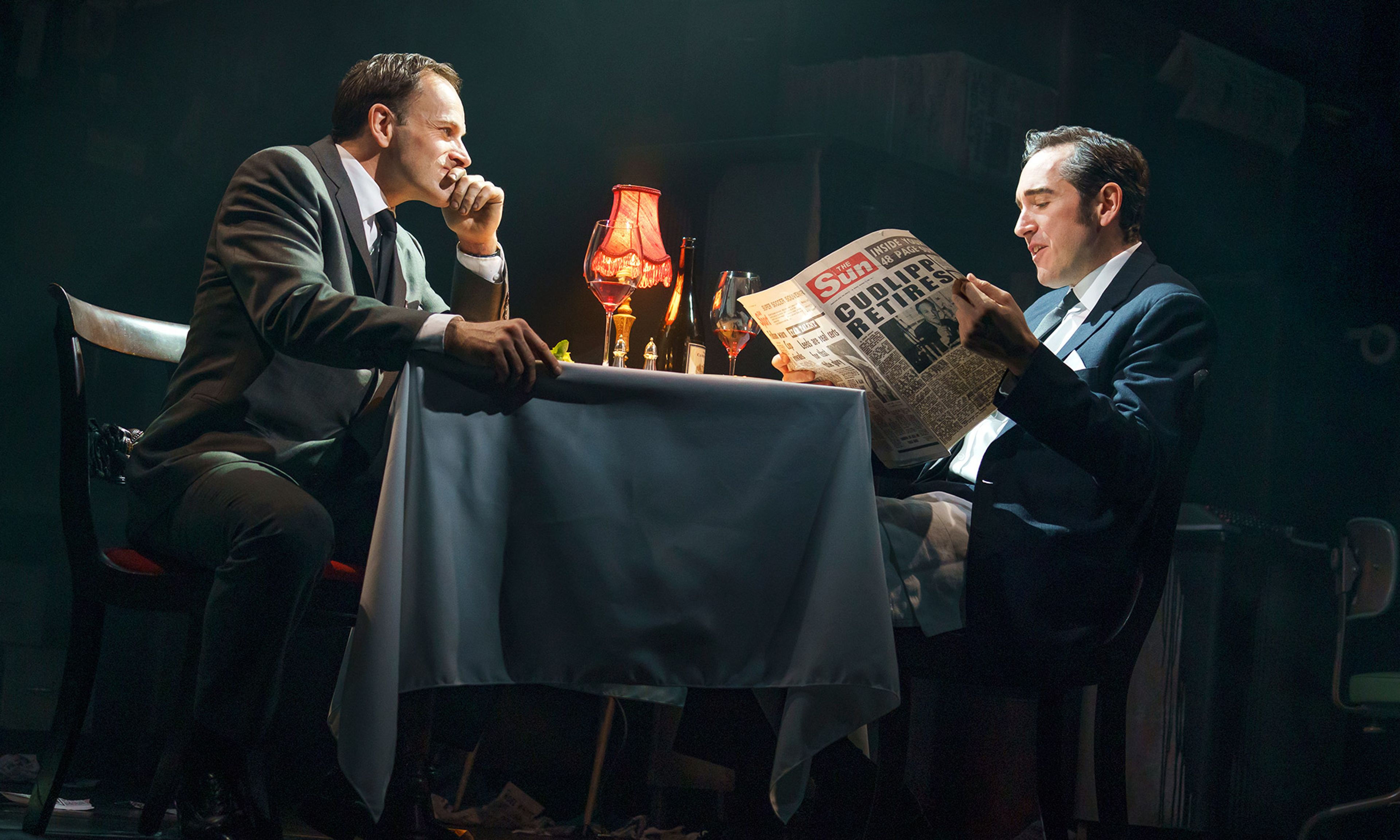
Our liberal friends love to quote Harper Lee’s To Kill a Mockingbird, “You never really understand a person until you consider things from his point of view . . . until you climb in his skin and walk around in it.” Does that go for Rupert Murdoch then? Because Murdoch, like Mockingbird, is suddenly big on Broadway.
To my surprise and pleasure, Ink, a zingy play about Murdoch’s explosive entry into the London newspaper market in 1969, isn’t a shallow hit piece, as you’d expect, but a robustly entertaining and measured work that dares to consider events from Murdoch’s point of view.
Since I happily spent many years working for Murdoch newspapers, including the one this play deals with, I’m not the guy to go to if you’re looking for a disinterested opinion on the man or his papers (although, contra thousands of angry emails I’ve gotten over the years, I’ve never had a meaningful conversation with the New York Post’s proprietor, much less taken marching orders on what to write in my columns). Ink celebrates Murdoch as a gutsy outsider who disrupted an industry, blew up the conventional wisdom, democratized the media, made shedloads of money, and had himself a lot of laughs at all the fools he humiliated along the way.
Written by James Graham, Ink (at the Samuel J. Friedman Theatre through July 7) begins in 1969, when Murdoch buys a sleepy broadsheet called The Sun and gives it an extreme makeover to which all other extreme makeovers should be compared. Murdoch, vigorously if eccentrically portrayed by Bertie Carvel (who doesn’t evoke the actual Murdoch in any way I can perceive), hires a former editor at The Daily Mirror, Larry Lamb (a ferociously committed Jonny Lee Miller, familiar to TV audiences from his role in Elementary), and urges him to throw out the rulebook. But revolutions have consequences.
Desperate to catch the world’s best-selling paper, then the Mirror, Murdoch brings in huge typefaces, a new logo, italicized headlines, and a brash voice, turning his paper into a tabloid and aiming at the masses via such innovations as extensive TV listings while finding clever solutions to intractable problems. The paper had to go to press before the evening sports matches, so the sports editor had to fill his pages with bloke-at-the-pub attitude instead of recaps.
Ink, which takes place on a gorgeously grimy set that portrays the literally dirty news business as a sort of semi-dormant volcano of battered editors’ desks, captures much of the bonkers energy of tabloids with all of their mischief and ingenuity. Assembling the front page in an era when newspaper type meant actual pieces of metal set in trays, Lamb discovers the printers are in possession of only three letter E’s large enough for the front-page splash, so the word “exclusive” has to go. He prays nothing happens to the Bee Gees.
The Sun hurls Britain into the Seventies in a nutty, Benny Hill–style musical sequence in which the paper staffs up and starts knocking down Fleet Street traditions. Some of the jokes and references will baffle Americans, even American journalists (editors known as “subs” who heavily rewrite stories are crucial to British papers but aren’t much used in the States), and I wouldn’t say Ink goes terribly deep into the details of newspapering. Nevertheless it’s a smart piece of entertainment that both recognizes the fun of the game and gives serious consideration to what a media outlet should be. In a TV interview, Murdoch says, “I don’t agree that it’s sleazy; I think it’s fun, and I don’t like this term ‘downmarket.’ Who is the arbiter of what is up and what is down. Is it you?”
How far should one take this principle of giving the people what they want, however? The matter gets harrowingly dramatized using a true incident I hadn’t known about: The wife of an editor at the paper was kidnapped by thugs who, incensed by Murdoch’s televised comments, sought to abduct his then-wife, Anna. Lamb decides to cover the story just as he would any other crime saga, sensationalizing it to the hilt, though Murdoch, who is in Australia at the time, expresses strong misgivings about his editor’s approach. Everyone involved wonders whether the paper made a bad situation worse, and the final chapter of the story is ghastly. Yet the play is thoughtful and balanced about such troubling questions. One longtime Sun editor who knew all the principals, Kelvin Mackenzie, declared the play captured the paper “exactly as I remember it.”
The Sun approached sex in an even more shocking way: Lamb, needing one last gambit to catch the Mirror in sales, starts putting pictures of topless women on page 3, again despite Murdoch’s objections. Ink handles the questions raised with sensitivity and maturity, and Miller does some of his most nuanced acting as Lamb, slightly disgusted with himself, explains to a young and vulnerable model what he’d like her to do. This was a defining moment for British media (just as The Sun’s decision to stop publishing “Page 3 Girls” in 2015 would be another), and the play gives it its due importance. Ink may pay tribute to a notorious tabloid, but amid all the larking about, it has a judiciousness and a seriousness of purpose that ought to shame the way the highbrow media outlets normally cover Murdoch’s enterprises.






Comments