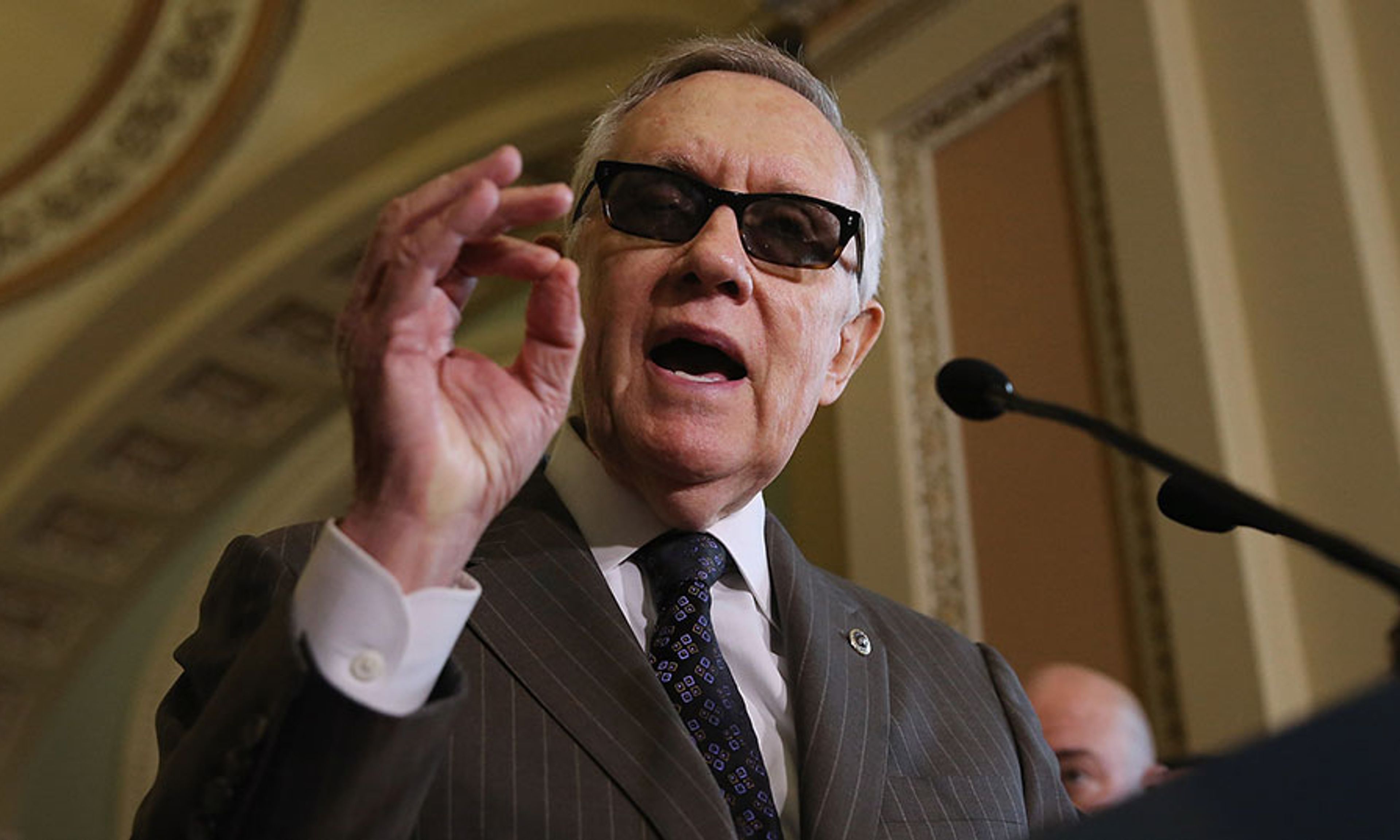
Senate Minority Leader Harry Reid (D., Nev.) endorsed President Obama’s nuclear deal with Iran on Sunday, an announcement quickly followed today by Senator Debbie Stabenow’s (D., Mich.) own decision to support the deal.
Reid has long been viewed as a dark horse in the Iran debate, but he removed all doubt Sunday. “I’m going to do everything in my power to make sure the deal stands,” he said, adding that that includes pulling out all the stops to rally other Democrats.
Although Israeli prime minister Benjamin Netanyahu opposes the deal strenuously, Reid touted the agreement as the best way to protect Israel. “At the end of the day, there is no doubt in my mind that the threat of Iran gaining a nuclear weapon — the one outcome we all agree is unacceptable — is far more likely if Congress rejects this agreement,” he said.
That puts the retiring Democratic leader at odds with his successor, New York senator Chuck Schumer, who announced his opposition to the deal earlier this month. “If Iran’s true intent is to get a nuclear weapon, under this agreement, it must simply exercise patience,” Schumer wrote on August 6. “After ten years, it can be very close to achieving that goal, and, unlike its current unsanctioned pursuit of a nuclear weapon, Iran’s nuclear program will be codified in an agreement signed by the United States and other nations.”
#related#Schumer’s statement came just hours after the junior senator from his state, Kirsten Gillibrand, announced that she would support the deal. Reid’s endorsement of the agreement preceded Stabenow’s announcement of support. “For me, the decision comes down to this: without this international agreement, Iran will have enough nuclear material for a weapon in three months,” she said Monday morning. “With this agreement, and the international coalition committed to it, we have the opportunity to stop Iran from ever getting a nuclear weapon, certainly for 25 years.”
Reid and Stabenow are the 27th and 28th Senate Democrats to announce that they will support the deal, while just two — Schumer and West Virginia’s Joe Manchin — publicly oppose it. President Obama is expected to veto the resolution expressing Congressional disapproving of the deal if it reaches his desk, a move that can only be overridden if twelve Senate Democrats cross party lines to vote with Republicans.
— Joel Gehrke is a political reporter for National Review.






Comments