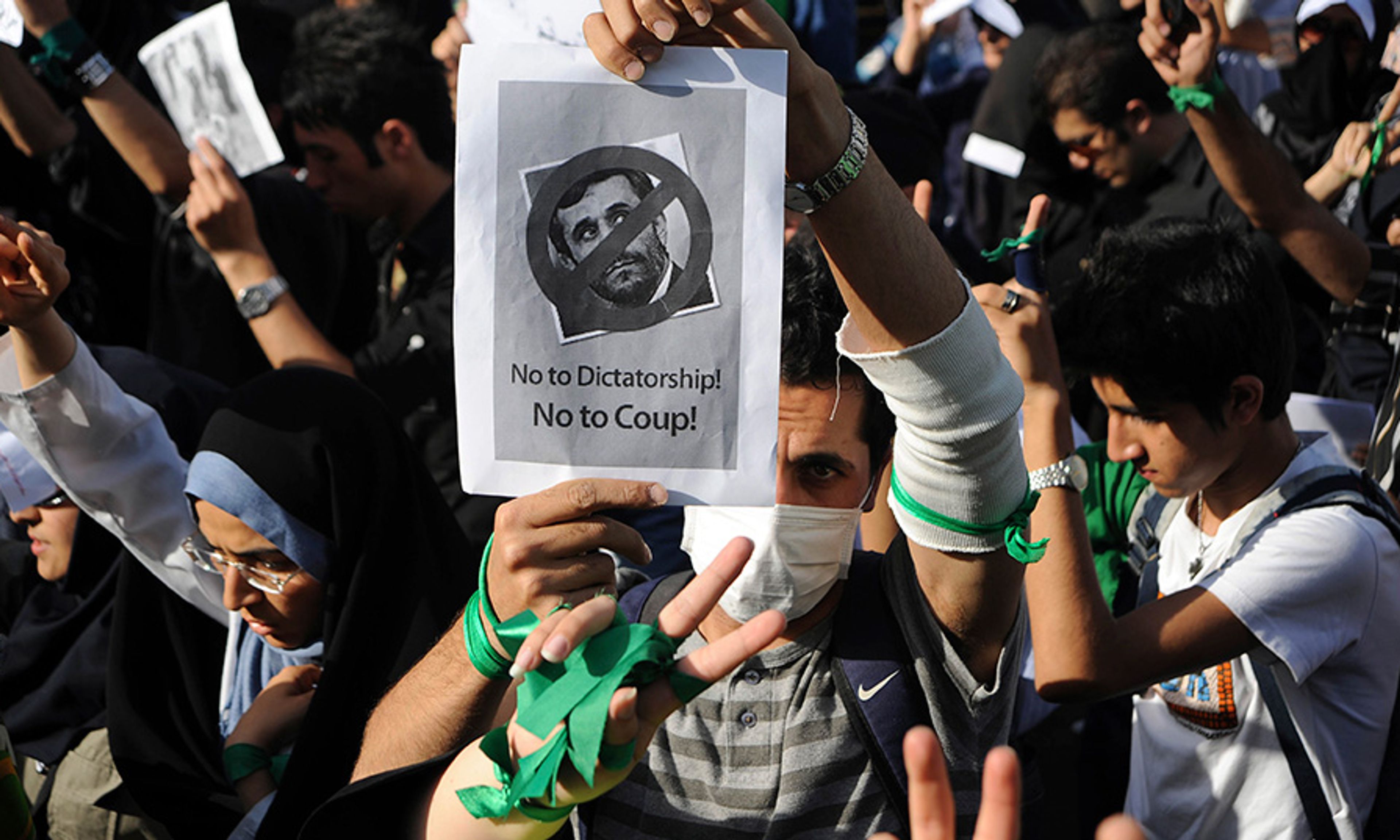
In June of 2009, five months after President Obama began his first term, Iran had a presidential election. According to Iran’s Government, devoted-Islamist incumbent Mahmoud Ahmadinejad won with 62 percent of the vote. According to hundreds of thousands of Iranians, the vote was rigged. They were probably right: the Guardian reported that several hundred balloting stations recorded turnouts of at least 95 percent of registered voters. At least 30 stations — or at least 70, according to some sources — reported turnouts of over 100 percent. Reports of ballot-box stuffing were myriad.
Hundreds of thousands of Iranians marched down boulevards and into city squares to protest. Not only did the protests spread all over the country, they spread to the very powerful clerical class, and even to members of the government. According to Grand Ayatollah Hossein-Ali Monazeri — a prominent figure in the ’79 revolution; a prominent, influential figure in contemporary Iran — the government was guilty of “declaring results that no one in his right mind can believe, and despite all the evidence of crafted results . . . in front of the eyes of local and foreign reporters, attacked the children of the people with astonishing violence. And now they are attempting a purge, arresting intellectuals, political opponents and scientists.” Clerics were put under house arrest. Social-media and news websites were shut down. Protesters were arrested, tortured, and murdered, but the protests went on, all summer and into the fall. To serious outside observers, it looked as if the toppling of one of the world’s most destructive, violent, and criminal regimes was imminent.
The protesters’ de facto leader was Mir-Hossein Mousavi, a reformer who was, according to the government, the election’s big loser. As a presidential candidate, Mousavi wanted to permit privately owned television stations, encourage a free press, end the Supreme Leader’s direct control of Iran’s law-enforcement, abolish the Islamic “morality police,” increase personal freedom and government transparency, and seek rapprochement with the United States.
Obama’s press secretary responded to the “Persian Awakening” by saying that the protests were “a debate inside of Iran for Iranians.” Obama himself told CNBC that “the difference between Ahmadinejad and Mousavi, in terms of actual policies, may not be as great as has been advertised.” The protests, receiving no US support, came to nothing. Hundreds of protesters were killed, thousands were arrested, and the government lived to fight another day. (At least it lived on in penury — until the windfall of Obama’s JCPA nuclear deal.)
But the spirit of 2009 hasn’t been completely stamped out. Last week, thousands of Iranians gathered at the tomb of Cyrus the Great, on the anniversary of his birthday, to protest the Islamic regime. Cyrus the Great, of course, founded the first Persian empire. He was, generally speaking, a benevolent ruler, an innovator, a reformer, and — somewhat ironically, given Persia’s contemporary rulers — a Zionist who famously emancipated the Jewish slaves of Babylon and repatriated them to Israel.
Cyrus remains a revered figure among Iranians, and at his tomb, in Pasargadae, in south-central Iran, thousands of them assembled to chant “Iran is our country, Cyrus is our father.” Some chanted “freedom of thought is impossible with the mullahs,” and others, “freedom of thought cannot take place with beards,” a reference to the appearance of orthodox Islamists. Some chanted “clerical rule is synonymous with only tyranny, only war,” some “no Gaza, no Lebanon — my life for Iran,” and some, “forget about Syria, think about us.”
Iranian brownshirts tried to snuff out the protest. Reportedly, they cancelled tours to the tomb, sealed off roads to Pasargadae, shut down local internet connections, and banned locals from hosting guests. The organizers have been arrested, along with, says a state prosecutor, “the initiators of the inappropriate slogans against the regime’s values.” At least one of those initiators, an Iranian Poet named Mohammad Reza Aalia Payam, was severely beaten by Iranian security forces. Before he was arrested, he recited some of his work for the crowd and posted video of the dissident chants to social media. Now he’s been hospitalized.
There is no word yet on what happened to the less well-known dissidents. But one thing we do know for certain is that the Persian yen for freedom hasn’t been extinguished. It will be up to the next president to protect it, and stoke it as much as he can.





Comments