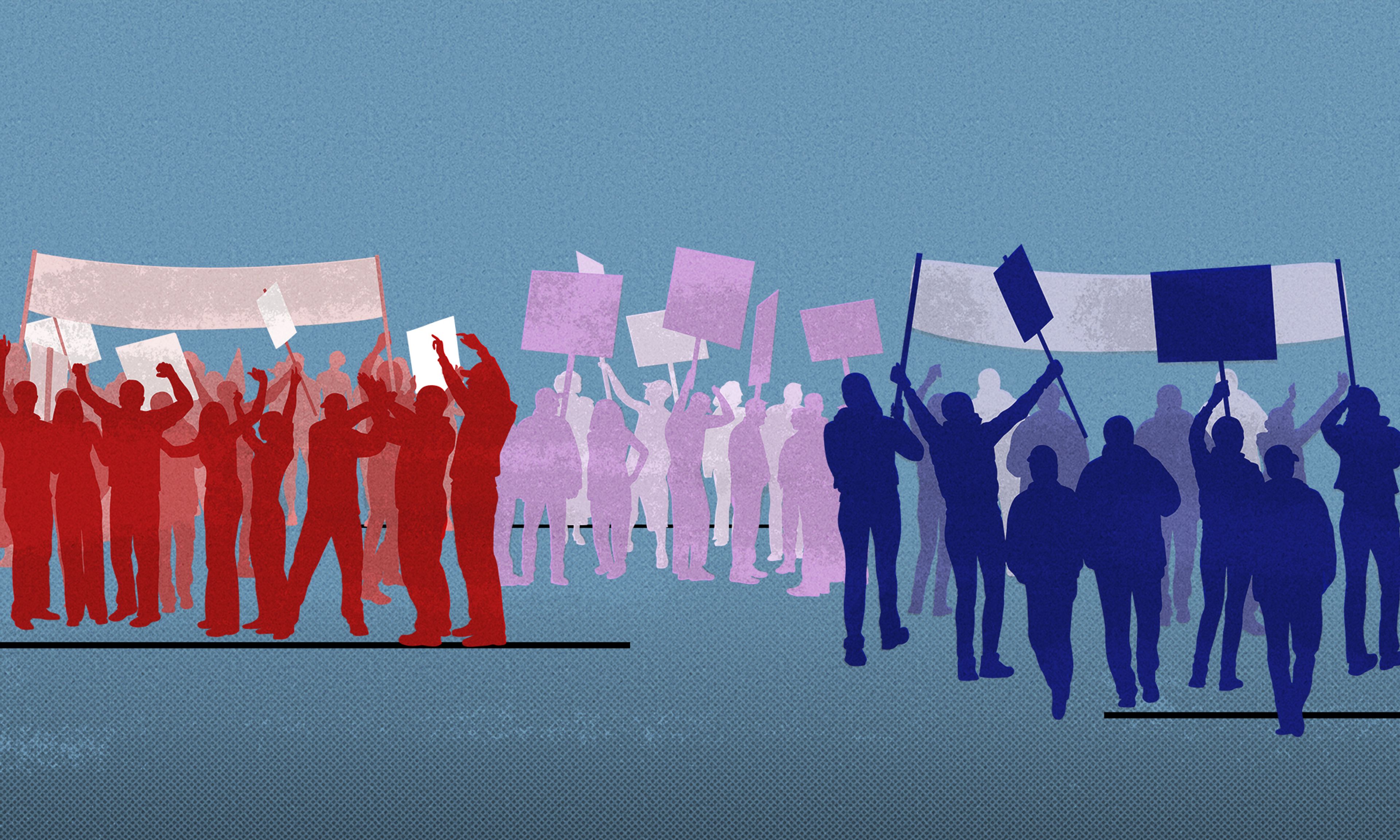
‘Tribalism” is an increasingly popular word. In a heated panel discussion on a recent Piers Morgan Uncensored episode, Rikki Schlott said the following: “I hate this argument that because some people were tribal we should be tribal too. Shouldn’t we want to live in a society where we say tribalism is bad in general and negative in general, and so therefore we should be erring towards individualism and not fighting tribalism with more tribalism?” She was, I think, referring to racial tribalism specifically, since the panel addressed the controversy surrounding Shiloh Hendrix, a white woman who directed a racial slur toward a black child. But others use “tribalism” to describe broader cultural and political tensions. James Lindsay employs “tribal” as a pejorative on social media when arguing with others, and he insists that “‘tribe over truth’ is low-IQ and beta.” Joel Berry, the Babylon Bee’s managing editor, wrote that “Black American culture is infected by racism, pride, hatred, and tribalism. It’s not something for Western culture to aspire to or emulate.” (Barry also stated that “I’m tribal. My tribe is the people of all races who live in the Truth, love their neighbors, and do the will of God.”) The word keeps getting thrown around without precision, so I have to ask: What is tribalism, and why is it necessarily bad?
First, let’s look at the “official” definitions. “Tribalism,” as stated in the Oxford English Dictionary, is (a) “the condition of existing as a separate tribe or tribes; tribal system, organization, or relations,” and (b) “loyalty to a particular tribe or group of which one is a member.” Such definitions just seem to describe commitment to a group and don’t readily lend themselves to the notion that tribalism is immoral. “Tribe,” however, has many definitions: one is “a group of people forming a community and claiming descent from a common ancestor,” another is “one of the traditional three political divisions or patrician orders of ancient Rome in early times,” and yet another is “a gang of criminals or delinquents.” Notably, “tribe” doesn’t apply exclusively to humans, since it is also defined as “a group in the classification of plants, animals, etc.” The only generalization that applies to all the meanings of “tribe” is that it references a group; membership can be conditioned on biology, politics, conduct, or something else entirely. Again, based on these definitions, a tribe isn’t intrinsically bad.




Comments