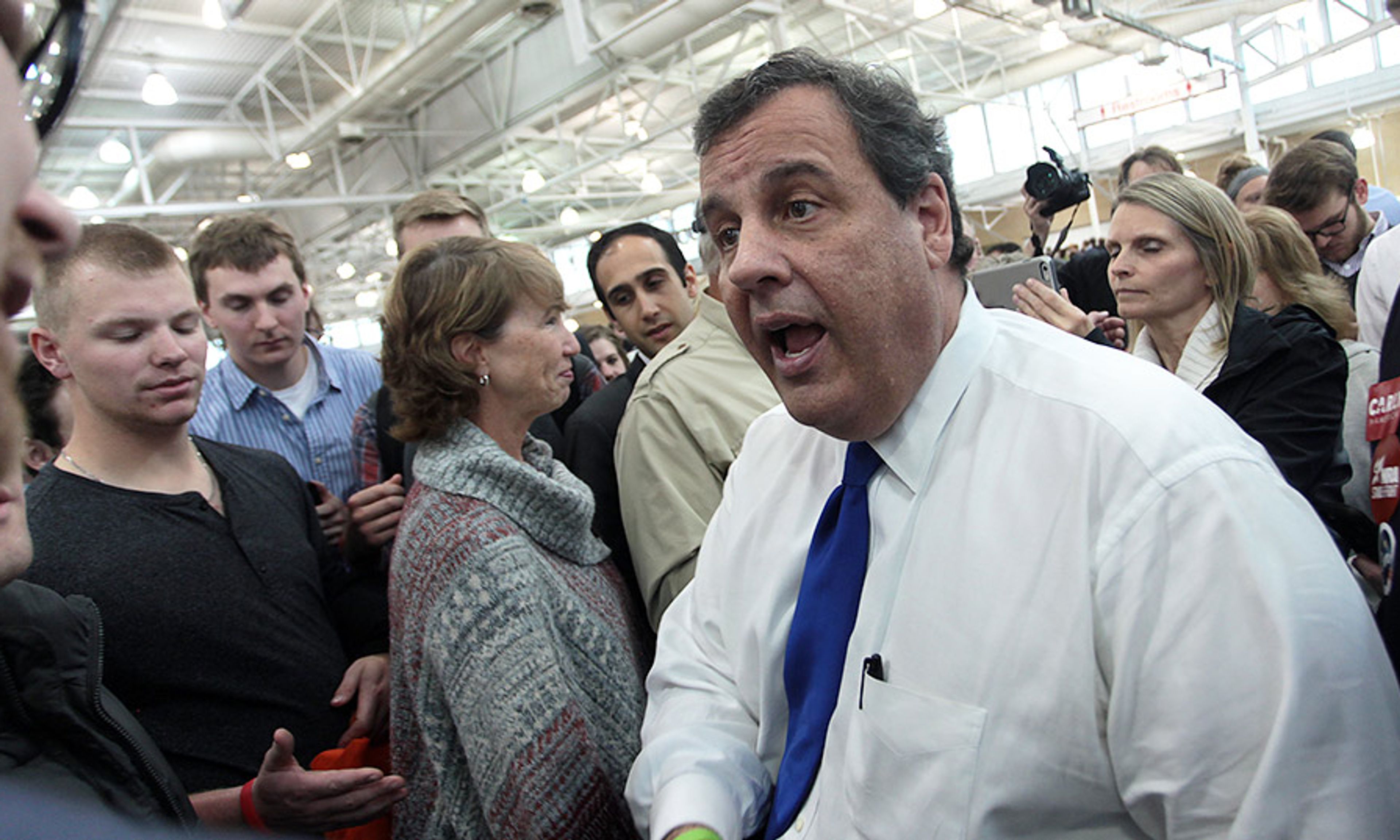
The most interesting fight in Iowa could be one few people are watching.
All eyes in the Hawkeye State are on Ted Cruz and Donald Trump, duking it out for first place. But another battle is going on between candidates who believe they can chalk up a win at the caucuses, even if they don’t come in first.
“Iowa always provides at least one surprise,” says Jamie Johnson, a GOP activist in the state. A candidate who defies expectations but falls short of first can often get just as much ink as the caucus winner.
Jeb Bush and Chris Christie want to be that candidate.
The battle to be the establishment’s standard-bearer has largely been waged in New Hampshire, where Bush, Christie, John Kasich, and Marco Rubio have been locked in a free-for-all. But how they finish in the Iowa caucuses could help one of those candidates stand out from the pack as they move on to the next contest. No one expects Bush or Christie to do particularly well in the Hawkeye State, where they have spent little time and where Cruz and Trump have dominated the polls for months. Yet both camps are hoping that beating the other in the caucuses, and putting on a surprisingly strong showing, could give them some tailwinds as the race moves to the Granite State.
Christie has started spending more time in Iowa in recent weeks, and his campaign has been fairly open about why.
“Our goal is to exceed expectations in Iowa, particularly as it pertains to Bush,” a Republican close to the Christie campaign tells National Review. “That would be a really good night for us. And then everything else is kind of secondary.”
Christie’s team aims to make sure their man is “the last governor standing,” says an adviser to the campaign. And that means beating Bush and Kasich. But Kasich has spent the least amount of time in Iowa of any Republican other than Jim Gilmore, and Republicans in the state do not see him as a significant factor.
A candidate who defies expectations but falls short of first can often get just as much ink as the caucus winner.
Christie’s campaign knows he will not win Iowa, where recent polls have him at around 4 percent support. But he’ll be back there this weekend, and the campaign has reserved television-ad time for the final week before the caucuses. The efforts have been successful in generating some buzz around Christie in the Hawkeye State, GOP insiders say. As chairman of the Republican Governors Association in 2014, he spent helping Governor Terry Branstad win reelection, and it’s helping him now: His campaign is stocked with staffers loyal to Branstad, who became the longest-serving governor in U.S. history late last year.
“Doing better than expected helps us have a strong showing in New Hampshire. . . . And it does put pressure on the so-called establishment candidates,” says the Christie adviser.
Bush, if anything, is looking at even lower expectations in Iowa than Christie. But beating the New Jersey governor would put some wind in his sails as he heads to New Hampshire and its friendlier electorate.
“Our goal is to compete hard in our lane and exceed expectations,” says Bush-campaign senior strategist David Kochel, an experienced Iowa operative who ran Romney’s 2008 and 2012 operations in the state. That means beating Christie and Kasich.
Bush supporters point to their organization in Iowa, which they say is a well-oiled machine — a crucial component to success in the caucuses, where the ability to turn out voters can be a campaign’s most powerful weapon.
As the caucuses near, the Bush and Christie camps are training a lot of fire on Rubio. Bush’s super PAC has come out with ads and mailers attacking him, while Christie recently told radio host Laura Ingraham that if he were the nominee, Hillary Clinton would “cut his heart out” in a general election. It’s a strategy geared toward New Hampshire, where the three of them are fighting with Kasich for oxygen.
But in Iowa, Rubio is in a different league: He has spent more time there, is running ads on television, and has consistently polled in the top three among likely caucus-goers, while Christie and Bush languish in a distant fifth or sixth. What’s more, he’s made obvious efforts to appeal to voters aside from the Mitt Romney supporters who would be most likely to back Christie or Bush. He’s positioned himself to siphon off at least some of the support that might otherwise go to Cruz, and neither Christie’s campaign nor Bush’s describes him as a direct competitor in the caucuses.
But by refusing to cede Iowa entirely, Christie and Bush might be able to eat into Rubio’s vote totals. And in a state where just 120,000 voters showed up to caucus for Republicans in 2012, a few thousand extra supporters could provide an opportunity to prevent the Florida senator from using Iowa as a launching pad into New Hampshire.
The big question is just how deep the pool of votes will be for the so-called establishment candidates. Romney won 25 percent of caucus goers in 2012, but it’s not clear how many of his supporters will back a similar candidate this time around. Cruz, by all accounts, is stronger and has wider appeal than Rick Santorum in 2012. Trump’s support is not easily pigeonholed, either, and he could draw some voters who would otherwise consider Bush, Christie, or Rubio. On a cold winter night in February, it’s hard to know if those Romney voters will be sufficiently convinced by anyone in the current field to even show up.
With such a small slice of the pie to go around, it could be difficult to find enough daylight to credibly declare victory. “You’re not going to be able to spin a win if it’s all jumbled up,” with the candidates within one or two points of one another, says one Iowa GOP strategist. At that point, the strategist says, it’s basically a push.
And in that case, it’s on to New Hampshire.
— Alexis Levinson is the senior political reporter for National Review.






Comments