British politicians do not often survive votes of no confidence in their leadership. For a prime minister, a loss in a confidence vote is typically the catalyst for a snap general election, if not a mortal wound. A leader, it is said, cannot carry on without the approval of the members of parliament he commands.
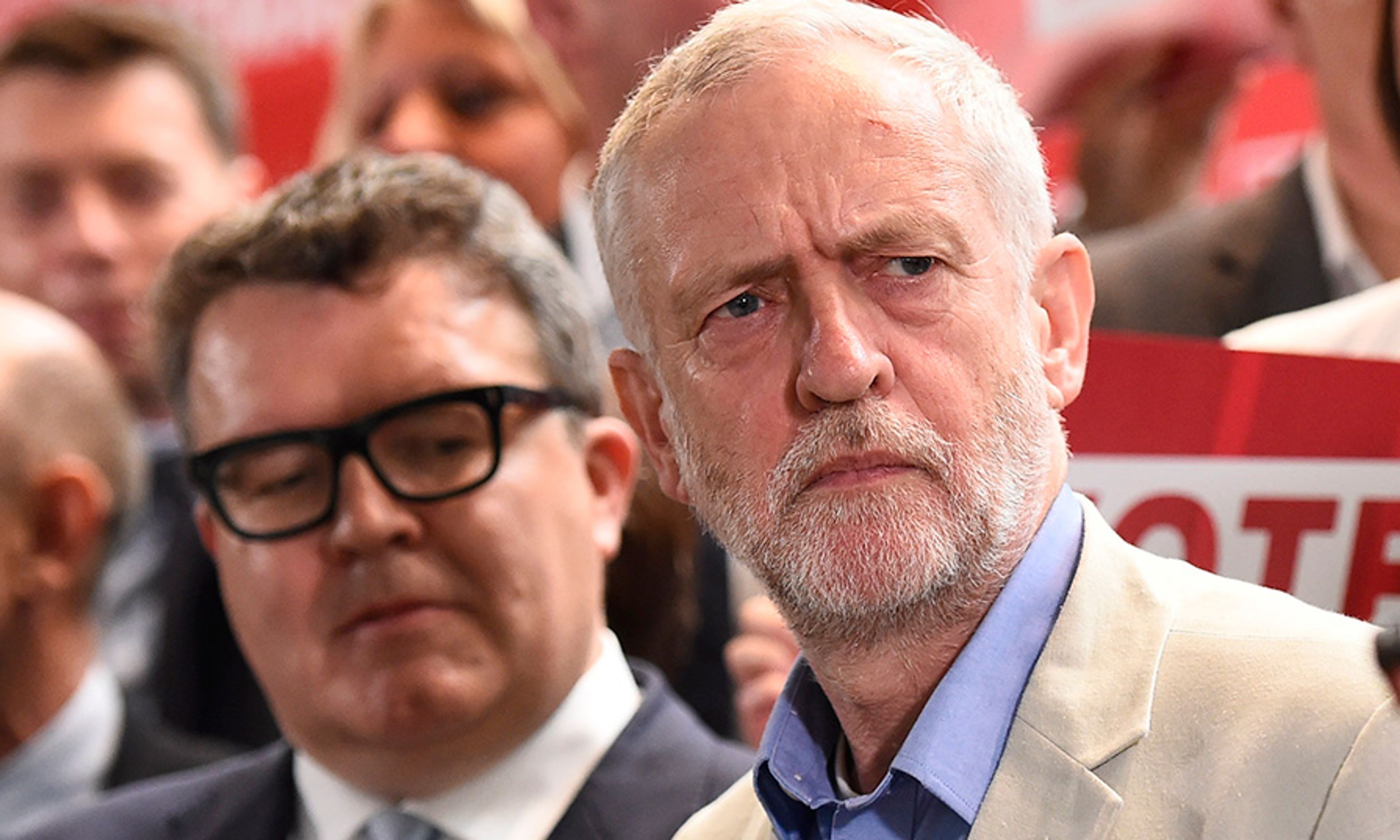
Jeremy Corbyn, the leader of the Labour party, lost a confidence vote today. His party’s members of parliament voted by an enormous margin — 172 to 40 — to express no confidence in his role as Labour leader. This comes after the mass resignation of his shadow cabinet following the EU referendum, leaving the ranks of his supporters barely sufficient to constitute a new shadow cabinet. Corbyn, his critics in his party say, is a good man, a decent man, a man of deep conviction and dignity — but unfit to lead the Labour party. They point to his active undermining of the Remain campaign, his refusal to campaign alongside the Tories or even make a positive case for the European Union, and, above all, the mass rebellion of Labour voters in the north of England, outside the country’s urban areas, who defied their party’s leadership to vote en masse to leave the EU.
In any other situation, Corbyn would immediately resign. Even a majority in a confidence vote can prove fatal if that majority is viewed as an insufficiently robust show of support — Margaret Thatcher won the first ballot of her final leadership challenge 204 to 152 but was forced to resign in any case, knowing eventual defeat approached. But Corbyn is, as they say, a man of deep conviction, and he won’t go without a fight. At a moment when Labour already faces a near-existential crisis, given the collapse of its support in its northern heartlands, its leadership and its representatives are locked in a tense and bitter standoff, neither side willing to concede an inch.
The internal crisis facing the Labour party comes down to this: Jeremy Corbyn is not like other politicians. He never was, and he never will be. The typical British politician, and especially the typical party leader, views the party as paramount: He is expected to follow the party whip’s line, and work for the good of the party whenever possible. His own personal ideological convictions are meant to be subservient to the good of the party. And when the party loses confidence in the leader’s ability to lead, the leader resigns. As former Labour minister Jack Straw said earlier today, “The Labour party exists to implement its values through a parliamentary majority.” Labour’s values, that is, not the leader’s. Whatever the leader might think, the good of the party and the will of the majority of its members of Parliament is supreme.
RELATED: How Labour Blew It
For Corbyn, though, it works the other way around. He is primarily an ideological politician, not a party one. He refused to accept the result of the confidence vote, deeming it without “constitutional legitimacy.” “I was democratically elected leader of our party for a new kind of politics by 60 percent of Labour members and supporters,” Corbyn said. “I will not betray them by resigning.”
Corbyn holds those who oppose him within the party in contempt and values ideological purity rather than party loyalty.
There is a (likely unintentional) syntactical ambiguity in that statement. Corbyn meant “them” to refer to the antecedent “Labour members.” But the pronoun could instead refer to the “new kind of politics” he claims to have been elected to represent. And by “new kind of politics,” what he really means is a certain dogmatic ideology, a Marxist-inspired set of beliefs that views the United Kingdom as in a state of quasi–class war and the interests of the rich and poor as diametrically opposed. (If his views sound similar to those of Bernie Sanders, that’s because they are, though Corbyn is by far the more radical of the two.)
Corbyn holds those who oppose him within the party in contempt and values ideological purity rather than party loyalty: If he stays on as leader, he plans to ease the process of removing from the party MPs who challenge his leadership, thus cementing both his hold on power and his ideology’s pre-eminence within the party.
#related#Ultimately, the party’s will is likely to win out. Corbyn may well resign tomorrow morning, or he could face a simple leadership challenge to play out over the coming months. The latter scenario is one that could prove favorable to him, at least for a time. Despite his deep unpopularity among elected officials, he enjoys a sort of sainthood among a certain young and disillusioned demographic seeking the apotheosis of their own agenda and deliverance from partisan politics. (Again, think of Bernie Sanders’s “political revolution.”) Many of his supporters aren’t actually Labour members and don’t campaign for Labour — for instance, the enormous demonstration Corbyn held outside Parliament last night was attended mostly by socialist trades unions that have no love for the Labour party. They are devoted to Corbyn, not the party. But recent changes in Labour’s election rules, which came into effect in last summer’s contest, mean that anybody willing to pay a small fee for party membership can have a vote.
But the party may find the process of ousting Corbyn harder than they’d like. If Corbyn can inspire the voters he reached last summer, the leadership may well be his to lose. In the contest between the party and its leader, the leader is the one who can call on ranks of devoted supporters. Corbyn’s position is stronger than the result of the confidence vote might suggest; Labour’s own rules governing leadership elections, allowing for the mass participation of the electorate, have seen to that. And in the process to select a new leader, Labour will have to confront an active and vocal portion of its base. Turbulent times lie ahead for the Labour party.






Comments