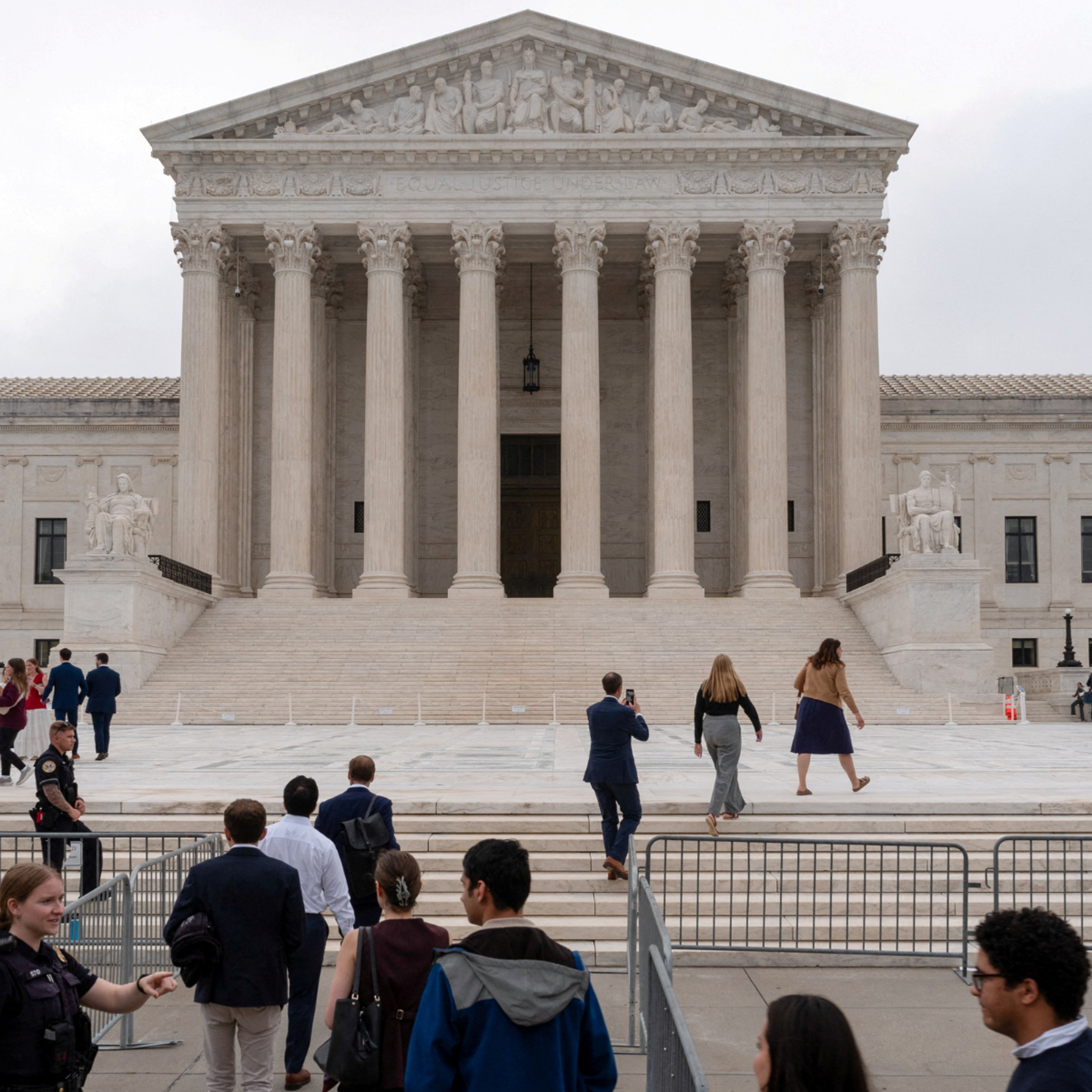
Today Michael Newdow faces our nation’s highest court. Last week he faced a less formidable opponent: me. I debated Newdow at the University of Maryland on the question, “Can Our Children Say ‘Under God’ In Our Schools?”
In case you’ve forgotten, Newdow is the lawyer who filed a lawsuit challenging the words “under God” in the Pledge of Allegiance. He gained legal immortality in June 2002, when, amazingly, the Ninth Circuit Court of Appeals ruled in his favor and struck down teacher-led recitations of the Pledge in public schools.
If last week’s debate served as Newdow’s test run for making an oral argument on his own behalf before the Supreme Court, he is prepped. He spoke without notes and appeared to know church-state case law well–which should not be surprising since he has conceivably thought about little else for the last two years. He was articulate, delivering his arguments coolly and collectedly. He did not come across as the anti-religious zealot that I expected him to be. In fact, he seemed almost tired of the whole ordeal.
Newdow repeatedly emphasized that he sought only to limit government favoritism of religion and not to encroach upon its private free exercise by religious individuals. I am sure that many doubt his sincerity, but he did not betray any hint of disingenuousness. He seemed genuinely upset that atheists like himself were treated, in his words, “like second-class citizens.” He appeared as ready as any first-timer before the Court could be.
That said, Newdow is not going to wow anyone. His arguments were routine at best. He cited all of the appropriate Establishment Clause tests–”Lemon,” “Endorsement,” and “Coercion”–but he too easily conceded that his construction of non-establishment encroaches upon free exercise. I argued that if public schools cannot “endorse” religion, as he claims, school administrators must limit the religious speech of official school speakers–including student graduation speakers who want to talk about their faith. If pressed to its logical conclusion, I continued, Newdow’s position, like that of Jacques Chirac, would prohibit public-school teachers from wearing religious articles–like a cross pendant. His only response was that a schoolteacher “couldn’t wear 50 crosses in class.” Owing to the debate format, I could not press him to explain the line between permissible and impermissible religious expression by public-school teachers. I imagined, though, that Justice Rehnquist and Thomas might just pursue that line.
After the debate, I was somewhat surprised when Newdow approached me in a friendly manner, as if to acknowledge a worthy adversary. We shook hands and I asked him how he thought the oral arguments would go. His answer gave me pause: “I’ll win eight to zero,” he said. “It’s an easy case.”
I do not know if he won last week’s debate, but I do know that Newdow will not win eight to zero at the Supreme Court. And then it dawned on me. In his campaign to purify the government of religion, Newdow may have become exactly what he purports to fight against: a dogmatic believer in his own moral and intellectual superiority who is blind to the weaknesses in his own position.
I pray that the Supreme Court will not be complicit in Newdow’s missionary crusade.
–Vincent Phillip Muñoz is a Civitas Fellow of Religion & Public Life at the American Enterprise Institute and an assistant professor of political science at North Carolina State University.




Comments