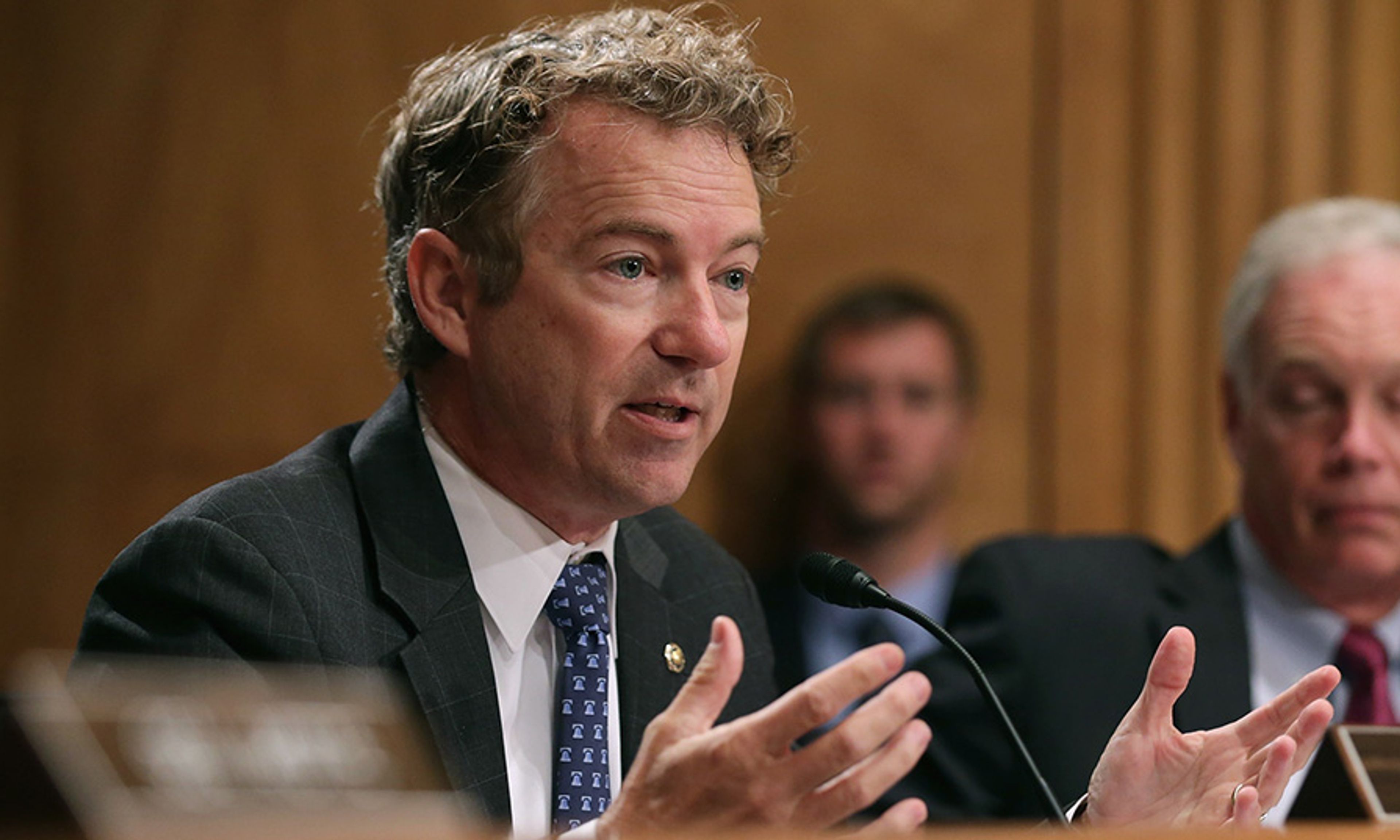
Last week the Wall Street Journal released a poll showing that three-fourths of Rand Paul’s supporters said it was in the “national interest” to attack the Islamic State, a number that tracked the level of support from tea partiers and actually exceeded the percentage of the general public.
What does this mean? While it certainly could mean that Senator Paul draws a large number of supporters from non-libertarian ranks — at least one prominent libertarian is already calling the conflict with the Islamic State “our next dumb war” — I think what we’re really seeing is something much simpler, much more basic: Libertarians want to defend their country.
Senator Paul has been a longtime proponent of the “Weinberger Doctrine,” articulated by Reagan-era defense secretary Caspar Weinberger. It has six main elements:
1. No overseas commitment of U.S. forces to combat should be made unless a vital interest of the United States or a U.S. ally is threatened.
2. If U.S. forces are committed, there should be total support — that is, sufficient resources and manpower to complete the mission.
3. If committed, U.S. forces must be given clearly defined political and military objectives. The forces must be large enough to be able to achieve these objectives.
4. There must be a continual assessment between the commitment and capability of U.S. forces and the objectives. These must be adjusted if necessary.
5. Before U.S. forces are committed, there must be reasonable assurances that the American people and their elected representatives support such a commitment.
6. Commitment of U.S. forces to combat must be the last resort.
Few libertarians (and few Americans of any ideology) can cite these six factors from memory, but they articulate core concepts that resonate with, for example, a great many libertarians I’ve known and encountered within the ranks of the military (where Ron Paul had a strong base of at least financial support).
The Weinberger Doctrine simultaneously limits and liberates the use of American force. Forces should be deployed only when “vital interests” are under threat (thus the limit), but then when committed, they must be committed with “total support” (thus the liberation).
In a 2013 Corner post, I speculated that this formula would result in a more lethal military, resulting in something we haven’t yet tried in our 13-year war on terror: the relatively brief deployment of truly overwhelming destructive force against identified enemies.
I’ve never met a libertarian who believed America shouldn’t defend itself from attack, and thoughtful libertarians understand that self-defense has to include force projection — attacking the enemy where he is rather than waiting for him to assault us at home or to storm our embassies abroad. But many of these same libertarians are understandably hostile to the “benevolent counterinsurgency” that’s dominated the Obama administration’s war in Afghanistan (to borrow Bing West’s excellent phrase), not to mention the Bush administration’s idealistic vision of democratizing the Middle East.
What does a libertarian-minded Rand Paul supporter see when he looks at the Islamic State? The same thing most of us see — a powerful jihadist organization that has beheaded two Americans, issued repeated threats to attack America directly, tweeted photos of American landmarks from domestic sympathizers, and armed and trained potentially hundreds of American citizens who of course hold American passports.
So, does the Islamic State meet the test of threatening a vital national interest? Absolutely. In fact, given the Islamic State’s status as the world’s largest, wealthiest, most brutal, and most powerful jihadist organization, it’s difficult to argue that its continued growth doesn’t threaten America’s vital interests. The Weinberger Doctrine — if it is to be Senator Paul’s basic policy on the use of force — applies.
Or, I should say, it might apply — if we go into combat with the necessary “total support,” with the level of force necessary to do the job. And that has been the problem again and again during America’s most recent conflicts. Rules of engagement and political calculations lead to long wars of half-measures and misplaced idealism — wars that spill American blood and drain the American treasury for unattainable cultural objectives.
One is not an “isolationist” if one looks at the last half decade of the Afghanistan war and, say, agrees with Bing West and says we’ve been fighting the “wrong war.”
Labels such as “interventionist” and “isolationist” are growing increasingly tiresome. Few but those on the tiniest and most irrelevant fringes take the extreme positions of intervening everywhere or nowhere. Instead, the relevant questions become (among others) “Where?” “When?” and “With what objective?”
When the questions are phrased more precisely, the gaps between the various strands of conservative foreign-policy thinking can narrow quickly indeed.
In fact, we may well be moving toward a period of increased consensus. It’s amazing how seeing the true face of evil can unite Americans quickly. The more distant the war seems and feels, the sharper the philosophical debate. But when Americans are brutally murdered, we close ranks.
In other words, reality has a way of making its presence felt. And in the face of this reality, libertarian-minded Americans are more than ready to defeat our enemies.
— David French is an attorney and a veteran of the Iraq War.






Comments