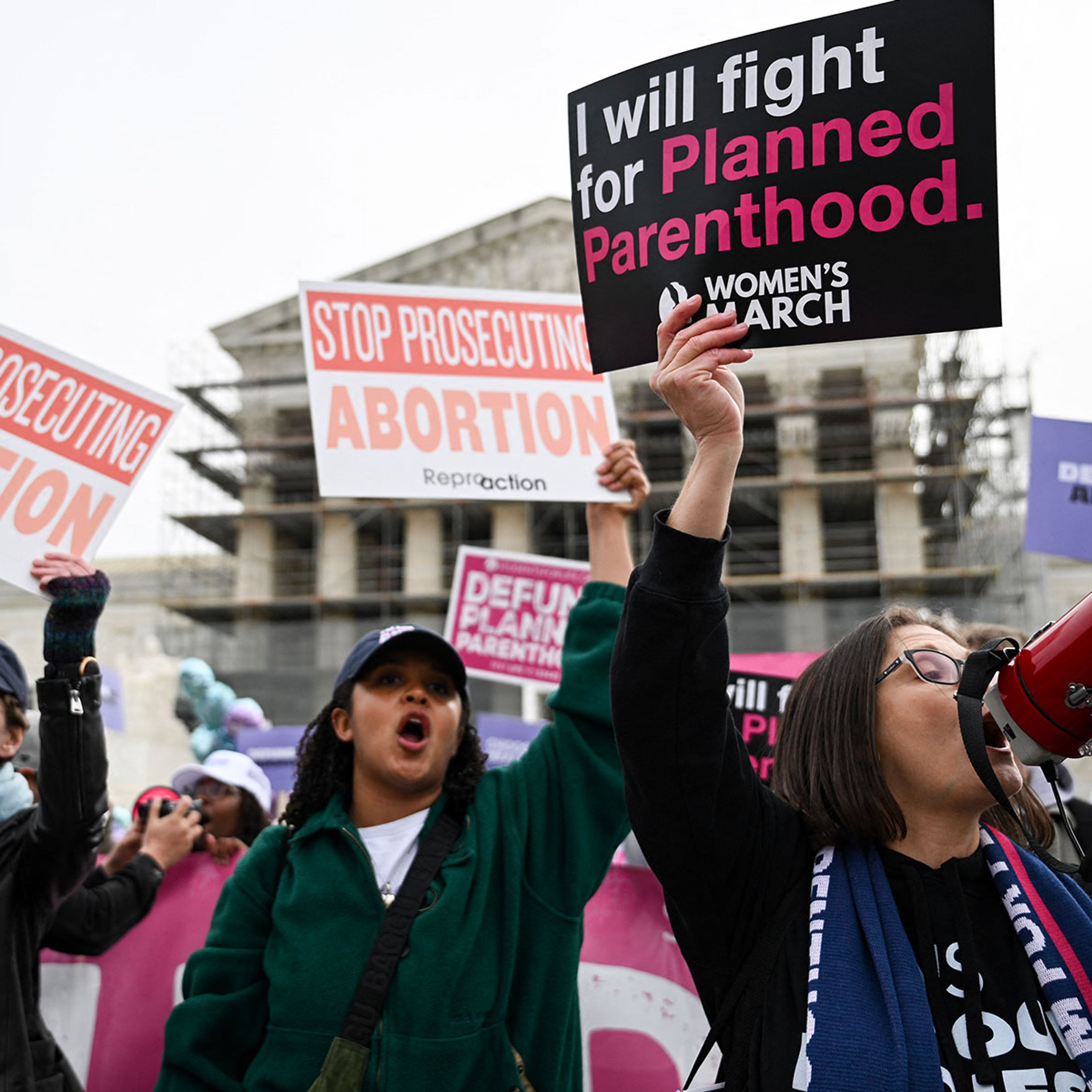
On the 36th anniversary of the Supreme Court decision that made abortion legal in the United States, I stood, for a while, just about exactly where I stood during the so-called March for Women’s Lives the “pro-choice” crowd had in April 2004. That was back in the Bush years, and it was an election year to boot; their rally was a bit of a pre-Democratic convention, since the Democrats then as now are in the pocket of the abortion industry. (The late Governor Bob Casey remains an exception, and an inspiring model. Today, President Barack Obama even has a former EMILY’s List leader as his spokeswoman.)
On Thursday, a display of despair and anger wouldn’t have shocked me. After all, Barack Obama, who has demonstrated a tolerance for infanticide, is president of the United States. The Speaker of the House is a Catholic who makes up her own theology with hubris. I could go on: Obama has promised a sweepingly radical piece of legislation that would threaten the very existence of many religious medical entities that our country depends on, striking a blow to religious liberty. Only the economic debacle has put that on the back burner. Maybe political pragmatism will keep it there, if Obama’s left flank will put up with it.
But I walked the whole March. I walked the March from the Mall to the Supreme Court after attending the pre-rally. I walked the March and hung around on the House side of the Capitol for a little while. The only display of anger I saw came from a woman walking a block away from the Supreme Court with a big round “Keep Abortion Legal” sticker from the National Organization for Women. She was furious, saying to a friend, “They don’t care about human rights. I can’t believe all these people. They just care about babies.”
Of course they care about babies. Some of them have had a lot of them, and brought some of them along; others look on with joy at the families. But it is because they know these babies are human–which shouldn’t be in dispute, though it seemed to be back when Obama was in the statehouse arguing that a newborn shouldn’t have the same rights as an older baby–that they care about this issue.
And that message–that this is a human-rights issue and men, women, and children deserve better than a culture that values the legal “choice” of abortion over all other values, including compassion and common decency–was emanating from the March for Life this year, and so many of the events surrounding it. “Healing” had a big presence there.
When I made my way over to the Supreme Court Thursday afternoon–hours after I expected to, there were just so many people; people, mercifully, it was a joy to be around–a middle-aged guy named Chuck was talking about his great regret: that he did not “protect” his girlfriend and their child. She needed reassurance when she got pregnant and he knew it. But instead, he gave her none and let her abort their child. He said that the momentary relief he felt as a young man that he had no baby to be responsible for doesn’t compare to the guilt he has felt for shirking his responsibility and letting that child be eliminated. But that child has not been eliminated from his memory–and, by telling people his story, Chuck may be able to make a difference in a lot of lives.
As I listened to him, and to a seemingly endless stream of women (organized by Silent No More) who told their abortion stories of wrong choices and false choices–“No one tried to stop me”–I couldn’t help but keep flashing back to that March for Women’s Lives. At a pre-rally event then, California congresswoman Maxine Waters told George W. Bush to “go to hell.” The march itself was a sea of crass signs (many playing on the then-president’s name) and anger. On a post-rally ride home, women talked–casually and openly, sitting in front of me–about how they wished Barbara Bush had aborted her son who would be president. But at the March for Life 2009, whether at one of the many pre-event prayer services or at the main event, what I saw was a whole lot of love. Even in the face of the Freedom of Choice Act, which is increasingly becoming a rallying point in churches, especially Catholic ones–the bishops’ conference has initiated a postcard campaign–there was hope that Barack Obama might be affected by reason, the office, a respect for liberty . . . a miracle. So many of the people gathered told me matter-of-factly that they are praying for Barack Obama. That he may see what they see. They don’t wish Barack Obama’s mother had aborted him; they celebrate (and pray that he will be affected by) the fact that she didn’t.
I don’t mean to paint the March for Life crowd as a gathering of saints. There are sinners on all sides. But it was striking to me that even the worst signs–usually invoking Hitler or a holocaust or graphic images of aborted children–were not malicious. And if you could describe them as angry, it was anger over the death of innocents being condoned and codified in American law. That is something to be angry about.
And yet, the overwhelming attitude at the March was hope for change. And it was no mere political hope. There was a lot of praying happening. And while Obama’s holding off (at this writing) on repealing the Mexico City Policy, which prohibits the federal funding of abortions overseas, may have been born of mere political pragmatism, that, too, could feed their continued hope.
But this wasn’t, either, only a religious rally. It was a youth rally. Thousands packed the Verizon Center for a pre-march Mass and rally. Down the block from the Supreme Court, a boys’ high school got warm on the cold winter day with an impromptu juggling demonstration and pep rally. While jammed shoulder to shoulder on the Mall, as their marching couldn’t begin because there were just so many people, a few teenage girls played one of those nonsense games they play, different but fundamentally the same from generation to generation.
And so my mind wandered again–this time, to the youth inaugural ball earlier this week. There, President Obama talked up the role of youth as a political movement, specifically in getting him elected. And then later, while bustin’ a few moves, he announced, “That’s what’s called old school.” Well, even with the introduction of an attempt to get a headcount by text messaging, there was something very old school about this. A great many of the people who gathered on the Mall Thursday know that the culture is never going to change unless behaviors change, individual by individual: One by one, young people need to choose to live differently from what they see on TV and in headlines and statistics. And it’s already showing signs of happening.
High-schoolers get on buses and go to Washington in support of life, because they’ve seen the way their parents live or they’ve got the backing of a solid moral education, given by parents, church, and/or school. Folks from all over (Nebraska to Virginia to Rhode Island to Alabama, I saw) brought their young children and their priests and religious sisters with them. They know that this is work that starts at home, at school, and at prayer. Ultimately, the work will be done by these youngsters. Speaking at the pre-march rally, Sen. David Vitter (R., La.) downplayed the ultimate importance of Congress in this effort, and urged the under-30 crowd to continue their “fighting, working, and praying” to “win the hearts and minds of your fellow young Americans.”
Finally, the March for Life 2009 was a true “march for women’s lives.” Ms. Magazine got some attention–and grief–recently for putting Barack Obama on its cover in a Superman pose and announcing “This Is What a Feminist Looks Like.” After these last few days in Washington–and knowing what I know about the beauty of the Catholic view of women–I’m tempted to do the same with, say, Pope Benedict. At the very first event I attended, Cardinal Justin Rigali of Philadelphia talked about “healing mercy” and the great damage abortion does to women. If you haven’t experienced it yourself, or seen it in the life of a close friend or family member, all you need to do to realize the harm abortion does to women is browse around the net. As much as the “choice” crowd claims to care about women, they in fact cast aside and shun the big picture of what’s good for women’s lives–in terms of moral, mental, and physical health. In 2009, a girl can have a chemical abortion in her bedroom. She’s perfectly free to do that, to take a human life and flush it herself–but at what cost to her, to that second life, and to a nation founded on a principle of life?
There was a lot of praying happening in Washington in the March for Life crowd, and it was not just for the babies who have been, are, and will be dying. It was for the suffering women and men among us, that they might be healed and testify to what they’ve experienced, and thus help others; and for our country, that through freedom of assembly and speech and a democratic process, abortion, too, might be “overcome, someday.”



Comments