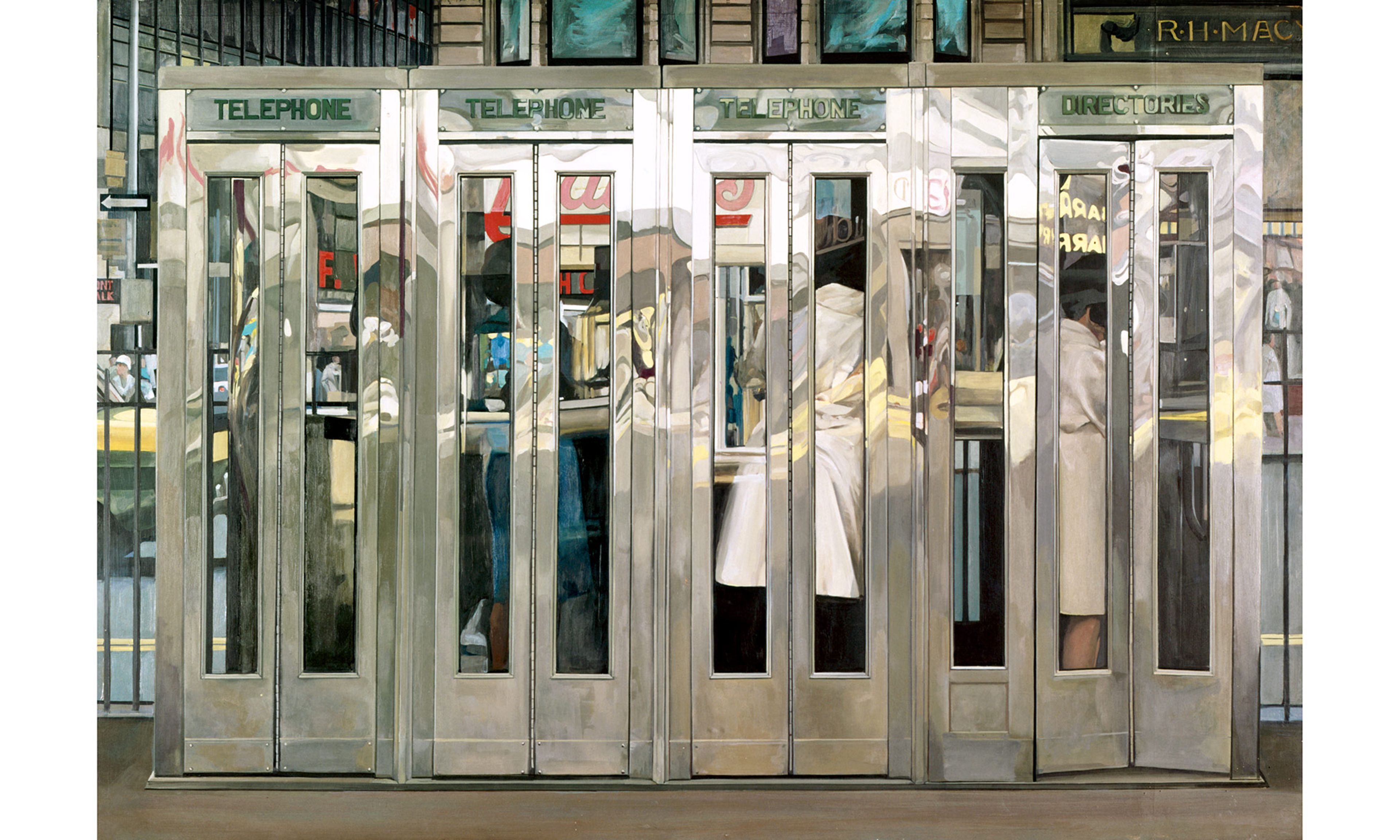
I don’t write about film, but today I’ll review a new documentary by filmmaker Olympia Stone called Actually, Iconic about Richard Estes (b. 1932), the American pioneer of photo-realism. It’s a school of painting I’ve always liked, and he’s not only one of its founders, along with Audrey Flack and Chuck Close, but one of its philosophers. I recommend the one-hour film for many reasons — it’s good art history, jargon-free, both jazzy and smooth — but most of all because it demystifies the making of art and the class of humans we call artists.
Estes became famous in 1968 for Telephone Booths, now at the Thyssen-Bornemisza Museum in Madrid. His paintings of everyday scenes, many in New York, have a meticulous, metallic look, so crisp they suggest photographs, but that neither does them justice nor is correct. Photo-realism, with Estes at the helm, salvaged American painting from its unnatural, counterintuitive affair with the kind of abstraction practiced by Pollock, Rothko, de Kooning, and Motherwell and returned it to its roots in realism and the material, tactile world.





Comments