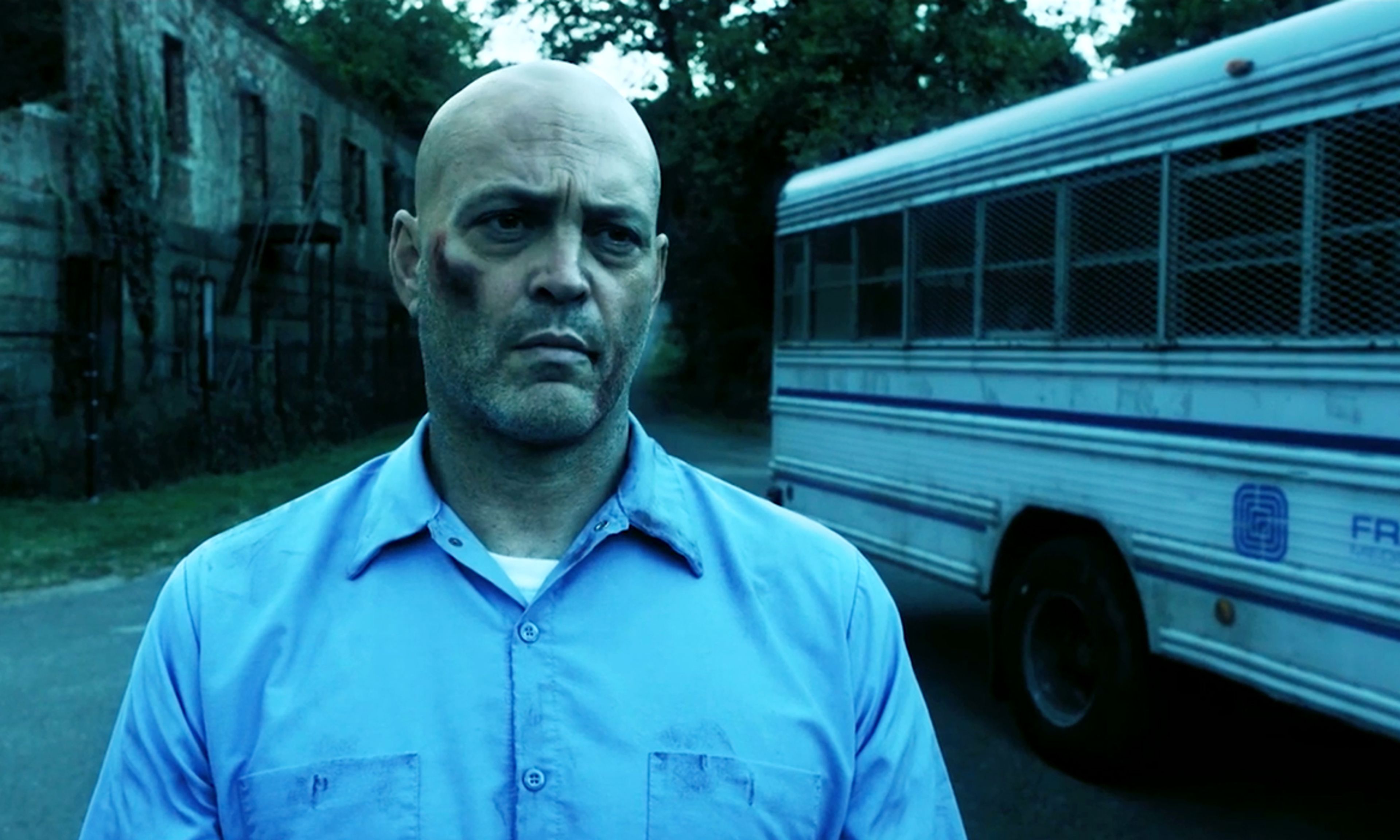
By lucky coincidence, I caught up with S. Craig Zahler’s Brawl in Cell Block 99 the same week that pandering governors Andrew Cuomo and Ralph Northam both jumped the shark on Roe v. Wade to promote infanticide in the name of states’ rights.
Of all the violent incidents in Zahler’s grindhouse thriller, the grisliest was a gangster’s repeated threat to dismember a woman’s in utero fetus “limb by limb.” It resembled a politician’s heartless manipulation, the cunning use of law as extreme social engineering — in this particular case, to control the baby’s father, the film’s protagonist, Bradley Thomas (Vince Vaughn), a two-fisted white Southern Christian who is not just an action-movie hero but an archetype of today’s media-disenfranchised electorate.
Abortion in movies isn’t necessarily a Juno-cute part of the culture war. Consider that Zahler specializes in the grotesque, which makes him an apt, even prophetic, reporter on emotionally driven issues; his schlockmeister approach successfully challenges news-journalist sanctimony. He works in macabre genres (see, for example, the cult favorite Bone Tomahawk), but now the macabre — the horror of legalized pre- and post-natal murder, endorsed by governors — has become politically feasible.
Maybe we never suspected how monstrous, ugly, and destructive political representatives could be or that our fellow citizens held such vengeance in their public personas; now Zahler showcases this dismaying truth. The vicious and brutal Brawl in Cell Block 99 is worth seeing because no other contemporary movie goes so daringly deep into the cruel absurdity of Millennial #Resistance.
Think about the current impasse between the executive and legislative branches of government. It can be easily symbolized as an ideological brawl: American citizens (both those furloughed employees and those who awaited a hostaged State of the Union address) are emotionally pummeled, turned into collateral damage. Zahler’s film humanizes such conflict through Vaughn’s tow-truck-driving Thomas, a working-class guy who pursues personal dignity but finds himself entangled in a rocky marriage, drug-dealing, and the prison system.
We first see the back of his shaven head bearing the vein-blue tattoo of a Saint Thomas cross. It initially recalls the berserk fanaticism of DeNiro’s cryptic full-body tattoos in Cape Fear, but Bradley’s single religious symbol pinpoints contemporary Christianity’s embattled status; his personal agony equates to class distress in this remarkable characterization.
Vaughn’s towering physicality and calm-under-pressure temperament show seething intelligence. Viewers who recall that shocked-appalled look Vaughn gave Meryl Streep during her pompous (“overrated”) political grandstanding at the Golden Globes may infer a critique of liberal class-based vanity. Vaughn’s puzzled expression, caught unawares (a thinking man’s curiosity), questioned the self-pitying audacity of social-justice show-offs. It powers this film’s exploration of their now routine prison-industrial-complex pieties.
Bradley’s incarceration ordeal is central to the film’s political allegory. The Redleaf maximum-security prison is described by Don Johnson’s Warden Tuggs (a performance of equally uncanny credulity) as a “minimum freedom” facility; it represents society’s officially authorized — ideological — madhouse. (The warden’s discipline order, “Give him some justice,” is dark satire indeed.)
The title’s symbolic prison is presented outside of reality — an expressionist dungeon where fairness, brotherhood, and civilization are reduced to mankind’s cruel nature. (Luis Buñuel once quipped, “You can judge a society by the way it treats its prisoners.”) Going from one institution called the Fridge to the Redleaf compound, Bradley enters a cobalt-blue color scheme that gets darker, evoking and mocking Robert Redford’s prison flicks Brubaker and The Last Castle. (Bradley’s All-American eccentricity also exposes the pseudo-sophistication of TV’s Breaking Bad.) His masculine grievance opposes bleeding-heart weakness in every extraordinary scene.
These are not face-saving, progressive, hipster fallacies. The harsh fantasy symbolism represents an insightful discovery for writer-director Zahler, who cracks open the sophomoric sadism popularized by Quentin Tarantino to make a film that is an unflinching reflection of our current social insanity. Its brilliance comes from Zahler’s sympathy for the newly disenfranchised — not simply the forgotten American but the “deplorable” who has been denied the advantages of ruling-class privilege. Despite Tarantino’s jokey homages to grindhouse movies and blaxploitation fare that cocoon adolescent viewers from real-life complexities, he has never produced authentic characterizations like Bradley’s interactions with black and white prison guards (a beautifully cast multiracial bureaucracy), which ring true to both the cynical sensibilities and sensitive yearnings that are basic to American plurality — and which yahoo moviegoers learn from social experience.
Zahler fulfills their secret regard for morality-tale retribution — and it is thorough. Bradley embodies this need like such preceding movie icons as John Wayne and Joe Don Baker — large-frame Americans (thinking he-men) who acted out national tensions and common desires across superficial ethnic differences. Zahler’s violence exceeds the action genre’s usual macho toughness. His narrative setups may take too long and sometimes overindulge sadism as if his only point is to spook us, but his moral perspective, that the independence of individual American men is always under threat from other men and social competition, is compelling and surprisingly moving.
This extreme violence (from Bradley’s destroying a car with his bare hands to his stomping on the back of a drug dealer’s head and dragging the man’s face across a concrete floor) characterizes Zahler’s unruly, visceral wit. His impetus is not just anti-authoritarian. It’s anti-hypocrisy, perhaps the gift of a true conservative, because it replaces liberal sanctimony with a modern equivalent of John Wayne–Clint Eastwood righteousness. It’s almost Straw Dogs for this millennium.
After Zahler’s previous film Bone Tomahawk, I never wanted to see another film by him. But last week’s bonkers political reality has given the director’s horror specialty expressionist power — it felt like the only accurate cultural response to the normalization of murderous madness. I celebrate the catharsis of Cell Block 99 for dramatizing the personal virtues imperiled by venal officials and partisan social arbiters as well as by fate. Updating the sensibility of mid-20th-century noir, it sounds a Millennial alarm for the precious gift of life that is cruelly bartered by politicians who think like criminals.





Comments