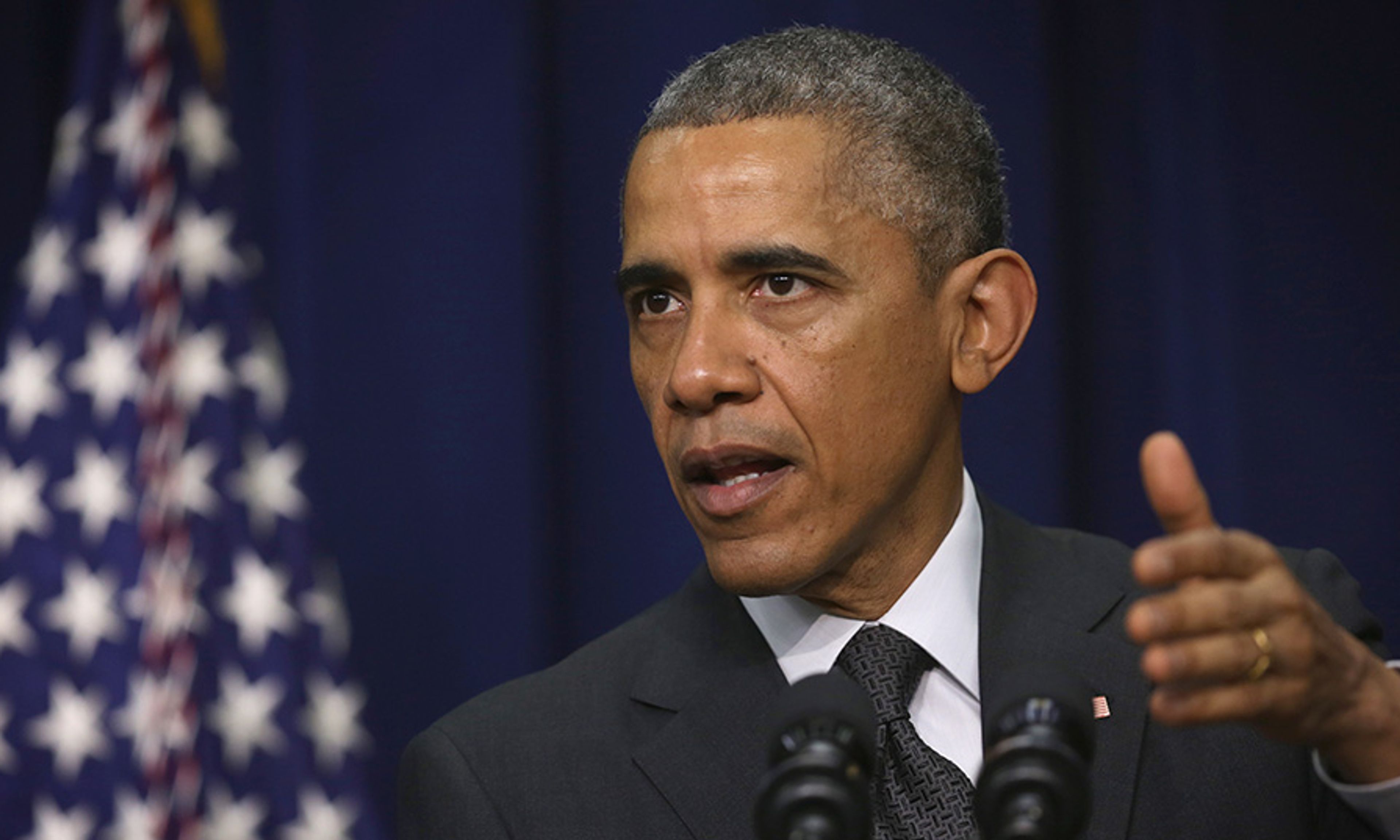
President Obama provided an extended explanation Tuesday of how lower taxes create prosperity even for Americans who do not directly benefit from the policy change.
Obama offered the remarks when asked by Marketplace’s Kai Ryssdal how the trade deal his team negotiated with twelve Pacific Rim countries would help people who work in “the regular economy.”
“If you have eliminated 18,000 taxes that other countries in this region effectively place on U.S. goods and services when we try to sell there — so it makes them more expensive and it makes them less attractive — if we eliminate those taxes, now U.S. goods and services are more competitive,” Obama said. “That means we’re selling more. If U.S. companies are selling more to these countries, then that means that those companies can hire more people and put more people to work.”
The trade deal, known as the Trans-Pacific Partnership, represents a rare point of cooperation between the president and Republican lawmakers, with some of the stiffest opposition coming from the unions that comprise a crucial component of the Democrats’ voting base.
RELATED: What’s Next for the Trans-Pacific Partnership
The president suggested that the repeal of foreign taxes on U.S. companies would reduce American corporations’ incentive to build factories overseas. “And keep in mind that a lot of people say, ‘Oh, it’s the big corporations that are all benefiting from this,’” Obama said. “Companies like a Boeing or a GE, they’ve got supplier chains that go from Maine to California. They’ve got companies that may only have 50 employees that produce one particular part.”
That’s an implicit response to AFL-CIO Richard Trumka, who denounced the trade deal in a letter to Obama, charging that the president had falsely accused unions of reflexive opposition to trade agreements. “To the contrary, we have supported trade deals when warranted,” Trumka wrote in June. “What we do not support are trade deals that benefit Wall Street, but decimate Main Street.”
#share#Obama’s past rhetoric — including his statements about previous trade deals and the disparagement of “trickle-down” economics that was a key part of his reelection campaign against Mitt Romney — might impede his efforts to rally Democratic support for the deal.
“Many members of the other party believe that prosperity comes from the top down, so that if we spend trillions more on tax cuts for the wealthiest Americans, that that will somehow unleash jobs and economic growth,” he said in June of 2012. “I disagree. I think they’re wrong.”
RELATED: How the TPP Would Help America’s Poor
Republicans, of course, have long argued that tax increases on millionaires would hurt the small businesses that file their taxes as individuals. “Fifty-four percent of American workers work in businesses taxed as individuals,” Romney said at the time. “So when the president wants to raise taxes on individuals — as he’s proposed, from 35 percent to 40 percent — he kills jobs.”
In his interview with Ryssdal, Obama refused to say when he would submit the agreement to Congress — “soon,” he promised — but his eventual submission will start a 90-day review period before lawmakers vote on final ratification of the deal.
— Joel Gehrke is a political reporter for National Review.






Comments