Upon arrival, I jot a little limerick. For whom? Well, for friends, and for interested parties on Twitter.
Norway has long been social democratic. Currently, however, there is a right-of-center government, which includes my beloved “Progs,” the members of the Progress party (which is Reaganite or Thatcherite).
I’m once again in Norway.
They’ve long done things the Gore way.
But now they swing
Toward Burger King –
Where “you can have it your way.”
Yes, I know: Keats can rest easy.
‐I see an advertisement: “Cool-headed, warm-hearted: Banking the Norwegian way.”
Very well conceived.
‐In the heart of Oslo, what do I see? Well, Burger King. Indeed, more than one.
‐I meet a trio of young Norwegians, having fun, playfully harassing strangers in a park. They are delightful, really.
One is a woman who spent a year in Montana. “There was nothing but Republicans and sheep, but I survived.” I tell her I’m a Republican. She replies, “I’m not.” I say, “Oh, I know.”
But maybe later . . .
‐My hotel is packed with Indian tourists. I am still amazed at this. I’ll tell you what I mean.
I never saw Indian tourists in Europe, or anywhere else, until 2008. (I’ve just Googled what I wrote at the time.) I’m not talking about immigrants. I’m not talking about economic refugees, job-seekers. I’m talking about tourists.
I first saw them at the Piazzale Michelangelo in Florence. They arrived in a couple of buses. This was something new under the sun. (I studied in Florence for a bit, incidentally, back in college.)
The tourists were a sign of India’s economic emergence. The development of a middle class. People could come to Europe and see the sights. Then they went home to resume their lives.
Normal. And wondrous.
‐Here in Oslo, pedestrians are waiting at a red light. There’s no car in sight. And yet I don’t cross — because of group pressure. There are children in the group. Don’t want to set a bad example for them! Or have their parents say, “You can’t violate the law like that. This is what crude Americans do . . .”
‐There are many Lincoln memorials in the world, the best of which is in Washington (D.C. — not the glorious state in the Pacific Northwest). My second-favorite memorial is probably the one in Oslo’s Frogner Park. It was a gift of the Norwegian Americans in North Dakota. It’s a touching thing.
I now see that it’s in sorry shape — not kept up. A pity, almost an outrage . . .
‐I am here to attend the Oslo Freedom Forum, the annual human-rights conference. At breakfast, I pull up next to two old friends of mine: Jian-li Yang and Marina Nemat. He is a Chinese democracy activist and onetime political prisoner; she is an Iranian-born activist and onetime political prisoner.
Often at these conferences, I find myself in a group where I’m the only one who has not been imprisoned or otherwise persecuted for his beliefs.
At breakfast, I have occasion to remark to Jian-li and Marina, “You know, we who have not been to prison like our creature comforts. We need to be pampered. You old prisoners — you’re tough and unspoiled.”
Marina replies, “We like our creature comforts more than anyone!” For example, a hot shower.
‐We are on the subject of religious minorities. Marina tells a story about her father, a Christian in Iran. When he was a little boy, his teachers were Muslim. And if a teacher’s robe happened to brush against him, the teacher would have to wash that robe, because the boy, as a Christian, or a non-Muslim, was unclean.
Holy Moses.
‐Later, I’ll record a podcast with Marina. To listen to it, go here.
‐Thor Halvorssen is the founder and capo of the Oslo Freedom Forum. At an opening press conference, he says that the theme of this year’s gathering is “Living in Truth.” That is a phrase from Václav Havel. It reminds me of the famous Solzhenitsyn admonition: “Live not by lies.”
‐Another leader of the Oslo forum is Garry Kasparov, the chess great, and human-rights great. He says approximately the following:
“Dictators want you to believe that they have all the cards. That we’re outnumbered. That no matter what, they’ll win, and we’ll lose. But that is a big illusion. It’s what they want to be true. But it’s not true.”
‐He also says something I happen to disagree with. He recalls that, in 1991, he received a “Keeper of the Flame” award in Washington. The date, specifically, was November 15, 1991. At that moment, President Bush (41) was greeting the Soviet foreign minister, Eduard Shevardnadze, with great fanfare. Bush was hailing a new dawn in Soviet-American relations. This was about five weeks before the collapse of the USSR.
And this illustrates, says Kasparov, “how shortsighted the Western governments are.”
In truth, I think, Bush knew what he was doing — and handled the dénouement of the Cold War rather well.
At any rate, there is a debate, and Kasparov may well be right.
‐Earlier this month, he gave the commencement address at Saint Louis University. He tells us that he wanted to explain to the graduates what it’s like to live in a Communist country. He wanted to put it in words they could immediately understand. He came up with something like this:
“Imagine you’re the only kid on the block who doesn’t have the Internet or television. To add insult to injury, they tell you how lucky you are not to have those things.”
‐I meet a student from McGill University (in Montreal). She comes from Argentina. Her grandparents, I believe, were Jewish immigrants, or refugees, from Europe. She speaks the Romance languages — every one of them. And very good English.
Man.
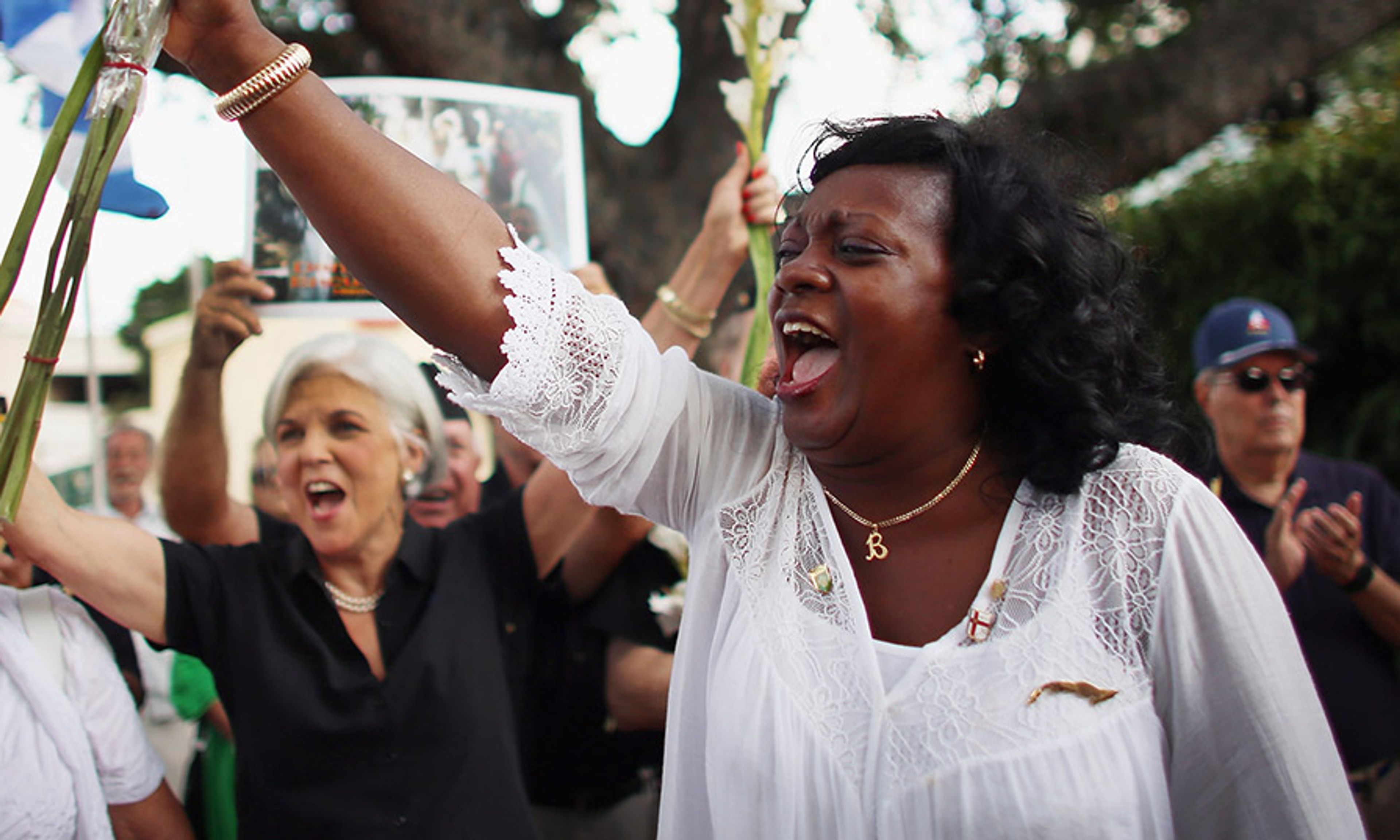
‐It is a great pleasure to see Berta Soler — she is the leader of the Ladies in White in Cuba. And a very, very brave woman. I wrote about her for National Review two years ago, here.
She is thinner than she was. With the help of my friend Javier El-Hage, who translates, I have a conversation with her.
“Berta!” I say. “How come you’re so thin and glamorous! What is this?” She says, “A lot of it has to do with the security forces of the Cuban state.” I believe she is in and out of prison. I’m not sure. “But the most important thing is that I am very well morally and spiritually, thanks to God.”
‐She speaks of “December 17th.” This is Cuban shorthand for President Obama’s opening to the Castro dictatorship. He announced it on that day.
Since then, Berta says, the Cuban democracy movement has endured heightened oppression. “We have been the victims of brutal beatings and arbitrary arrests by the security forces.”
The Ladies in White go to church, or attempt to do so. “Many times, we haven’t been able to get to church. The few who actually do make it to church have been detained for over five hours. They have been beaten. When we’re arrested, we’re arrested with plastic handcuffs, which cut into your skin. We are bitten by guards. The police have broken the bones of some of us. For the last two or three Sundays, they have handcuffed us with metallic handcuffs.”
I ask Berta a question I have asked Cuban dissidents before: “Do they enjoy beating you? Do the agents enjoy the physical violence?”
“Some of them do, some of them don’t,” Berta answers. She tells me about a female agent who beat the hell out of one of the Ladies in White. Later, the group was on a bus (probably being taken to prison, or from prison).
“We asked the agent, ‘Why do you do this to us? You’re a Cuban woman, just like us. We may have different philosophies, but we are sisters. Why do you have so much hatred? Why do you beat us?’”
The agent broke down crying, and, in fact, had to get off the bus.
Another agent admitted, “I didn’t study so that I could later beat people.”
‐I quote to Berta something that Oscar Biscet, another great democracy leader, said after President Obama’s announcement in December. “I feel as though I have been abandoned on the battlefield.” Does Berta feel the same way?
“The European Union, the USA, Pope Francis — they have turned their backs on us. It seems that they care more about business and government relations, and have forgotten human rights in Cuba. President Obama said that this new policy was a way to empower civil society in Cuba. But we are seeing that what he has done is give a green light to the Cuban government to crush civil society.
“And we have seen no denunciation of this situation by the pope or the European Union or the U.S. government.”
‐Berta met Obama once — in the company of Guillermo Fariñas, another great democracy leader, who has suffered much. They had about ten minutes with Obama in Florida. This was in November 2013.
Obama seemed receptive to their message, says Berta. And when he made his announcement on December 17, 2015, “it was a huge surprise, because he clearly hadn’t taken civil society into account. He had taken only the Cuban government into account.”
As Berta sees it, “the Cuban government is not sovereign” — not properly sovereign — “because they have never been elected, democratically.” And sovereignty rests with the people.
‐By the way, Berta Soler and Guillermo Fariñas are “Afro-Cuban,” i.e., black. So is Oscar Biscet, and so are many of the other democracy leaders.
Why do I bring up race? Because, for decades, the Castro dictatorship and its apologists have claimed that the dictatorship is good for blacks — one lie among many, but an especially galling one.
‐A few weeks before meeting Obama, Berta met Vice President Biden, in the White House. “He was very open, very receptive,” says Berta. “He showed a great will to help the Cuban people. He acted the way the U.S. government had always acted toward us — positively.”
Then came 12/17/15. “The only one benefitting” from the new policy, says Berta, “is the Cuban government.”
‐As long as I’m fuming against the U.S. government, let me mention this (though Obama and Biden have nothing to do with it): The U.S. embassy in Oslo? It must be the ugliest building in town. An example of eye-assaulting, soul-deadening modernism. We’re getting a new embassy, I understand. I don’t know what it’ll look like, but it’s bound to be better.
Thanks for joining me, dear readers, and I’ll see you tomorrow for Part II.





Comments