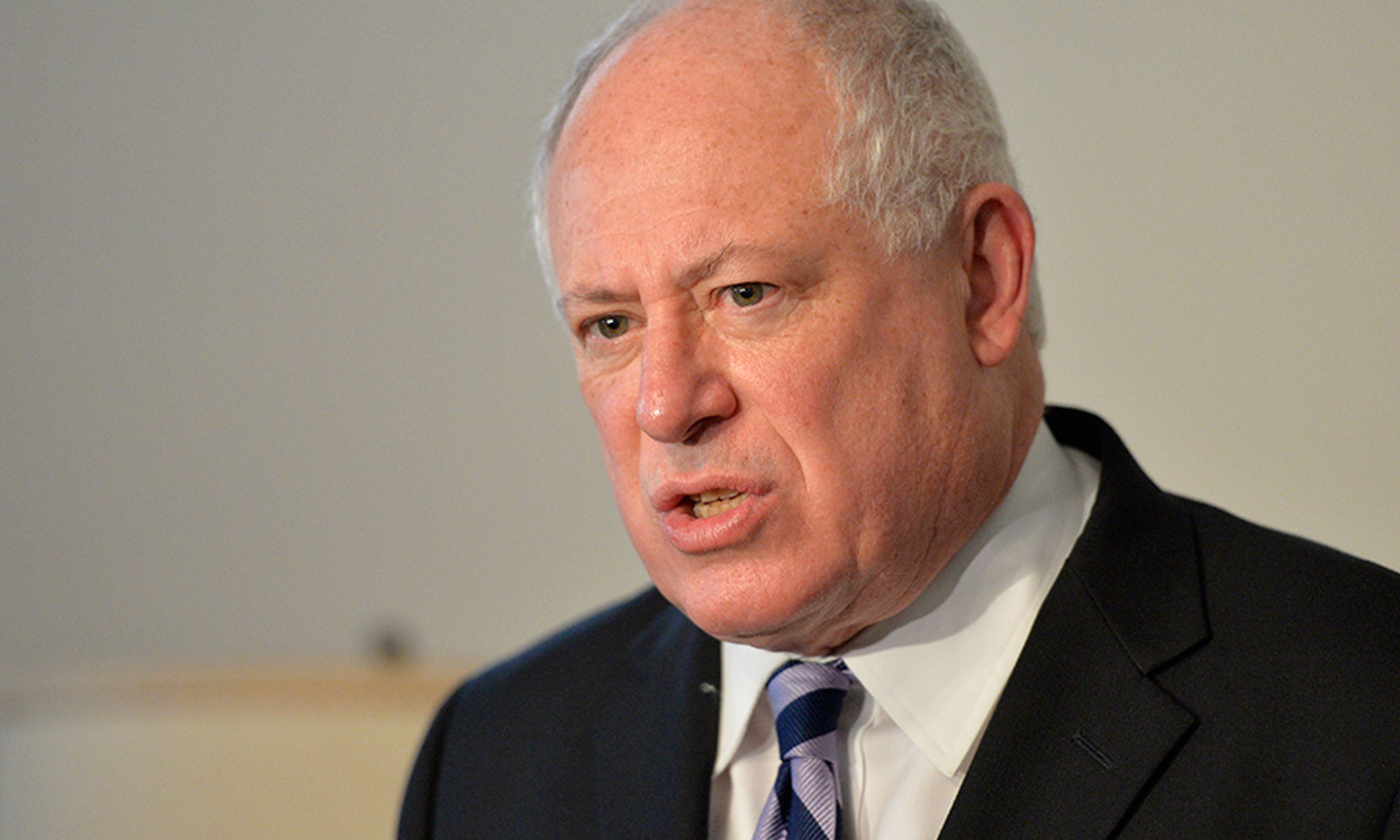
It might seem like a sign of political desperation when the Democratic governor of a blue state runs a TV ad enthusiastically talking up his fiscal restraint. But Illinois governor Pat Quinn’s recent spot, in which he tends his lawn with an old push mower, sporting cargo pants and a few extra pounds, is even stranger than it looks.
As he pushes the mower, he looks squarely into the camera and boasts of closing “50 state properties” and cutting state spending. In a state with Illinois’s dreary fiscal outlook, those claims might seem like a winner. For Quinn, however, they threaten to resurrect black marks on his tenure and inflame a key Democratic constituency. What he does not mention explicitly in the ad, but what Illinois voters, particularly those downstate, are sure to remember, is that some of the properties he shuttered were prisons, including the state’s only super-max facility, and that one of his budget-saving measures was a secret 2009 program that allowed for the early release of upward of 1,700 inmates before they’d served their sentences.
On the website of the American Federation of State, County and Municipal Employees (AFSCME) Chapter 31, based in Illinois, you can get your fill of attacks against Quinn’s Republican opponent, Bruce Rauner. But the governor’s decision in 2012 to close the Tamms super-max prison and a women’s maximum-security prison pitted him against the union, which warned that the closures would lead to overcrowding when inmates were relocated. It staged protests against the measure.
When two guards and a chaplain were attacked by a group of inmates at a prison in Champaign, Ill., in February 2013, AFSCME members blamed the closures. When a female guard was called into a laundry area and assaulted at a Springfield, Ill., prison in May 2013, the union again blamed overcrowding: Inmates, according to the Associated Press, were sleeping in the prison’s gymnasium rather than in cell blocks. Even a 2012 report from a prison-monitoring group that supported the closures cited concern about “aggressive cellmates” and crowding, before a series of violent incidents unfolded in early 2013.
In fact, one of Quinn’s budget-cutting measures nearly cost him the 2010 Democratic primary. In late 2009, the Associated Press revealed a secret prisoner-release program that let inmates ranging from drug users to violent offenders to gang members — over 1,700 in total — back on the streets before they’d served almost any time at all. The program, known as MGT Push, allowed accelerated release for good behavior, or “meritorious good time” available almost immediately after a sentence began. Several went on to commit violent offenses. Quinn’s 2010 Democratic-primary challenger, former Illinois comptroller Dan Hynes, repeatedly cited the case of Edjuan Payne, who in 2009 was released as a part of the program after serving two months for parole violations. Months later, he murdered a grandmother and severely injured her eight-month-old granddaughter. Quinn himself called the program a “big mistake.” The report he commissioned on it concluded, “While pursuing cost-saving measures, it neglected the most important consideration — the potential impact on public safety.”
Quinn, who landed in the governor’s seat after the Illinois senate ousted former governor Rod Blagojevich, narrowly survived his last election, winning his primary by just 8,500 votes and the general election, in deep-blue Illinois, by less than one percentage point.
This year, Quinn may not be so lucky. He’s already trailing Republican Bruce Rauner in the polls. In 2010, he won only three counties in downstate Illinois, where the now-empty prisons are located, and this year he is proving an electoral drag on all Democrats in the region.
Shortly before his death in 1987, Quinn’s old boss, former Chicago mayor Harold Washington, said his decision to appoint Quinn revenue director at city hall had been “nuts.” He went on to describe Quinn as a “totally and completely undisciplined individual who thinks this government is nothing but a large easel by which he can do his PR work.” Of course, Washington had handed him the brushes in the first place. This fall, Illinois voters might finally take them away.
— Eliana Johnson is Washington editor of National Review.






Comments