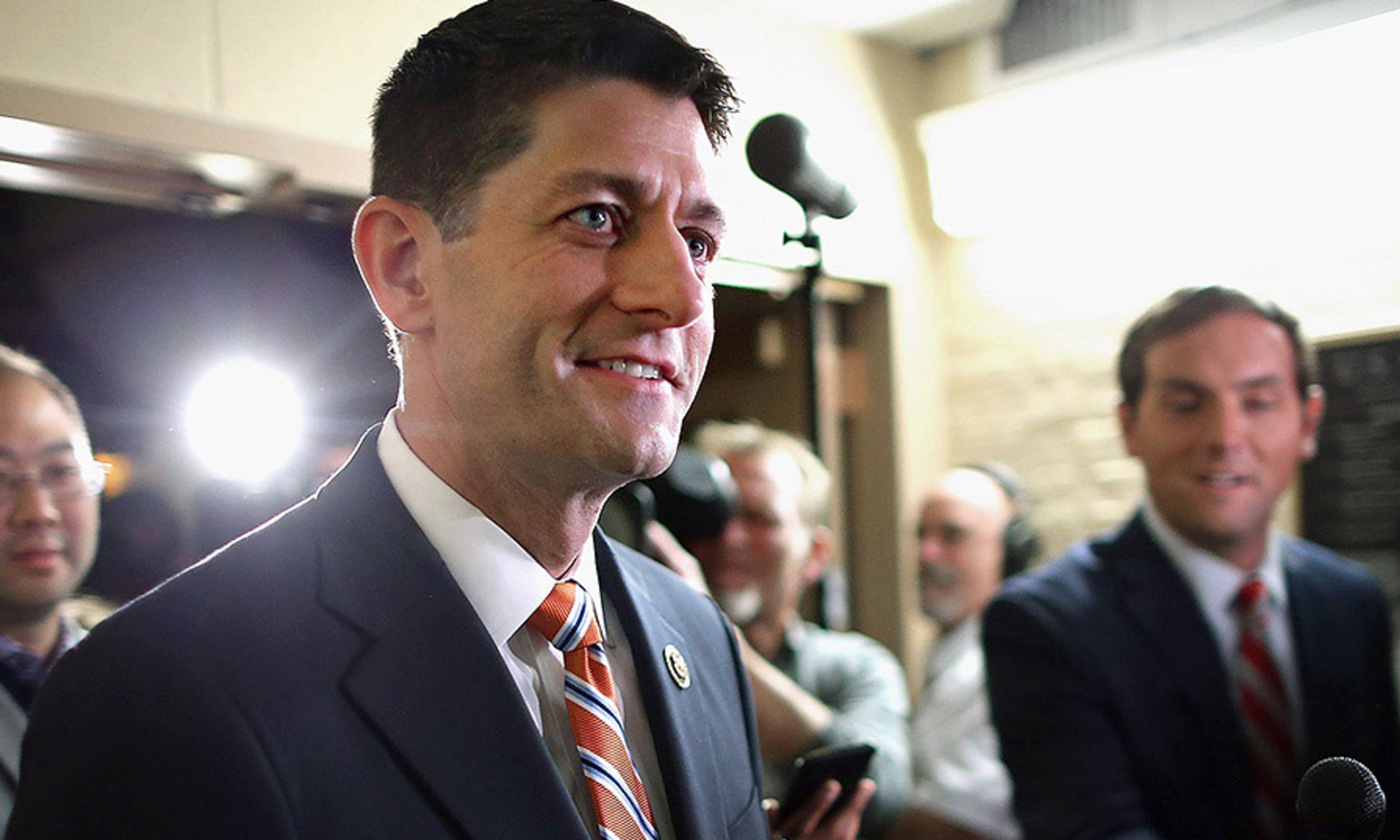
House Freedom Caucus (HFC) members filed into the Capitol early on Wednesday morning. They’d had a restless night, grappling with the quiet chaos unleashed by Paul Ryan’s announcement of a conditional bid for speaker. Ryan’s terms were steep, including weekends off, limited travel, and a scaled-back role in GOP campaigning and fundraising. But that morning, the House’s rightmost flank, the beating heart of the anti-establishment fervor gripping the Republican conference, had only one demand to confront: its formal endorsement.
It wouldn’t ultimately come, and it didn’t ultimately matter. After a day that would end with concessions from both sides — the HFC publicly announcing that Ryan had supermajority support from its members, even though he failed to clear the 80 percent required for a formal endorsement, and Ryan backing off his seemingly ironclad demand for such an endorsement to signal that the supermajority would do — Ryan emerged all but guaranteed to be the next speaker of the House.
Mere hours after his announcement in a private conference meeting on Tuesday, Freedom Caucus members scheduled a sit-down with Ryan to discuss his terms. Tensions were tight as representatives such as Tim Huelskamp wrestled with what they had just heard. It quickly became clear that the biggest sticking point was Ryan’s request for unspecified changes to the motion to vacate the chair — the Thomas Jefferson–authored procedure that gives rank-and-file members the power to oust a sitting speaker. Huelskamp, pacing alone with headphones in the nearly empty basement of Rayburn, shook his head. “Is Ryan thinking he’s better than Jefferson?”
RELATED: How Paul Ryan Got from ‘Never’ to ‘All In’ for Speaker
Huelskamp was not alone: For most Freedom Caucus members, Ryan’s message read like a power grab, uncomfortably reminiscent of the heavy-handed tactics they had been fighting to purge from House leadership for months.
The Wednesday-afternoon conference was arranged as a way to clear the air, allowing Ryan to address qualms about his desired rules changes. Just as important, it gave the Freedom Caucus a chance to test whether all of Ryan’s terms were truly etched in stone.
Expectations were mixed among members as they gathered across the marbled floors of Ryan’s stomping grounds, the Ways and Means Committee. Representative Mark Meadows strode in feeling “hopeful,” as befits someone often labeled the most congenial member of Congress. He told me he was “convinced” that the meeting would “illuminate” areas in which Ryan and the Freedom Caucus could achieve common ground.
RELATED: Speaker Ryan’s Conditions
But mingling with reporters before the meeting, representatives like David Brat and Paul Gosar didn’t hide their skepticism. “I’m optimistic in person with Ryan,” Brat said. “But I taught ethics for 18 years. What you look for there is what people are willing to actually put down on paper.”
“I don’t appreciate that he’s even putting forth demands in the first place, especially when there are other candidates in the room,” Gosar said. “He’s not showing that the power should lay in the 435, not the speaker.”
At the suggestion that the Freedom Caucus might decide to throw its weight behind Ryan for a formal endorsement after more talks, Gosar was definitive: “It’s not going to happen.”
He was right.
That morning, Freedom Caucus members expected to spend the day meeting with Ryan and then mulling their potential endorsement. They were in no rush: Ryan had publicly given them until Friday to decide, and they intended to take their time. But by Wednesday evening, the tide had shifted. Around 7:45 p.m., Freedom Caucus co-founder Raul Labrador entered the scrum of anxious reporters gathered outside 441 Cannon, where the HFC had been debating for a few grueling hours, with a resolution: Support for Ryan had reached what he called a “supermajority,” but had failed to clear the 80 percent needed for a formal endorsement under the caucus’s rules. There would be no endorsement.
Struggling for room against the onslaught of microphones and cameras, Labrador emphasized that, though no consensus was reached for a formal endorsement, “two-thirds of the caucus” would be voting for a Ryan speakership.
Representative Mick Mulvaney translated: “If [Ryan] wants to be speaker, he’s got the votes.”
Ryan issued a statement shortly after the decision, signaling that he was prepared to move forward in the race even without the HFC’s formal backing. “I’m grateful for the support of a supermajority of the House Freedom Caucus,” he said. “I believe this is a positive step toward a unified Republican team.”
#share#To listen to Gosar and other restive HFC members tell it earlier in the day, the turn of events was inevitable. There was too much discontent, too much offense taken by what Meadows, who filed the motion back in July to dethrone Speaker John Boehner, called a potentially fatal undermining of the “process” for electing a House speaker. It galled the conservative caucus that anyone could win the third most powerful office in the nation by making demands while seeming to reject any possibility for negotiation — and yet, a fatalistic resignation had set in. It was a feeling that registered in every conversation I had with members early on Wednesday, a grimness that at times tinged the rhetoric of even the perpetually upbeat Meadows.
But that evening, Labrador and the members who followed him out of 441 Cannon exuded warmth, even tempered excitement. On the whole, “we will vote for him,” Labrador said. “We need to move forward, because it’s time for the conference to unite.” He reported that he had personally voted for Ryan.
It wasn’t pretense, and it wasn’t the relief of a long day finished. It was a genuine sea change in the outlook of the Freedom Caucus, a signal that, between that morning and that evening, Ryan was able to convince the lion’s share of HFC members that he did in fact respect, and would promise to uphold, the process they held so dear. Equally important in that timeframe was the increasingly shared understanding among Freedom Caucus members that to hold up this election, to draw a hard line against Ryan’s candidacy, just as they were criticizing him for drawing hard lines, would endanger their political capital.
Even Gosar, who remained adamant that he would support Webster, expressed unease about the damage that could come with an outspoken attempt to undermine Ryan’s bid: “It’s becoming harder for me to know how that could play out,” he said.
Ultimately, the supermajority support was an olive branch, a plain indication that, when it comes to bridging divides between House GOP caucuses, Ryan is likely unmatched.
It would be a grave mistake to view the caucus’s “supermajority support” as a “no.” It was the closest thing to a “yes” that a candidate such as Ryan, cozy with leadership and the establishment wing, could ever hope to earn from this group of lawmakers. One member texted me just 20 minutes before the decision was announced, saying that there was a “chance” they could rope in the 80 percent of members needed. But a microscopic look at the day shows that there really never was a chance for an endorsement. Ultimately, the supermajority support was an olive branch, a plain indication that, when it comes to bridging divides between House GOP caucuses, Ryan is likely unmatched.
It is telling that, when Labrador made the announcement, he kicked it off not with the fact that the Freedom Caucus would not endorse Ryan, but instead the fact that “two thirds of us” would be supporting his bid.
It would be easy to suggest that this was politics at its finest, a testament to Ryan’s ability to make nice, a fulfillment of Brat’s fear that Ryan could play the game face-to-face, but not on paper. But as Mulvaney happily reported upon leaving 441 Cannon, it was, in reality, proof positive that Ryan had actually convinced a supermajority of the Freedom Caucus that he would not hang them out to dry, and that their voices mattered. Through promises to uphold the Hastert Rule, which requires that legislation achieve majority support from the GOP caucus before going to the floor, and to maintain the procedural integrity of the motion to vacate the chair, Mulvaney said that Ryan had changed enough caucus members’ minds. The prevailing feeling now was that Ryan was a sure bet for “chang[ing] business as usual in Washington D.C.”
#related#Ryan, of course, still must square off against Florida’s Daniel Webster, who continues to enjoy support among the rightmost members of the House, and who will undoubtedly launch a spirited campaign, riding the wave of anti-establishment sentiment currently washing over the party. But after Wednesday’s events, that contest is looking like a formality. Many are estimating that Ryan’s vote count already lies somewhere between 220 and 235 votes, easily more than the 218 he needs.
Ultimately, the gavel is Ryan’s for the taking. Labrador wouldn’t even rule out the possibility that the Freedom Caucus could change its mind, moving to formally endorse him before Friday.
“If he wants to come back and convince a few people to switch it to an endorsement,” Labrador said, they’re prepared to listen.
— Elaina Plott is a William F. Buckley Fellow in Political Journalism at the National Review Institute.




Comments