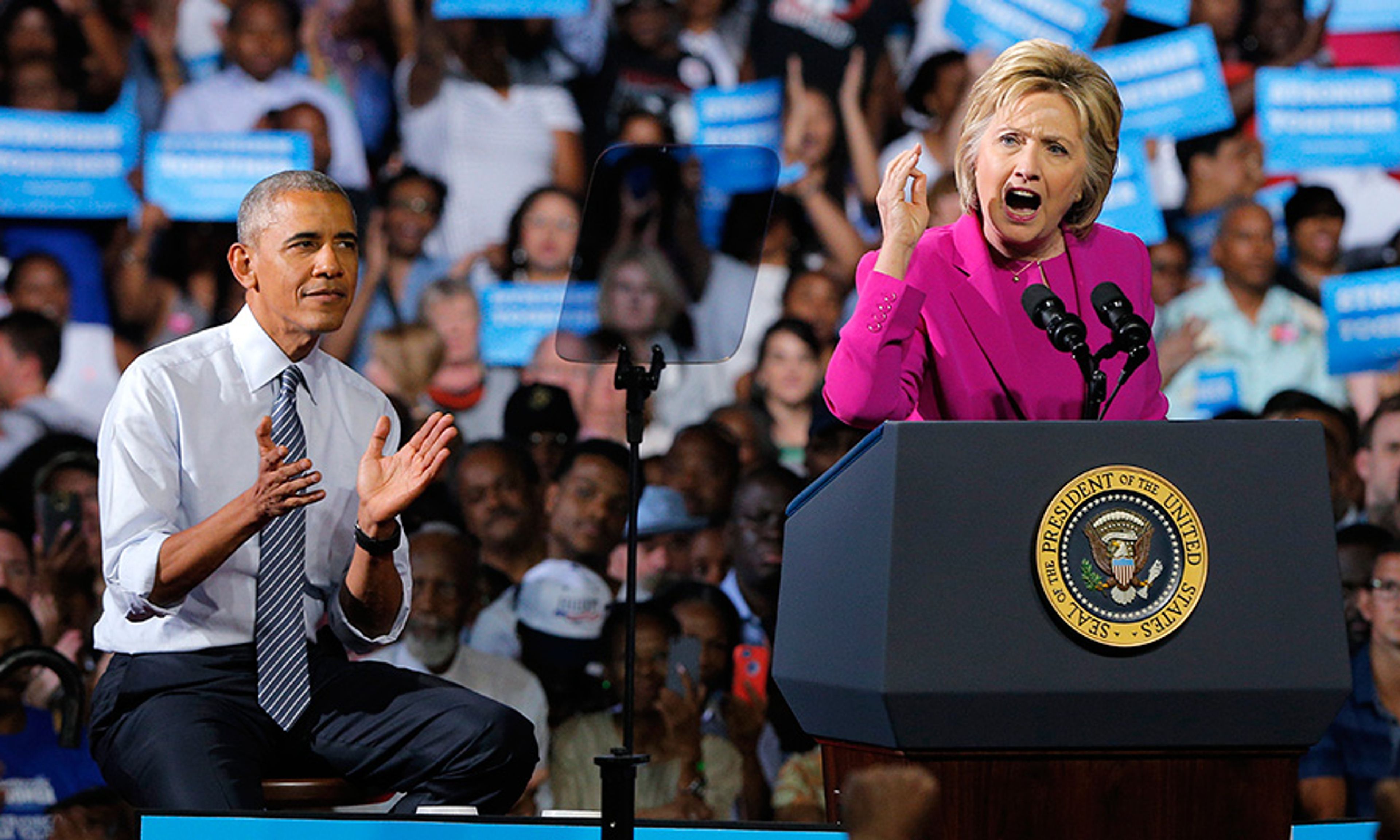
This week, President Obama headed down to Louisiana to view the flood damage in Baton Rouge. He’d resisted doing so for weeks; according to political ally Chris Cillizza of the Washington Post, Obama “believes he can monitor the situation as well — or better — from where he is. And that the sole reason to go to Louisiana is for the theatrical piece of politics, a piece that he not only rejects but detests.”
Of course, Obama didn’t detest such politicking in 2012, when he flew to New Jersey to view Hurricane Sandy damage — and then took Chris Christie for a romantic stroll along the boardwalk. And he didn’t detest visiting Louisiana flood areas when he blasted George W. Bush for seeing the victims of Hurricane Katrina “from the window of an airplane instead of down here, on the ground.”
This, of course, is why only about half of Americans consider Obama honest. And that’s a higher number now than it has been in years.
Obama isn’t the only dishonest national politician, of course. Hillary Clinton lies routinely to her own supporters. She campaigned on the ridiculous pledge to stop crony politicking — but meanwhile, she’s been plagued by allegation after allegation of pay-for-play corruption at the State Department, where she traded access for donations to the Clinton Foundation Official Slush Fund. Hillary says she wants to take the rich down a peg, but she and her husband turned their “dead broke” status into a $100 million fortune on the back of backscratching from friends at firms such as Goldman Sachs — companies she pretends to hate.
Just 11 percent of Americans think Hillary Clinton is honest and trustworthy.
Then there’s Donald Trump, who spent the early part of this week walking back his hardline position on illegal immigration. After flip-flopping positions on every issue from due process for gun removal to punishment for abortion, Trump has reportedly decided to renege on his central campaign promise: to deport 11 million illegal immigrants.
Just 16 percent of Americans think Trump is honest and trustworthy.
Americans know our politicians lie to us. And yet we’re more loyal to politicians than we’ve been any time in recent history.
Honesty and trustworthiness are now seen as obstacles to political success.
Personal unpopularity, as pollsters have noted, now seems completely disconnected from election results. Voters know they’re pulling the lever for liars and charlatans, but they don’t seem to care. In fact, they seem averse to candidates who tell them precisely what they’re going to do. The most truthful candidates in the Republican primaries did the worst: According to a February 2016 Quinnipiac poll, for example, 72 percent of Republicans said that Marco Rubio was honest and trustworthy; 70 percent said that Jeb Bush was; 65 percent said John Kasich was; 62 percent said Ted Cruz was; just 60 percent said Trump was. Among Democrats, 87 percent said Bernie Sanders was honest and trustworthy, while Hillary Clinton clocked in at just 61 percent.
Guess who won.
There are two reasons for that.
First off, honesty and trustworthiness are now seen as obstacles to political success. Americans think that the government is so corrupt that we need corrupt people to fix it — people who won’t work within the system, but who will instead shatter it. New Trump campaign CEO Steve Bannon, a bona fide former Goldman Sachs Beltway insider turned faux-political outsider, expresses the sentiment well: “Lenin wanted to destroy the state, and that’s my goal too. I want to bring everything crashing down, and destroy all of today’s establishment.”
Democrats nominated Hillary Clinton to use her corruption on behalf of leftism. Republicans nominated Donald Trump to use his corruption on behalf of nationalist populism.
Then there’s the second reason: In the absence of loyalty to political principle, Americans instead fall into god-worship for their politicians. Most Americans believe in certain political solutions: higher taxes or less regulation, more military funding or criminal-justice reform. But few Americans have a coherent political worldview. Why is one solution better than another? Why should we respect some rights while quashing others?
For decades, both Left and Right have answered: Certain policies are better because certain policies are more effective. But effectiveness isn’t a foolproof argument, thanks to the complexity inherent in politics. For example, which was responsible for the 1990s economic boom, Ronald Reagan’s tax cutting, or Bill Clinton’s tax increases? Who was more responsible for the economic collapse of 2008, Clinton for his sponsorship of subprime lending, or George W. Bush for not restricting investments by banks? Policy experts battle these issues out daily, but there’s no clear-cut answer (though some arguments are significantly stronger than others).
In the end, most Americans decide which policies they prefer on the basis of morality. And because Americans no longer learn political morality — they no longer learn about the moral framework that supports the Declaration of Independence and the Constitution — they fall back on bumper-sticker morality.
Democrats believe in “Stronger Together.” Republicans believe in “America First.”
These slogans have little meaning in a vacuum. Political leaders must give them meaning. And so Americans fall in behind politicians they don’t trust to impose slogans that mean nothing, but give them a sense of meaning. The politicians need not fulfill any philosophic worldview — they need only offer an agglomeration of policy positions under their broadly agreeable rubric. Hillary’s flip-flopping on the Trans-Pacific Partnership doesn’t threaten her “Stronger Together” sloganeering. Trump’s flip-flopping on immigration doesn’t change that he believes in “America First.”
And so we get politicians who lie — and we celebrate their lies, since only liars can win in a corrupt system.
The only corrective to this perverse marriage of cynicism and star-worship lies in a revival of principle. Imagine a world in which we hold our politicians to the standard of God-given rights protected by a government designed not to invade those rights, in which interest checks interest, in which states and the federal government balance each other in a great ongoing battle for power.
That was the vision of the Founders. And that vision meant that Americans demanded that our politicians not lie to us — that they cohere to our worldview, and stand for that worldview in the eternal grinding of gears that the Constitutional structure represents.
Until we have such a vision again, we’ll get petty, corrupt politicians we worship as saviors from our petty, corrupt system. We’ll cheer them because they mouth dumbed-down slogans three generations removed from any real philosophic underpinning. And then we’ll wonder why our politics continue to degrade.



Comments