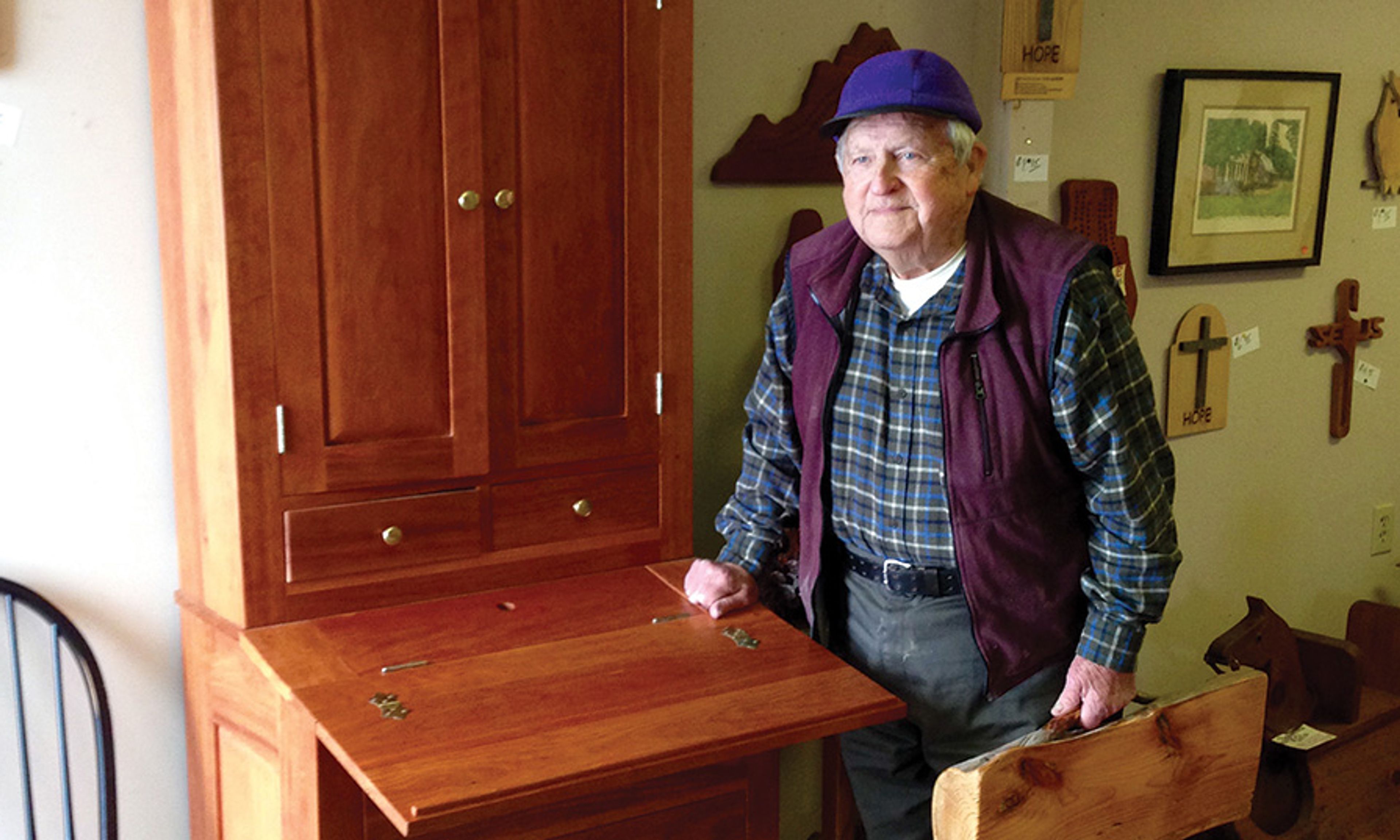
In the current issue of National Review, we have a piece on Clive Babkirk, a “Yankee in the South.” He’s a craftsman from Maine who has long lived in Virginia — the town of New Market, specifically, in the Shenandoah Valley. I would like to expand this piece here in Impromptus.
Mr. Babkirk is not a public figure. He’s not a politician, TV actor, or rock star. He is simply one of the most gracious, and eloquent, and likable people I know. And I thought many readers would like to know him too.
‐I told him I wanted to come see him. He said, “When are you comin’? As they say down here, I’ll get a hold of a woodchuck, and we’ll have woodchuck stew.” Hearty laughter. Then he said, “I would make rabbit stew, but they move a little fast for me now.” More laughter.
‐Clive has one of the richest, most distinctive, most redolent New England accents you’ll ever hear. The same is true of his wife, Lois, who is also from Maine. You hardly hear these accents in New England anymore, to say nothing of the Shenandoah Valley.
The homogenization of speech: one of the saddest developments in America (and a subject I’ve written about all too often).
(Speech is being homogenized for happy reasons, largely: prosperity, mobility, etc.)
‐Clive Babkirk is a woodworker and furniture-maker. He can make things large and small. He can create virtually anything out of wood, and has. His business card says, “50 years of creating happiness.”
‐He was born in Berlin, N.H., in 1928. When you pronounce the name of the town, you put the accent on the first syllable: “BER-lin.” Clive’s father was from extreme northern Maine — the Swedish settlements of Aroostook County. This was potato-growing country. But the Mainer was in Berlin because he had found work at a paper mill. The town stank — there’s almost nothing like the smell of a paper mill — but it provided jobs.
Clive’s mother had a couple of reasons to call her baby “Clive.” First, there was a movie actor, Clive Brook. Second, there was “Clive of India,” Robert Clive, the British general and statesman in the 18th century.
‐Our Clive — Clive Babkirk — goes by both “Clive” and “Kirk,” his nickname. His original Scottish ancestor in North America was James Kirk (“kirk” meaning “church,” of course, in Scotland). Somewhere along the line, this James picked up “Bab.”
Clive is a typical American blend. “I’m mixed up,” he says. On his dad’s side, he is Scottish and Swedish. On his mother’s, French and Irish. “People say, ‘You’re a good-natured cuss.’ I tell them, ‘That’s my Scottish and Swedish side. Don’t get me upset, though, because my French and Irish will come out. And then you’d better start runnin’.’”
‐He is free with remarks about the fabled cheapness — or frugality — of Scots. Citing a real bargain, he’ll say, “That’s a Scotch deal.”
‐In the teeth of the Depression, the mill in New Hampshire went bust. Clive was three at the time. His father took the family back up to Maine, where he had come from: to the farms of Stockholm, at the very top of the state. In all, the family had four children. At least they wouldn’t starve to death.
Times were lean, though. “We had rolled oats for breakfast,” says Clive, “and then Mum would fry ’em in a little bacon fat for lunch.”
‐Would you like a taste of perfect Babkirkian English? Once — well, more than once, but on this particular occasion — little Clive got his mother mad. “She was some upset,” he recalls.
‐An uncle of his had a shortwave radio. It got Germany. Clive heard someone yelling on it — Hitler. Whenever there was a pause, Clive asked, “What’s he doin’?” The uncle would answer, “He’s gettin’ a mouthful of sauerkraut.”
‐Several years before he learned to drive a car, Clive learned to fly a plane. He was taught by a trapper — Freddie Anderson, the Flying Trapper.
‐Clive’s mother was born Ellen Nordica Norton. That peculiar middle name came from her great-aunt, Madame Lillian Nordica — who was present at the girl’s birth.
Madame Nordica was born Lillian Allen Norton in Farmington, Maine. A soprano, she became the first American opera singer to achieve world renown. She was known as “the Yankee Diva” (as Joyce DiDonato, the mezzo-soprano from Kansas, is today).
‐According to Clive, his mother could sing, too. She would sing when she was down on her hands and knees, scrubbing the floor. When he was a boy, Clive heard this every day.
‐Madame Nordica was one of the first celebrity endorsers of Coca-Cola. In fact, she was featured in the first national magazine ad that Coke ever ran — the year was 1905. Clive and Lois have a little tray on their kitchen wall: a commemorative item, showing Aunt Lillian, advertising Coke.
‐Clive tells me something about Madame Nordica and her family: They disowned her, some of them, at least. A woman might be able to sing in church. But on the wicked stage, all over the world? (Lillian Nordica died in the Far Pacific — the Dutch East Indies — in 1914.)
‐A clever boy, Clive graduated from high school when he was 15. He had one teacher he thought was nothing but “a lousy old maid.” Her name was Vera Peterson, and when Clive got older, he realized that she had taught him a great deal. She was the best teacher he ever had. Clive never went to college, but he went far.
‐When he was about 17, he was working down in the lower part of Maine. A friend was dating a girl named Ruth. One night, they were going to the movies. Clive’s friend said to him, “Ruth has a younger sister, Lois. Do you want to blind-date her? Do you want to double-date?” Sure, Clive said. They went. Clive and Lois have been together ever since.
Unfortunately, neither one can remember what the movie was. That datum has been lost to history. Lois does remember, however, that they had brownies and strawberry ice cream afterward.
The boys got the girls home real late that night. Clive and his friend thought there’d be hell to pay from the girls’ father. At first, Clive was afraid of this fellow: “He was a big Scotsman.” Come to find out, however, “he was the nicest guy that ever walked on the street.”
‐Clive and Lois were married in 1947. He was 19, she 21. He likes to remind his wife that she’s older than he. But he does this with great affection. “I’ve always liked older women,” he says.
‐Mrs. Babkirk is not related to an opera star, but she is related to a literary star: Ralph Waldo Emerson. Also the Winchesters, of rifle fame. She wonders, humorously, why no money made it down to her.
‐With work unavailable in Maine, Clive and Lois moved down to New Hartford, Conn. Clive caught on as a tool-and-die maker. His employers included Pratt & Whitney and Bendix. But what he really liked to do was fiddle with wood.
I ask, “Did your father have this talent?” “No,” says Clive. “He couldn’t saw a straight line on a board.” But Clive had the talent, and so do his children, or at least some of them.
Clive and Lois had five. One of them, Dale, died at the age of 20. He was killed in a car accident. He was a very talented woodworker, as the things he made prove.
#share#
‐Where Clive did his fiddling around was his cellar. He later rented space at the old Underwood factory. (Typewriters.) He made bookends, pipe racks, cribbage boards, and the like.
These items came to the attention of a man named Bill: a buyer at G. Fox & Co., the department store in Hartford. He took them to a trade show in Chicago. Soon after, Clive heard from the chief buyer at Neiman-Marcus, in Dallas — who wanted as much as Clive could make. This led to orders from Marshall Field’s, I. Magnin, and the rest of the big stores.
‐The first sizable thing that Clive made was a bulkhead — for the yacht of Mr. Fuller, of the brush company.
‐In the mid-1960s, Clive decided to go full time into woodworking and furniture-making. He and the family decamped to New Hampshire, eventually settling in Epsom. The first piece of furniture he made was a desk — for a traveling salesman (which seems a little odd, when you think about it).
“The hardest thing in the world was to build that desk,” says Clive. “Now there’s nothing to it. But that first time, it was a little rough, I’ll tell you.”
To me, this says a great deal about starting out, overcoming obstacles, and going on to prosper.
‐Clive presided over a village, actually: a village of craftsmen. There were blacksmiths, potters, and more.
“This was the hippie era,” Clive recalls, and a lot of hippies came to him. “You could hardly see ’em for hair,” says Clive. They wanted to join the village, the community of craftsmen. Clive said yes — provided they cleaned up and flew straight. Which they did, he says.
And a lot of parents were grateful …
‐Clive’s operation was known as the House of Kirk. He and his people made everything from desks to pipe organs, from beekeeper’s benches to armoires. They sold to ordinary people and to the country’s most prominent families — including the Firestones, du Ponts, and Mellons.
“Which pieces are you proudest of?” I ask Clive. He thinks of a series of rolltop desks he made.
‐In 1985, he and Lois moved down here to Virginia. Why? “For the wood,” says Clive — it was diverse and plentiful in this region. Also, he and Lois had gotten to love the Shenandoah Valley. They got to know it through trips they took from New England down to Florida.
‐When they came to Virginia, they came here to New Market and bought a building — a building intended to be a warehouse. It became a rollerskating rink. Then it became Clive’s shop and factory.
The facility sits on a Civil War battlefield. Eight Confederate soldiers were killed on the very spot, says Clive. And there are three ghosts in the place. They didn’t like the new occupants, the “damn Yankees.” But ghosts and Yankees have made their peace, says Clive. They are living harmoniously together.
‐Clive’s shop is a Willy Wonka wonderland for woodworking and furniture-making. It is loaded with machinery, and patterns, and wood. There are also antiques — including two streetlights from Boston, complete with their stanchions. These are exceedingly rare. Virtually all the other streetlights and stanchions were melted down during World War II. Everything was needed for the war effort.
Clive figures these things are worth quite a lot. “Mother and I could live good off them.”
‐There are a number of curiosities around his shop — including a trail marker (as I understand it) that he got from “a 90-some-year-old Indian who made it when he was a brave.”
‐In addition to working with wood, Clive works with plants and trees, as a hobby. He has tended one ponytail palm for 50 years. (It has a name, Palmie.) There is also a banana tree, a night-blooming cereus, Martha Washington geraniums …
‐Clive stopped making furniture about five years ago, and is now making smaller pieces — “gift items,” as he says. This is the way he started out, back in Connecticut, fiddling around in his cellar.
He has lazy Susans, flying geese, etc. He does business as CAKirk. (His name is Clive A. Babkirk — “A” for “Arthur,” his father’s name. He has long signed his furniture and other items “CA Kirk.”)
His latest project is an ornament — not a Christmas ornament. (He has done lots of those in the past, for the U.S. Post Office.) This is a “forever ornament,” as he says, and it has the word “Hope” on it. “Say you’ve got a friend that’s really hurting,” says Clive. “You give him one of these and tell him that’s an inspiration for him.”
Clive is a believer in God, and goes to Him in prayer. He is also a man of tremendous compassion toward others.
‐Back in New Hampshire, Clive knew several politicians, including Meldrim Thomson, the governor during the 1970s. Thomson was a rock-ribbed conservative. Clive also knew another rock-ribbed conservative, William Loeb, the publisher of the Manchester Union Leader. He has wonderful stories about Loeb.
Anyway, Thomson wrote a memoir, called, naturally, “Live Free or Die.” He inscribed a copy to Clive: “a great American who is an outstanding proponent of the free-enterprise system.”
I say to Clive, “You’re a great supporter of the free-enterprise system, aren’t you?” He says emphatically, “Darn right I am.” I wish you could hear the Maine way he says “darn.” Fabulous.
‐Before we part, I ask another question: “Are you optimistic about the country?” The answer is no. Among the young, says Clive, there is too much “disrespect,” even “hate.” And “it’s hurting our country, terribly.” Too many young people “have no allegiance to what we’re all about, where we come from.”
Now, it could be that Americans in every generation have thought this. But maybe it’ll be true someday? Like now?
‐Nonetheless, Clive is anything but a sourpuss. He has come through a number of hardships — the death of his son Dale was brutal, of course — and he has coped with physical pain for a long time. But he will not be talked into gloom.
“I found out in life that you can smile and be cheerful or you can be down in the dumps. And when I get down in the dumps, it doesn’t take long before I say, ‘Come on, Kirk, this isn’t going to get you anywhere. You got to get back to that cheerful self.’”
Another thing: “The happiest people I’ve seen are the ones with the least. They were happy. I’ve been with people that had the most — they could have bought our town — and they were not happy.”
‐I feel a little unhappy myself when I leave Clive, and Lois. Will there be people like this in the future? Is this kind of American caput? Is the mold broken, forever?
Probably people have thought this since colonial times. There is always another generation, doing the necessary, rising to the occasion, demonstrating good. Anyway, I’m very glad I know Clive Babkirk and his (only slightly older) bride.





Comments