The airport here in Prague is named for Vaclav Havel. Why shouldn’t it be? Unless it should be named for Antonin Dvorak …
‐The customs agent — or immigration officer or whatever she is — is beautiful. I’m not in Kansas anymore. (No offense to the Kansas TSA.) But I am in Prague.
‐Oh, cripe, one of the first signs I see is for Hooters. Well, if there’s a Hooters, there’s civilization …
‐Seriously, Prague is a garden of Eden (whatever its problems). I’ve been lucky enough to come here every few years for many years. Each time, it is more beautiful: more spruced up, more elegant, more striking.
I think of a Czech-born friend, who, with her family, fled this country in 1984. She was 16. Prague is her native city. She has had a beautiful life in our golden state: California. She has a golden family of her own. But I wish she could have enjoyed her native city when it wasn’t a place of oppression and fear.
‐They have renamed the country, as I understand it: It is no longer “the Czech Republic” but “Czechia” — which I like a lot (not that anyone asked me). “The Czech Republic” is rather a mouthful, like “the Dominican Republic.” Often, we say “the DR.” I’m not sure we have said “the CR.”
“Back in the old CR”?
One possible drawback of “Czechia”: Sounds like “Chechnya.” I had a friend who lived in Austria. He said, “If you mail me something, it might wind up in the land of the kangaroos.”
‐I hear a fair amount of Russian spoken on the streets, here in Prague. The people do not appear to be tourists; they seem to live here.
English, of course, is widespread. How lucky someone like me is to have been born into the lingua franca of the present-day world. I didn’t even ask to be.
‐Also lucky for me, it’s lilac time. (“Lilac Time” is the title of an old operetta.) (I realize there aren’t many new operettas.) The lilac bushes are even lovelier in their fragrance than they are in their appearance.
‐A store is called “Made by Praha.” (That last word is the local word for “Prague.”) The sign is in script. It crosses my mind, “They want people to think it says ‘Made by Prada.’”
‐This is very much a musical city, as I’ve noted in journals past. Right now, I’m standing in front of the Rudolfinum. It is resplendent in the sun. I think, “This is what a concert hall should look like” (no offense to modern ones, such as Frank Gehry’s Disney Hall in Los Angeles).
I also think of the great musicians who have led the Czech Philharmonic: Talich, Ancerl, Kubelik, Neumann. Ancerl, in particular, I have always regarded as underrated. A great conductor.
‐I’m happy to have a peek at Smetana Hall. The ticket windows come complete with stained glass. Now, that is class.
‐On the Charles Bridge, someone is winding some device that plays a Joplin rag. I wish he were here to hear it. (Scott Joplin, that is.) I’d like him to know that his fame, his music, is enduring.
‐Last time I heard the Bridge Band — the Charles Bridge Band — they were playing “Sweet Georgia Brown,” with one modulation just slightly wrong. Now they are playing “It’s a Long Way to Tipperary,” in a jazz version. These guys are like the men I saw at Preservation Hall (New Orleans) many, many years ago. But Slavic.
I also wonder, “Are they like the Vienna Philharmonic?” Does their personnel vary day to day? Are there, say, 25 members, of whom a handful will be on the bridge at any moment?
‐The sight of Wilsonova Street reminds me of something: The Continent is dotted with streets — major streets — named after our 28th president. It seems to me that he is in very bad odor at home. But he has long been revered here for a reason — a damn good reason.
We could get into this, over multiple volumes, but I’m loath to go all Arthur S. Link on you …
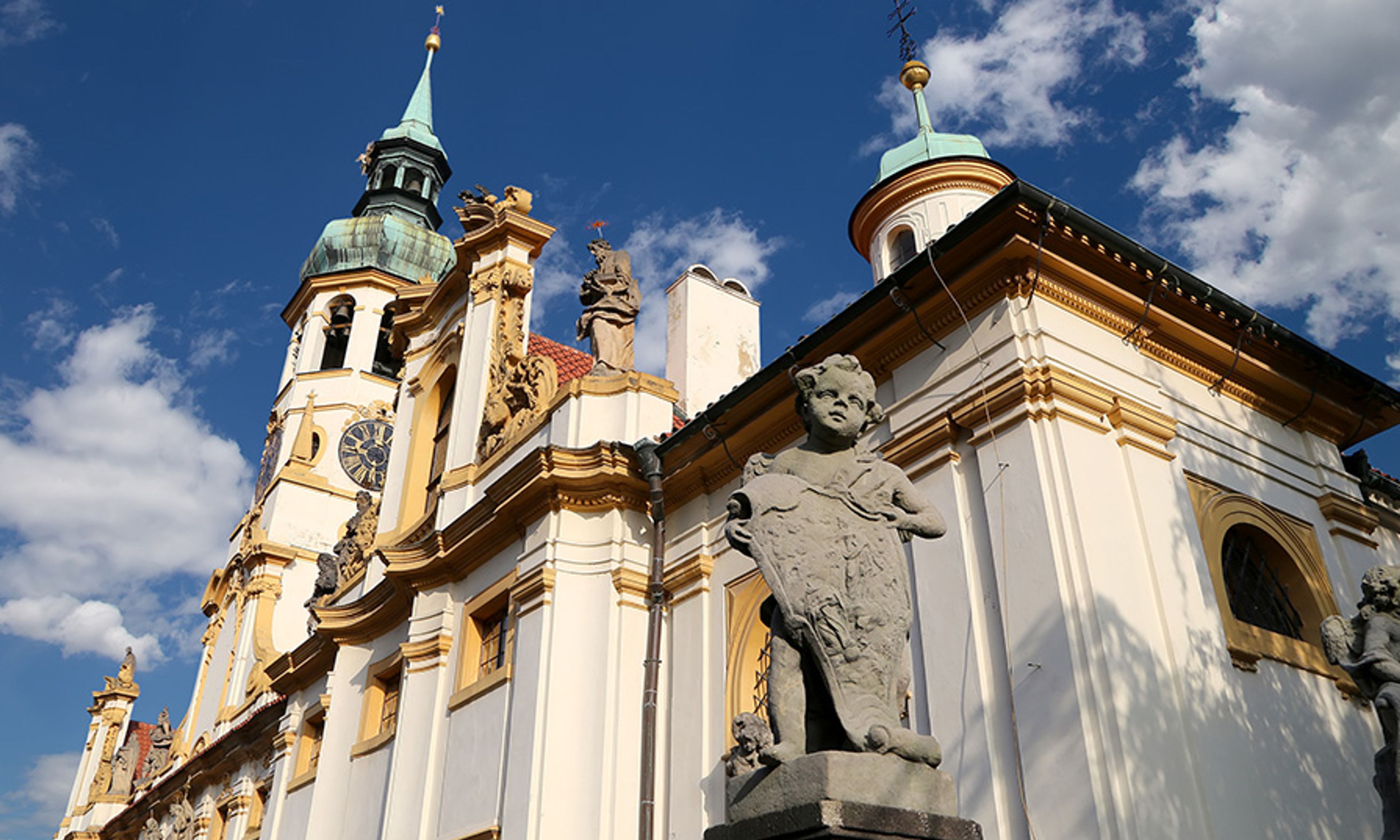
‐If you have a chance to visit the Loreta Monastery, do. It breathes spirituality and beauty. A spiritual beauty. (A sunny, soft spring day helps, true.) Merely being in this place is elevating.
‐I’m not sure about the Chill Inn. That’s a play on “chillin’,” isn’t it?
‐Outside a café is a chalkboard sign: “WiFi Free.” Ah, the perils of English. The sign means, “We have WiFi and you don’t have to pay for it,” surely. But maybe the café is free of WiFi?
‐There’s a guy — there are several guys, throughout the city — making bubbles, dipping some instrument in a pail. More and more, I see this in cities. Many days, I pass a guy in Central Park who does this. People tip the bubble-makers. Children are especially lured, I think. Their parents are obliged to tip.
Well, people have to make a living …
‐The Basilica of St. James is fantastic. It is an exaltation, and gives you that feeling. It is a beautiful, narrow church with a high, high ceiling. There’s something about a narrow church, isn’t there? It has more of a chance, somehow, to be impressive than a wide church.
My appreciation of the place is marred — just slightly — by the rock music coming from the oyster bar across the street.
#share#
‐Leaving the Basilica of St. James, I have a song in my head: “St. James Infirmary,” that blues from New Orleans …
‐Some years ago, I was here on the day of the Prague Marathon — must have been a Sunday. Well, it’s that Sunday again. The finishers draped in foil, or whatever the proper word is, tell the story.
I dodge a run in Central Park most every Sunday, except in the coldest months. That’s what Sundays are for, apparently, at least in cities: organized runs.
‐There was a novel, Le ragazze di San Frediano — “The Girls of San Frediano” (in Florence). Would you like to know about le ragazze di Praha? They are good-looking and, moreover, know it. They make clear they know it. And enjoy it.
High maintenance too, I hear. (A friend from the Balkans once gave me the rundown on Slavic women — their various characteristics. The Czechs came out (1) attractive and (2) high maintenance. The Parisians of Central Europe, perhaps …)
‐This will be slightly mean, but I don’t intend it to be so: If it weren’t for Europe, would James Dean and Marilyn Monroe be as famous as they are? I see their faces much more on this continent than I do at home, I think.
‐Prague is beautiful — a stunner of a city — but every once in a while a Communist building will pop out at you and you’ll recoil, as though assaulted. Take the Hotel InterContinental, by the river. Please. A Commie eyesore, a soul-crushing building, to go with their ideology and practices. It is a monument to ugliness (which, in a way, serves a purpose).
‐Speaking of Communists: I come across a ceremony to mark the end of World War II. It is also a ceremony to celebrate the Communists. Red-shirted children sing. Hammers and sickles abound, as does the red star. A man is dressed in an old uniform (not an old man). People hold pictures of their parents, grandparents, and great-grandparents, I presume. The deceased are wearing their uniforms, and an assortment of Communist decorations.
As for the living, who can begrudge them a ceremony like this, right? But consider: If you prick a Nazi, will he not bleed, too? There is no tolerance for ceremonies celebrating Nazis — replete with swastikas and the strains of “The Horst Wessel Song.”
You know what I’m saying, right? (I know you do.)
‐Enrico Berlinguer was the leader of the Italian Communist party. He died when I was a student in Florence (1984). I remember the ceremony they held for him in the Piazza della Signoria. I was struck by how much like a religious service it was, including homilies and hymns. I felt that I had dropped in on Communist church.
‐We can’t end this journal on Communism, can we? Let’s end it on chocolate. In front of a chocolate shop, there is a sign about a “balanced diet.” A balanced diet is when you hold chocolate in each hand.
I might put it differently: A balanced diet is composed of milk chocolate, dark chocolate, white chocolate …
Thanks for joining me, ladies and gentlemen, and I’ll see you soon for a Danube journal. (Prague’s river is the Vltava, and no one ever claimed it was blue, to my knowledge.)






Comments