Barack Obama has been at pains to convince voters that he cares about jobs. It seems to be a hard sell.
But he can definitely demonstrate that he cares about certain jobs — the 7 percent of private-sector jobs and 36 percent of public-sector jobs that are held by union members.
During his two years and eight months as president, he has worked time and again to increase the number of unionized jobs. As for non-union jobs, who wants them?
Some pro-union moves have a certain ritual quality. Democratic presidents on taking office seek to strengthen federal employee unions, just as Republican presidents on taking office seek to weaken them.
Other steps are more important. Fully one-third of the $820 billion stimulus package that passed with almost entirely Democratic votes in 2009 was aid to state and local governments.
This was intended to keep unionized state and local public employees — much more numerous than federal employees — on the job, and to keep taxpayer-funded union dues pouring into public-employee union treasuries.
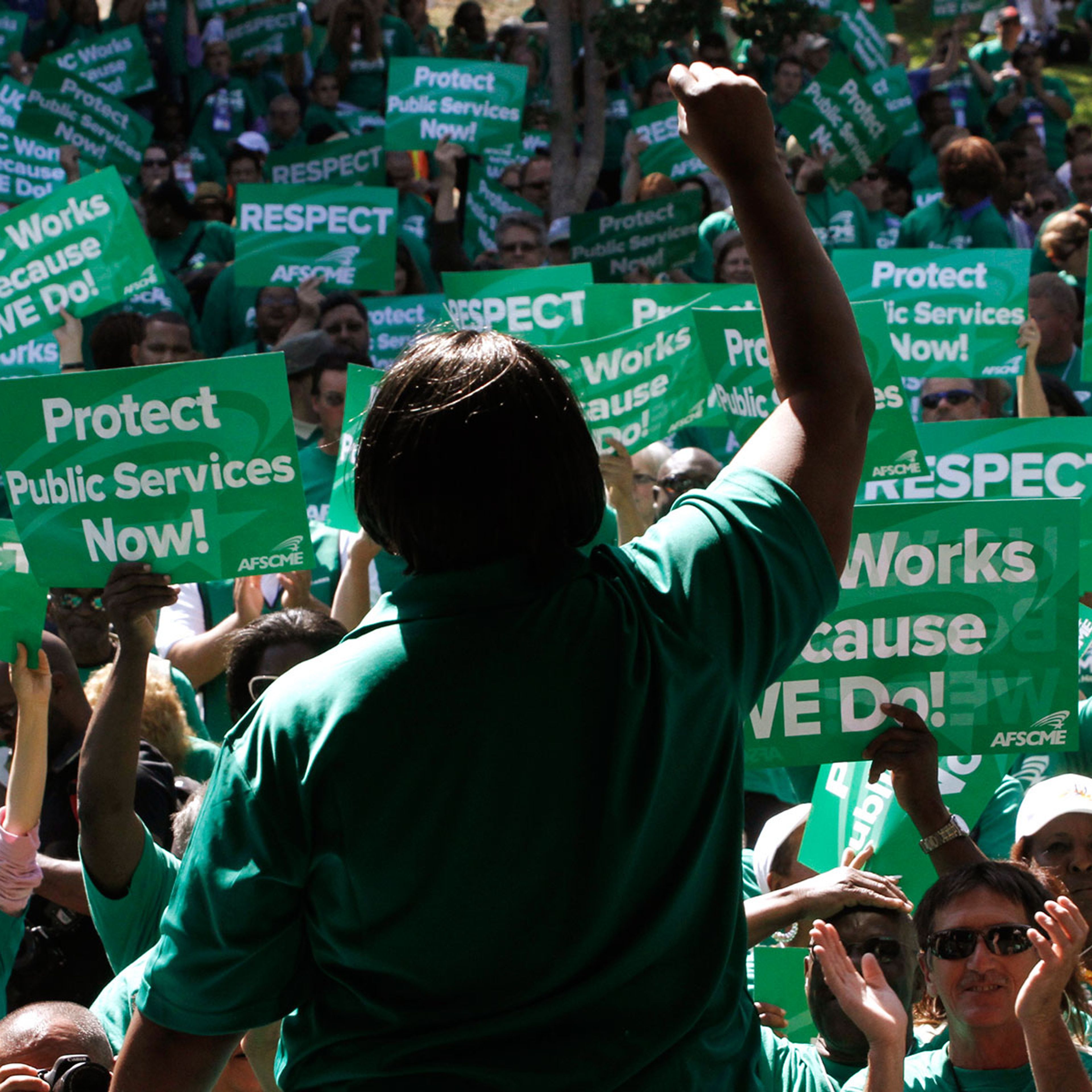
It was just last year that, for the first time in history, public employees came to account for a majority of America’s union members. This is a vivid contrast with the peak union-membership years of the 1950s, when more than one-third of private-sector workers but almost no government workers were unionized.
Which is not to say that the Obama administration has neglected the interests of private-sector unions. In arranging the Chrysler bankruptcy, the Obama White House muscled aside the secured creditors who ordinarily have priority in bankruptcy proceedings in favor of United Auto Workers members and retirees.
That’s an episode that I labeled “gangster government.” Former Obama economics aide Lawrence Summers responded that his White House colleague Ron Bloom had made similar arrangements before. But in those cases, Bloom was working for the unions, not for a supposedly neutral government.
The 2009 stimulus package also contained provisions requiring that construction workers be paid “prevailing wages,” which under the bureaucratic formula turn out to be union wages. That means the public pays a premium for government-financed construction.
It also means that Labor Department bureaucrats must calculate “prevailing wage” rates for as many as 3,141 counties. That takes time, and it’s one reason there were not nearly as many shovel-ready projects as presidential rhetoric led some, including the president, to think.
In the meantime, the administration has gone to great pains to promote union representation in private-sector companies, even where there’s no indication that the employees want it.
It appointed pro-union stalwarts to the board supervising airline-industry unionization elections. That board changed longstanding rules on what counts as a majority, in an attempt to get unions approved at mostly non-union Delta after it absorbed mostly unionized Northwest.
The problem is that the employees kept voting against unionization anyway.
Then there’s the Boeing case.
Obama has called for doubling American exports over the next five years. But when America’s No. 1 exporter, Boeing, built a $1 billion Dreamliner plant in South Carolina, Obama’s appointee as general counsel of the National Labor Relations Board brought a case to force it to shut down.
The theory is that Boeing needs to build the airliner in pro-union Washington state rather than in South Carolina, which has a right-to-work law that prohibits requiring employees to join unions. Maximizing union membership evidently comes before all other goals.
The Obama White House won’t comment on the Boeing case, just as Obama himself had no comment when Teamsters president Jimmy Hoffa, introducing him at a Labor Day rally in Detroit, said of Tea Party backers, “Let’s take these sons of bitches out.”
The president’s eloquent and apparently heartfelt pleas for civility voiced after the Tucson shootings apparently don’t apply to union leaders.
Obama’s partiality to unions is apparently rooted in a conviction that we would be better off if every employee were represented by a union.
The marketplace says otherwise. Private-sector unionism has produced the General Motors and Chrysler bankruptcies, while states with strong public-sector unions, according to a Harvard study, have to pay higher interest rates to borrow money.
But unions do have one positive characteristic from Obama’s point of view: They funnel taxpayers’ or consumers’ money to the Democratic party — $400 million in 2008. So they get one payoff after another in return.
— Michael Barone, senior political analyst for the Washington Examiner, is a resident fellow at the American Enterprise Institute, a Fox News Channel contributor, and a co-author of The Almanac of American Politics. © 2011 the Washington Examiner.





Comments