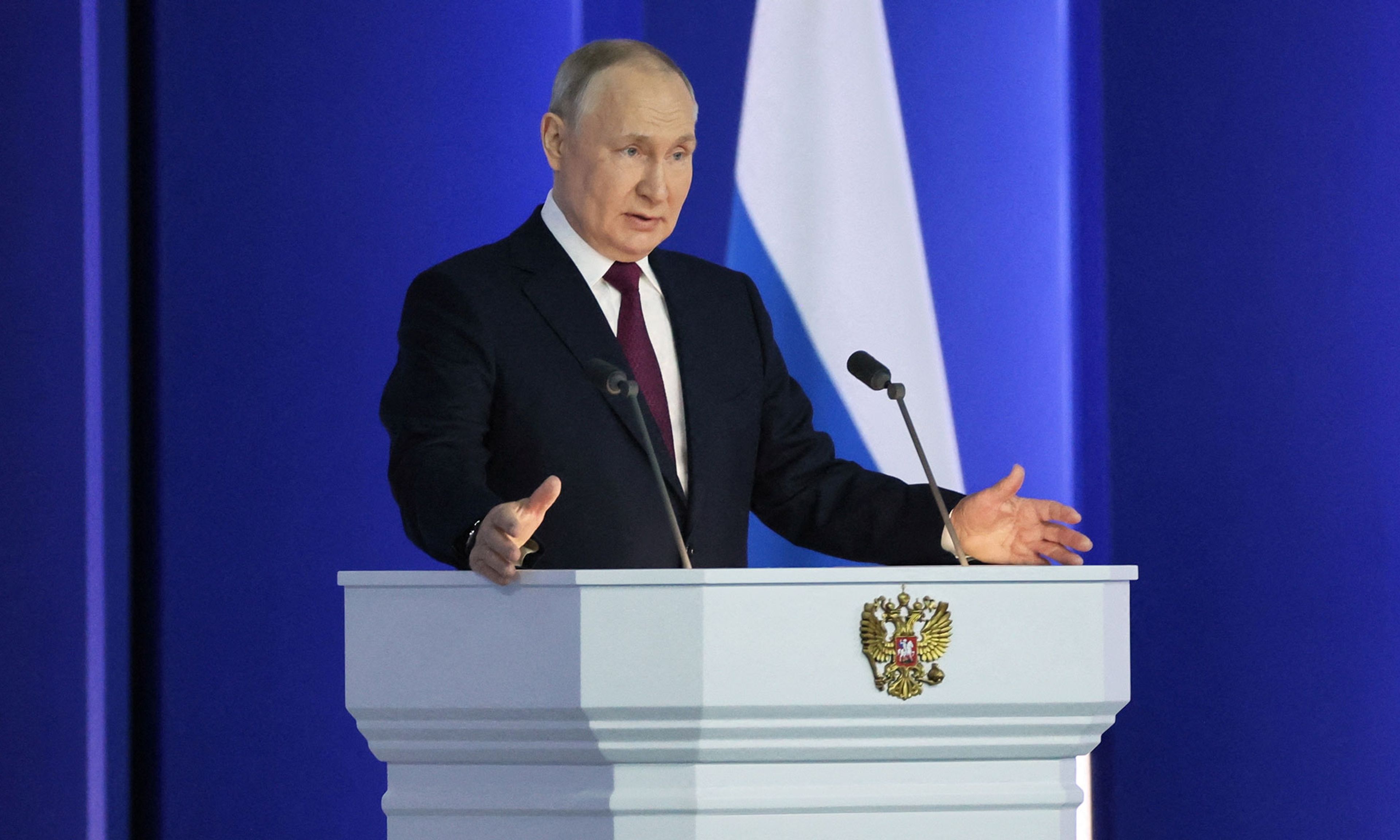
After a year’s wait and just hours before a speech by President Joe Biden in Poland, Vladimir Putin gave his first “State of the Nation” speech since the invasion of Ukraine. In the nearly two-hour address, the Russian autocrat promised to press on in Ukraine, calling the “existential” conflict a “war” for the first time and asserting that the West had started it. He attacked the leaders of the Ukrainian government as “neo-Nazis,” and addressed the West directly, mocking its economic sanctions as a failure and accusing it of normalizing pedophilia, among other social ills. He also made news by officially withdrawing from the New START nuclear-weapons treaty, although Russia had not been in compliance with the treaty for some time.
Subtly referenced in the speech, and undergirding the whole thing, was a message that the Kremlin and its supporters have reiterated again and again over the last year: the notion that Ukraine is a fundamental and historic part of Russia. Putin stated that the invasion was meant “to protect the people in our historical lands, to ensure the security of our country,” and presented Russian forces as “defending human lives and our common home” (emphasis added). He praised the denizens of the Ukrainian regions Russia has attempted to annex, saying “there has been nothing stronger than your intent to be with Russia, with your Motherland.” This view of Ukraine as a territory of Russia, the prime justification for the invasion, was most directly apparent when Putin addressed the Ukrainian people:




Comments