Putin’s Bloody Leviathan

The Russian autocrat’s dark and violent vision of state power is not without precedent — but neither is the Lockean answer to it.

Share this story

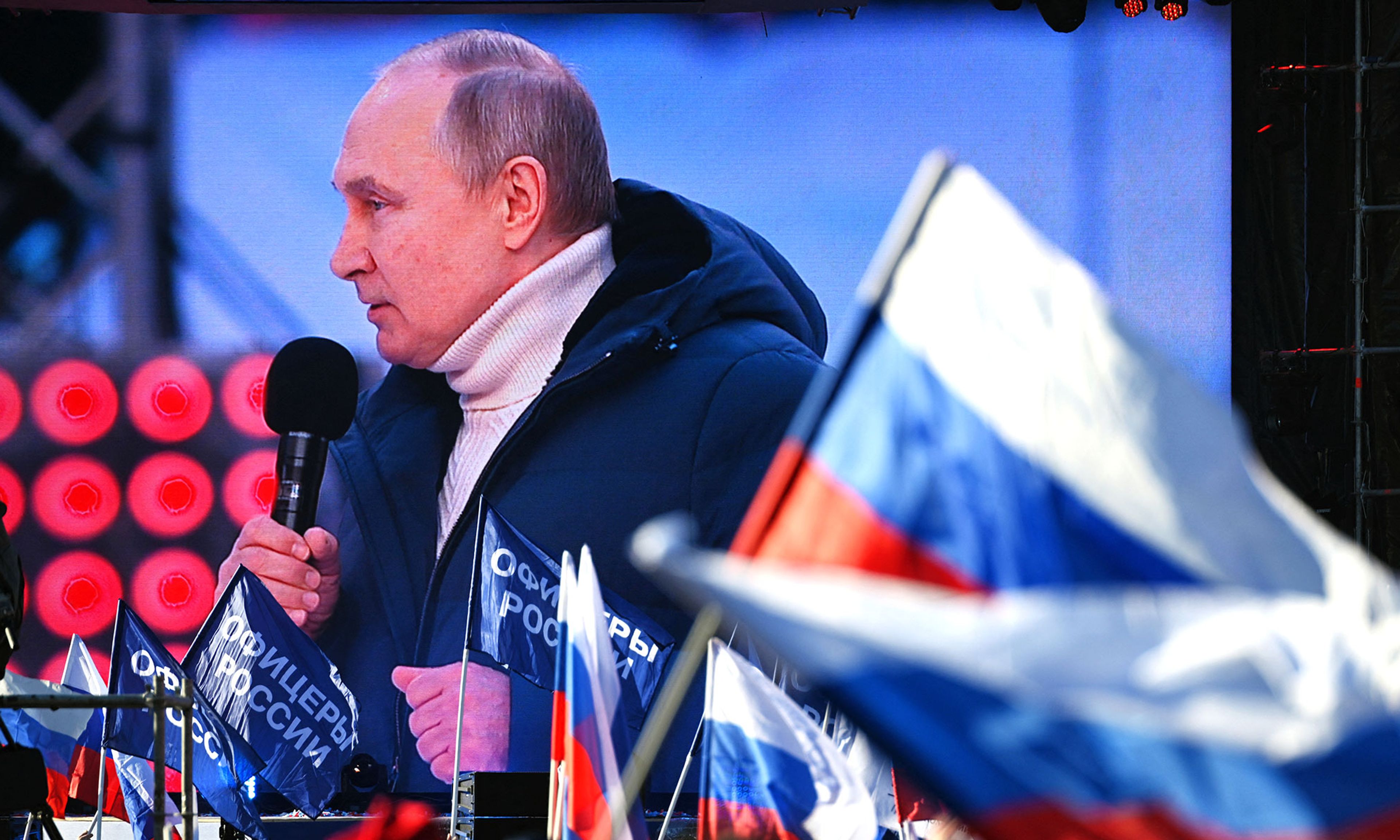
Russian president Vladimir Putin seen on a screen as he delivers a speech during a concert marking the eighth anniversary of Russia’s annexation of Crimea outside Luzhniki Stadium in Moscow, Russia, March 18, 2022.

RIA Novosti Host Photo Agency/Vladimir Astapkovich via Reuters

The rise of authoritarian regimes, wars of aggression, the erosion of basic human rights, a bloody civil war, a refugee crisis in the heart of Europe — welcome to the 17th century.

Out of the turmoil of this period — what historian Paul Hazard called “the crisis of the European mind” — emerged two visions of political society that are once again competing for dominance on the world stage. One belongs to Thomas Hobbes (1588–1679), who saw unconditional obedience to an all-powerful state, a leviathan, as the only path to security and political stability. The other belongs to John Locke (1632–1704), who argued that freedom and equality were mankind’s birthright.
Joseph Loconte

About the Author

Joseph Loconte

Joseph Loconte is the director of The Rivendell Center in New York City and the author of The War for Middle-earth: J.R.R. Tolkien and C.S. Lewis Confront the Gathering Storm, 1933–1945. He serves as a senior fellow at the Sagamore Institute and as the C.S. Lewis Scholar for Public Life at Grove City College. He is at work on a documentary film about the impact of war on the lives of Tolkien and Lewis.

Comments

Advertisement

Advertisement