Ronald Wilson Reagan and Russell Amos Kirk would seem to have little in common. Reagan was known as the Great Communicator. Kirk was once described as “communicative as a turtle.” Reagan lived in the glare and cameras of Hollywood. Kirk preferred a converted toy factory in rural Michigan. Reagan of course became governor, then president. Kirk sought no political office, and served in none, except for justice of the peace.
Yet despite their differences, each had a profound respect for the other. And it is safe to say that conservatism as we know it would not have existed without the both of them. The conservative intellectual movement Kirk inspired through books such as The Conservative Mind bore political fruit in the 1980 election of Reagan. Reagan, in turn, was able to communicate the conservative message–increased liberty, smaller government, hope in America, and traditional values–to an electorate exhausted with the scandals of Watergate and the Carter malaise.
In a collection of essays, Kirk chose Reagan’s election in 1980 as one of the ten conservative events worth remembering. It was a turning point for America, and the world. Kirk spent many years looking for an American statesman that could carry on the mantle of Edmund Burke, the first modern conservative. Nixon, Eisenhower, Hoover, and even Taft ultimately fell short of the abilities Kirk thought were needed to present the conservative case.
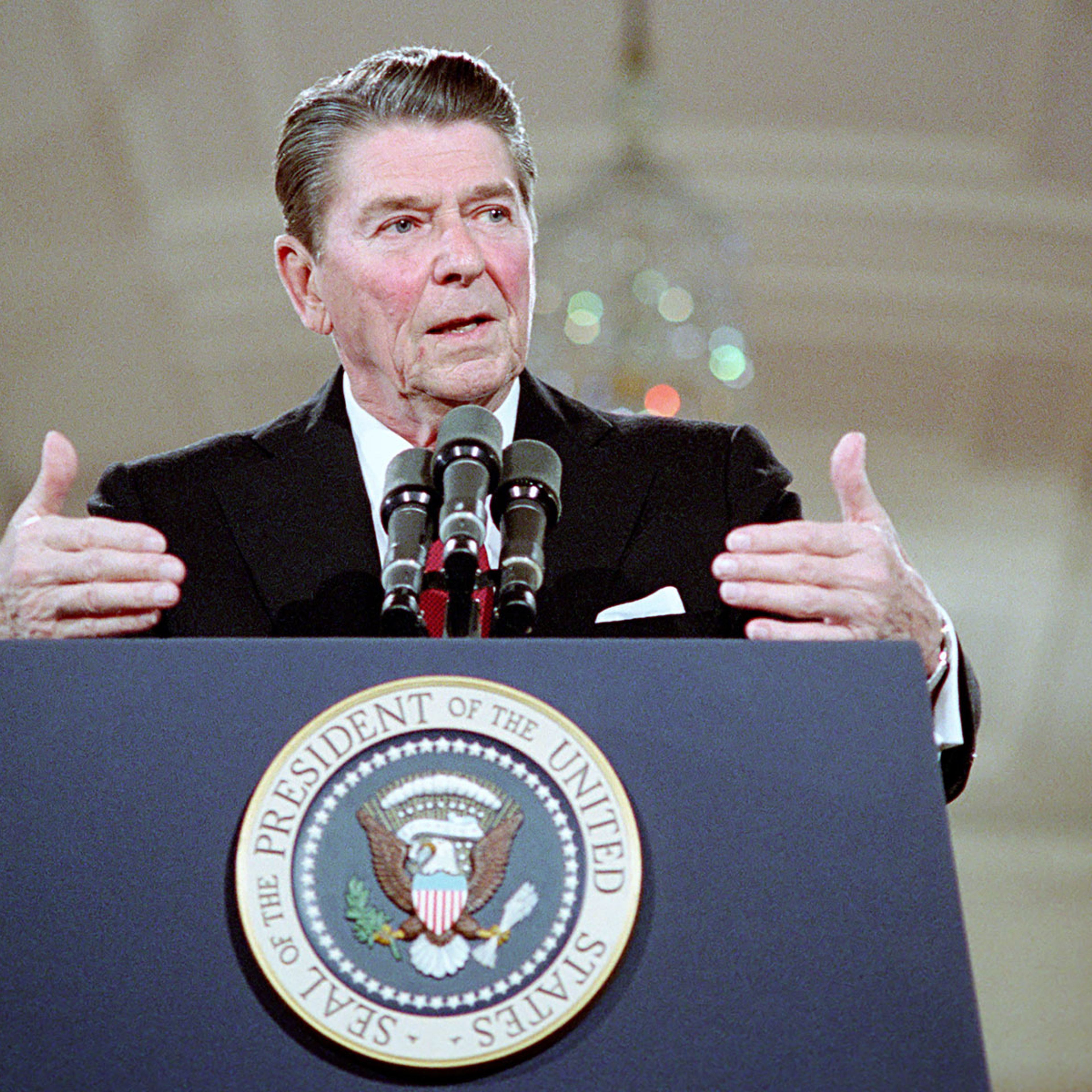
Reagan was of a different mold entirely. He came closest among contemporary American politicians to Kirk’s idea of a creative and imaginative political leader. In his autobiography, The Sword of Imagination, Kirk credits Reagan with winning the presidential nomination with his “humor, candor,” and “the vigor of his speeches.” The ability to conjure images and evoke feelings through words is a skill long honored in the West under the name of rhetoric. Reagan had it, in spades. There was no elitism in his speeches. He simply called on all Americans to succeed. The elites disparaged this combination of strong rhetorical skill with equally strong belief. They preferred the cult-like language of policy, open only to chosen initiates.
In his reliance upon settled American truths, Reagan evoked the language of Lincoln, a political hero he shared with Kirk. Kirk wrote that Lincoln was the first defender of order in America from the common clay–that is, not the aristocracy. He represented the best of what America could offer. In his first inaugural, Reagan too invoked Lincoln, saying that “[w]hoever would understand in his heart the meaning of America will find it in the life of Abraham Lincoln.”
The Southern conservative Richard Weaver, in his book, The Ethics of Rhetoric, stated that traditional rhetoric has a “spaciousness” because it relies on settled truths to communicate with an audience. Reagan intuitively connected to these truths, and conveyed them in a language that was immediately comprehensible. Kirk said of him:
Had a few more Republicans apprehended the drift of public opinion in the United States, and understood how the popular rhetoric of Mr. Reagan spoke to American minds, Mr. Reagan might have been elected years earlier…
Ronald Reagan will be remembered as the President who gave hope to the American people–even great expectations. Old sureties that the ritualistic liberal had mocked were unshaken in Ronald Reagan’s mind; and President Reagan’s reaffirmation of those ancient convictions began to arouse the nation from the discouragement of twenty years or more.
Further, Reagan “really was the Western hero of romance…audacious, dauntless, cheerful honest–and skilled at shooting from the hip.” Indeed, it was these abilities that made Reagan so effective. In speaking of Reagan, Kirk reminds us of William Butler Yeats, who “tells us that everyone ought to make a mask for himself, and wear it, and become what the mask represents. Ronald Reagan put on the mask of the Western hero…and truly lived the part, and became the Western hero.” This was no criticism by Kirk, and turned on its head the criticism that Reagan was “just an actor.” T. S. Eliot, in his essay “Tradition and the Individual Talent,” reminds us that we have to participate in tradition to maintain it, and we do that by taking on the role that history and choice assign to us. Assuming that role takes imagination, and an understanding of the larger story in which you are involved. In speeches such as his D-Day praise of “the boys of Point du Hoc,” Reagan placed us within the broad sweep of Western history and American liberty.
Kirk was occasionally offered posts within the administrations. He consistently refused them, preferring the life of an independent writer. But in 1989, Reagan awarded Kirk the Presidential Citizens Medal for his achievements.
Kirk died ten years and one month ago. With the loss of Reagan the conservative movement has lost the other half of the intellectual and political partnership that propelled American conservatism into the 21st century.
–Gerald J. Russello lives in Brooklyn. This was adapted from a talk given at a Young America’s Foundation conference at the Reagan Ranch.





Comments