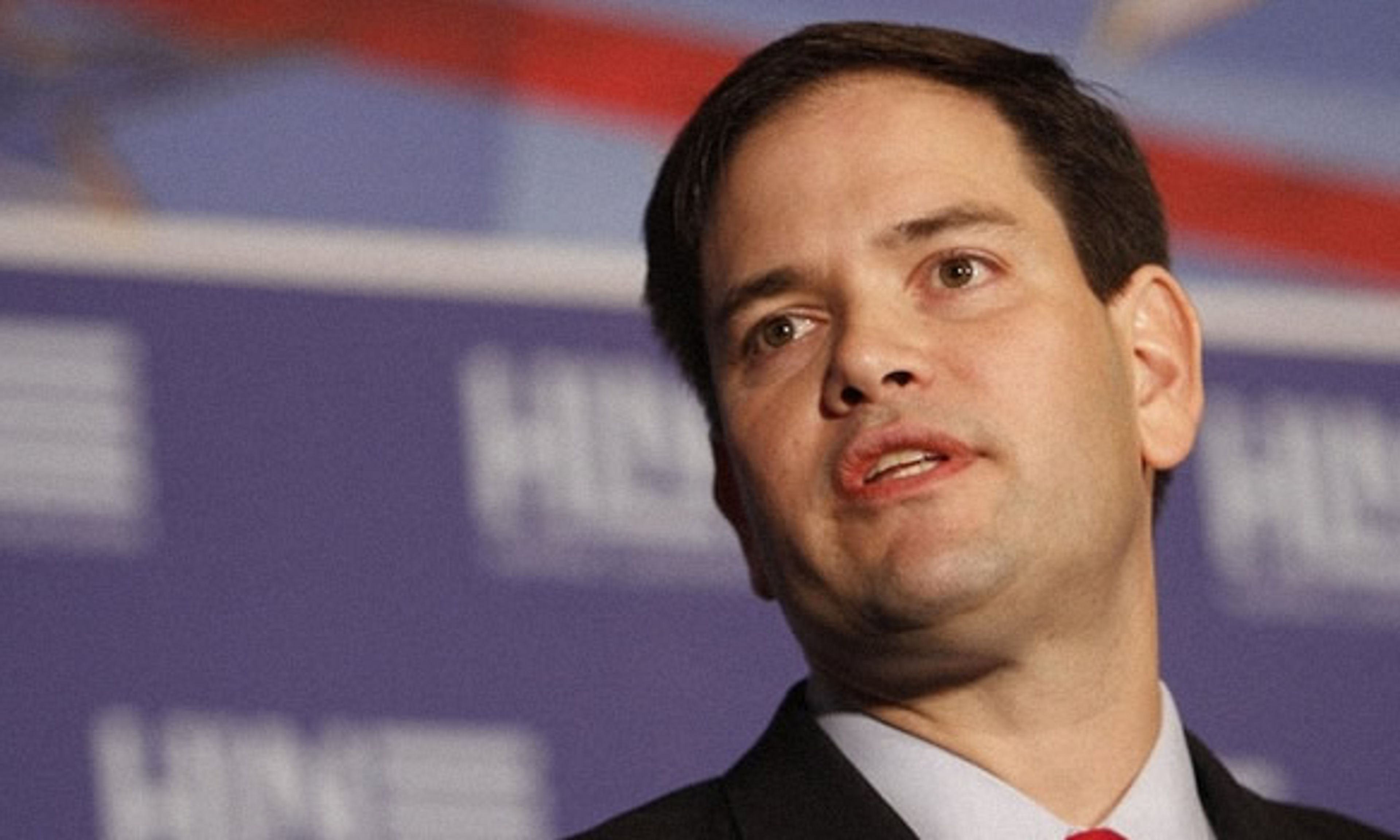
Have some sympathy for the men and women who will receive serious consideration as a potential running mate and vice president to Mitt Romney. In the coming weeks and months, they will be asked to turn over every detail of their political, financial, and personal lives to a group of strangers. And — in the case of one potential running mate — some of those strangers spent the 2010 cycle attempting to beat him in a tense primary and general election.
From all appearances, Florida senator Marco Rubio and Romney hit it off well. Rubio’s endorsement of Romney effectively ended the Republican primary campaign; the senator is often deployed as a Romney surrogate on television and radio and Rubio appeared with Romney at a rally in Philadelphia on April 23. (The Romney campaign refused to say whether their staff has yet contacted any possible running mates about the selection process.)
Many suspect Rubio will make the cut; the benefits of a young, Cuban-American, telegenic, articulate conservative from a key swing state are obvious. But if Rubio accepts consideration from Romney — he repeatedly denies interest in being vice president — the Florida senator will be required to turn over enormous amounts of personal information to a campaign full of former employees of Rubio’s 2010 rival, former Florida governor Charlie Crist.
Romney’s chief strategists, Stuart Stevens and Russ Schriefer, played the same roles on Crist’s senatorial campaign last cycle. Romney’s national press secretary, Andrea Saul, was Crist’s communications director. One of Romney’s regional press secretaries, Amanda Henneberg, was press secretary for Crist’s Senate campaign.
In the political world, Romney’s people are regarded as consummate professionals, and staffers’ changing bosses is part of the nature of campaign work. What’s more, some members of Rubio’s team are Romney veterans: Rubio’s chief of staff, Cesar Conda, and his deputy, Terry Sullivan, worked on Romney’s presidential campaign in 2008. Also, Romney adviser Albert Martinez served as a senior adviser to Rubio’s Senate campaign. (Beth Myers, Romney’s former chief of staff, is the official manager of Romney’s running-mate selection process.)
But Andrea Saul’s time with Crist has already garnered some attention. ABC News had fun looking through Saul’s comments on behalf of Crist, declaring that Rubio was a “wheeling and dealing Miami lobbyist and politician, always trying to scam the system for his personal benefit.” (Saul left the Crist campaign when the governor announced he was leaving the GOP and would run for the Senate seat as an independent.) If Rubio is on the 2012 ticket, it is likely that the Obama campaign would run some “even Romney’s own staffers say Marco Rubio is a no-good so-and-so” ads.
Any contender for the running-mate slot has to contemplate the risk of turning over all kinds of information — most of it innocuous, but certainly some potentially embarrassing or simply not for public eyes — to staffers who could end up working for some primary rival someday. In a perfect world, every campaign staffer would deserve trust, but the ghost of the McCain campaign haunts this cycle. Every potential running mate remembers frustrated, scapegoat-seeking McCain staffers leaking all kinds of negative information and anecdotes about Palin before and after Election Day 2008.
Unless a potential running mate withholds the information — and thereby probably ending his or her consideration by the Romney campaign — the vetting process is likely to feel intrusive and discomforting. In 2008, Tim Pawlenty wasn’t contacted about running-mate consideration until early July; the convention was September 1. In his autobiography, Pawlenty describes the veep-consideration process as “a phenomenally huge amount of time and hard work”:
The first step required preparation of written responses to an extraordinarily long questionnaire that arrived in the mail. This wasn’t a census form, mind you. It was page after page of every conceivable question about my personal and family life, as well as my various business and political dealings through the years. Ditto for Mary [Pawlenty’s wife].
That questionnaire also required us to produce a large volume of documents. Tax returns, real-estate records, investment records. Questions ranged from “Have you ever been disciplined?” to “Have you ever been arrested?” to “Have you ever been unfaithful to your wife?” They wanted to know if I had ever been subject to any controversies while in office. Had I ever written anything that had been published? And if so, copies were requested.
The responses took digging, time, and many late nights.
The Romney campaign is likely to overcompensate for what became perceived as a key mistake on the part of McCain’s campaign, a too-quick and too-shallow examination of Palin. For much of the summer, McCain wanted to cross party lines to select Democrat-turned-independent Joe Lieberman, but that idea polled badly and almost guaranteed a brutal fight at the convention in St. Paul. On August 24, 2008, the Lieberman option was dropped and the serious consideration of Palin began; Arthur Culvahouse, the former White House lawyer who ran the vetting process for McCain, spent days on a process for Palin that normally took weeks.
Republicans watching the 2012 GOP presidential primary characterize the Romney operation as risk-averse, placing a high value on loyalty and trust. This is fueling speculation that the process will gravitate to someone like Ohio senator Rob Portman or even Pawlenty, who’s been a Romney surrogate for the past six months. (National Review’s Bob Costa reported that Portman is a close and longtime friend of Romney chief strategist Stuart Stevens.)
Rubio has already been vetted by the national media in a way few senators are. He attracted national attention from the moment Crist left the GOP to run as an independent candidate for Senate. He’s had one unauthorized biography written about him and his autobiography, An American Son, is hitting bookstores now. In an interview with Fox News’s Bret Baier on April 30, Rubio discussed the sorts of minor controversies that tend to become media storms in the current political environment: claims that his personal expenses got mixed up with business expenses on a credit card issued to him by the Florida state GOP; his friendship with, and hosting of a fundraiser for, Congressman David Rivera, and a foreclosure proceeding on a house he and Rivera owned when the pair served in the Florida state house of representatives.
“Senator Rubio has said we’re not going to comment on the vice-presidential process,” says Rubio spokesman Alex Conant. “It’s notable that the best efforts of Marco Rubio’s unauthorized biographer, the well-respected Florida press corps, and plenty of enterprising national investigative reporters haven’t turned up anything in Marco’s past that would prevent him from someday seeking national office.”
— Jim Geraghty writes the Campaign Spot on NRO.






Comments