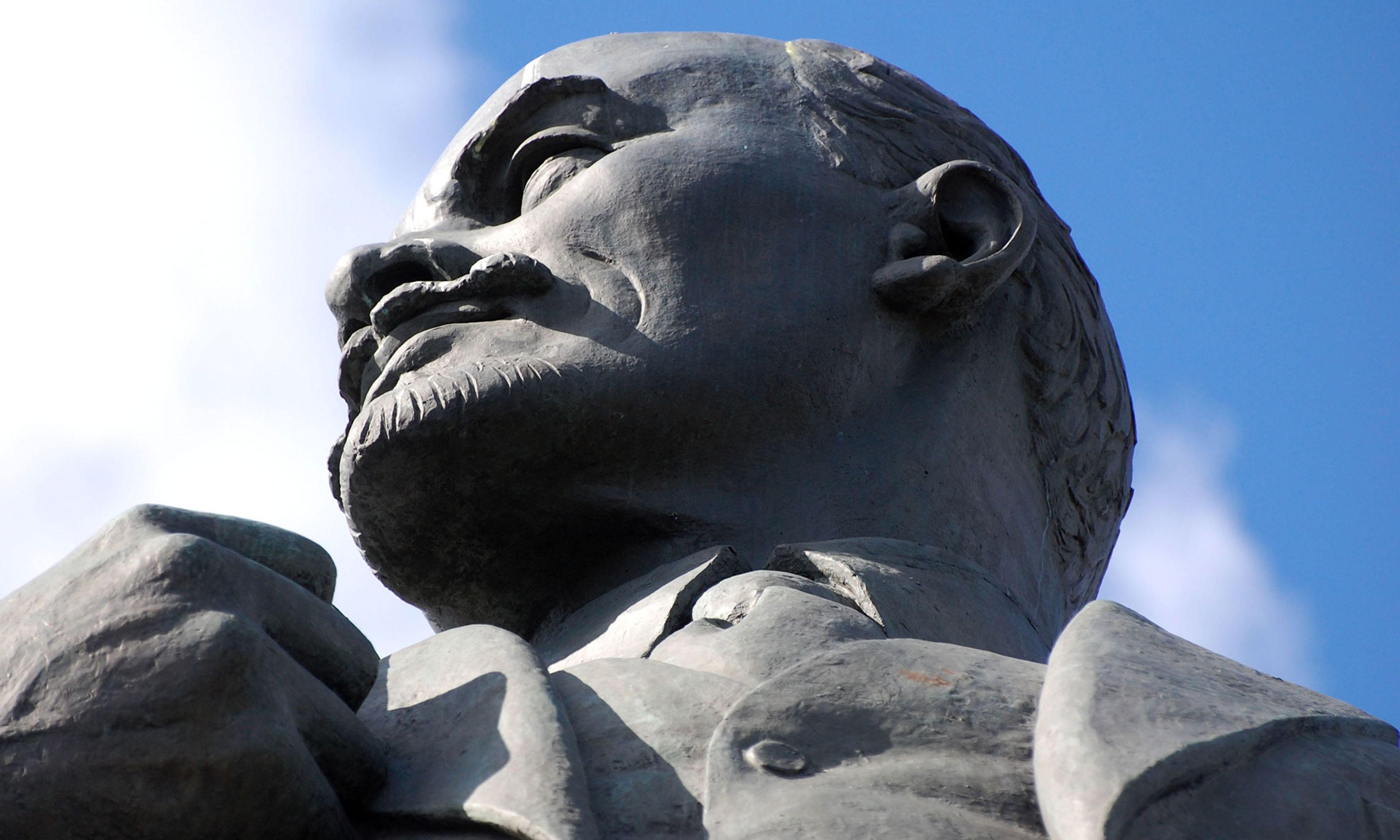
One hundred years ago, Vladimir Ilyich Lenin led his Bolshevik party to triumph in Russia, sweeping aside the Provisional Government, a liberal government that had replaced the czarist regime in February 1917. Why was liberalism so short-lived? Does its fate tell us anything about the Arab Spring or the color revolutions, the promotion of liberal democracy, or liberalism’s frailty?
In fact, it’s hard to imagine the Provisional Government’s surviving much longer. The Romanovs had ruled Russia for slightly over 300 years, doing relatively little — even toward the end — to invite public participation in governance, to encourage the sort of civic associations that can take charge of needs overlooked by government, to build institutions embodying the rule of law, or to ease the path for entrepreneurial spirits.
Yes, there was an elected legislative body, but under a franchise overwhelmingly skewed toward the land-owning classes. Until emancipation in 1861, the most conspicuous property-holders had depended on the czar to hold their serfs captive, so history associated property rights with oppression rather than, as in the West, with stalwart independence of government.
Yes, there had been reforms enabling peasants to change their squishy interests in land into rights more closely approaching standard Western property rights. But even these reforms, which were only partly completed, left peasants without the power to sell land outside the peasant community, and thus to use the land effectively to raise capital for improvements. And with limited ability to sell their lands, peasants lacked the usual set of incentives to compare their prospects as farmers with alternative occupations, and make an independent choice for what might suit them best.
Yes, there had been reforms in the 1860s nominally creating independent courts — but in fact allowing officials to “bend” judges to their will (in the words of a longtime minister of justice). And citizens had few effective judicial remedies against blundering, lawless, arbitrary officials.
Yes, markets were generally open, but for the dynasty’s entire existence there had been no provision allowing businesses to incorporate without individual bureaucratic approval — a system that trammeled enterprise and supplied officials with opportunities for crony capitalism.
Yes, there had been local self-government (in rural areas, bodies known as “zemstvos”). But their powers were limited, subject to supervision from the center (the ministry of internal affairs). And at the lower level of government, the township, there were no representative bodies at all; at that level, the ministry and its representatives exacted in-kind services such as road maintenance from the peasants, without compensation.
Even apart from the effects of everything described above, the government actively intervened to stifle development of civil society. It viewed most associations between citizens with alarm, obstructing their development — not consistently, to be sure, but enough to slow a healthy process. Even when employers were happy to bargain with employees and their representatives, the government might jump in and short-circuit the negotiations.
This chilling of civil society produced a landscape quite similar to that of pre-Revolutionary France as described by Tocqueville:
When the Revolution happened, one would have to search most of France in vain for ten men who had the habit of acting in common in an orderly way, and taking care of their own defense themselves; only the central power was supposed to take care of it.
The liberals who took power in February 1917 had at best a fuzzy vision of what might be needed to run the Russian state. They believed in a kind of “flick-a-switch” transition, in which everything would fall into place as soon as free speech was allowed, most of the czarist discriminations were repealed, and most of the incumbent law-enforcement personnel were discharged.
In 1917, with civil society growing but hardly robust, Russia was in no position to found a liberal democracy. So too, it seems likely, with countries across the globe today.
But those measures obviously did little to protect the “order” of “ordered liberty,” and nothing to build a consensus on how to deal with the war — fight on in the hope of victory (and of winning the spoils agreed on with Russia’s allies)? Adopt a kind of defensive crouch, so that soldiers could at least believe they were fighting for the fatherland? Sue for peace at almost any price? Moreover, the Provisional Government had kicked aside any institutional link to the Duma, the legislative institution that had operated since the reforms of 1905–06. If the Provisional Government had retained the Duma and applied a readily feasible expansion, by adding in members elected before the czar’s contraction of the franchise in 1907, the Duma could have debated the issue and produced a choice with some legitimacy.
Instead, deserting soldiers roamed the country, primed for violence. Workers seized control of factories and subjected them to conditions incompatible with continued operation. Peasants took control of land in defiance of government orders to wait for some orderly redistribution. The “ten men” Tocqueville yearned for were nowhere to be seen.
As the poet Nekrasov had said, “It’s not easy to correct the work of centuries.” In 1917, with civil society growing but hardly robust, Russia was in no position to found a liberal democracy. So too, it seems likely, with countries across the globe today.
READ MORE:




Comments