Editor’s Note: Our senior editor Jay Nordlinger spent the better part of August in Salzburg, doing a job or two at the Salzburg Festival. His music criticism has appeared in NR and on The New Criterion’s website; further criticism will appear in the October issue of TNC. The present journal, composed of odds and ends, is supplementary to all that. For Parts I-III of the journal, go here, here, and here.
Up on the Mönchsberg, I see a bumper sticker I like: “The good will out.”
‐In the Mirabell Gardens, I hear a song on the accordion: “New York, New York.” Incongruous, and wonderful!
‐Time after time, you see a young person and think, “He [or she] could be a von Trapp.”
‐In the Grosses Festspielhaus (Great Festival Hall), the young women who usher are so good-looking, you think they had to be hired for that reason. But honestly: They are not all that unrepresentative of the population …
‐I speak with an American and international businessman. We agree that what the United States needs, and the world at large needs, is growth. Dynamism. Liberalization. Opportunity. We are crying out for it.
Yet government policy is often stupid and cruel. It leads to immense waste.
Some recent legal mucking around having to do with a) Dodd-Frank and b) a European government has cost my friend $500,000. In describing the sheer idiocy of it, he calls on an old Army punishment. He did the equivalent of moving a big pile of dirt from one place to another. Nothing productive was involved.
Think what my friend could have done with that half a million! He could have hired more people, invested, bought, put it under a mattress — whatever. Anything would have been better. As it was, it was just a waste.
And stories like this are common, I’m afraid.
‐I spot a T-shirt on a young woman. It’s now my favorite T-shirt: I Don’t Need You. I Have Wi-Fi.
‐When I’m on top of a mountain, taking in an ineffable view, I often think, “I really should memorize ‘God’s Grandeur’” (the poem by Gerard Manley Hopkins).
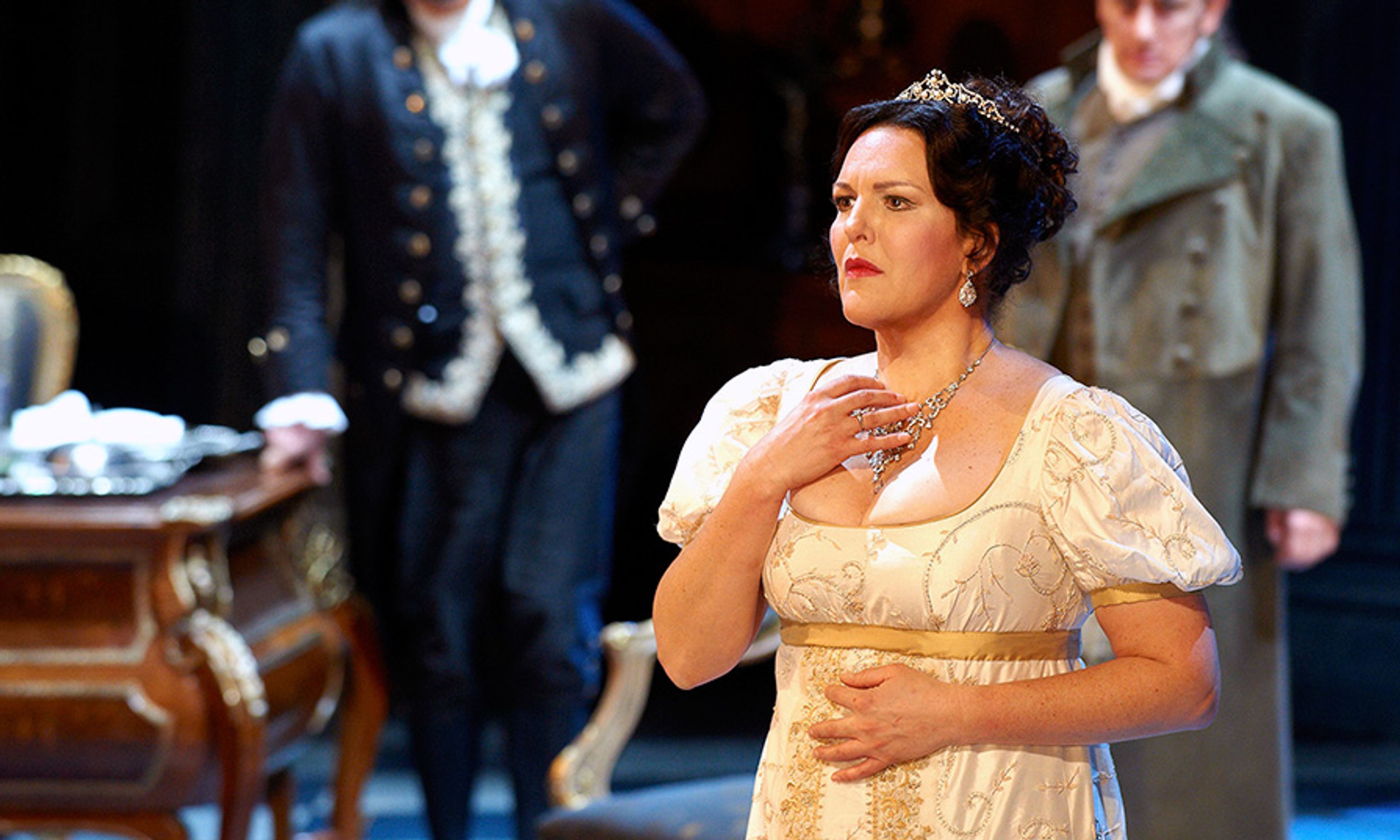
‐The fourth guest in our Salzburg Festival Society series is Adrianne Pieczonka. (There will be five.) She is the Canadian soprano (of Polish descent). And at the festival this year, she’s singing Leonore in Beethoven’s Fidelio.
She is an excellent guest, composed, thoughtful, and warm. Members of the audience want to talk to her about Salzburg’s production of Fidelio — a production that, in my view, is not all that defensible. She is very diplomatic and gracious. I admire this (and I never make a cast member defend a production). (I also believe — in fact, know — that a cast member has to “buy in” to a production, at least to a degree, in order to drag himself to work every day.)
Recently, Pieczonka has been a juror in a voice competition. I ask her what she looks for. She says, in effect, “Something special. Something out of the ordinary. Something individual and distinctive. Something with a spark or a glow.” Pieczonka herself has that. Her Leonore is very moving.
But aren’t they all? Because it’s such a moving role! No, not all of them are, for some reason.
By the way, Adrianne’s teacher was — maybe I should say “is” — Hilde Zadek, the German soprano born in 1917. She attended one of her student’s Fidelio performances this year.
‐I’m walking along a country-ish road, some distance from the city center. Two little girls want to block my way — they’re just having fun. They’re about seven and five. They tug at my shirt, they push me back. I’m like Franco Harris, trying to get through a line, but they’re a pretty good and dogged line. A giggling one, too.
Question: Would American parents let their daughters do this, if they knew about it? I wouldn’t, I can tell you that. And yet — I love the innocence and fearlessness and naturalness. The way things should be.
Do you know what I mean?
‐Near the city center, a man has stalled out. His car is old and kind of beaten up. He hops out of the car and looks under the hood. And I mean hops. He has one leg — no prosthesis. He has a crutch. He’s strong, by the look of it. And he’s no-nonsense.
He gets back into the car, but can’t get it started. He hops out again, to search for something in the back seat. This is in the middle of an intersection.
After a minute, he and I push the car, away from the intersection, and into a more reasonable place. He wants to do most of the pushing himself, while steering at the same time. And he could surely do this by himself, without me.
The things people go through. The things people prove. Ginger Rogers said she did everything Fred did, only backward. This guy works with one leg.
The bravery and toughness of people.
‐Something kind of new in Salzburg? Chinese tourists — plenty of them. The rise of China, economically, is gratifying (leaving aside everything else).
‐Local friends explain to me that there are some things Americans do that Austrians, among others, do not: muffins, doughnuts, and brownies. Someone has opened a doughnut shop in Salzburg — an American outpost amid the schnitzel and Mozartkugeln and all that.
I don’t get there, so can’t review it for you. Next time?
‐I pass a monument that says “Our Heroes: 1914-1918; 1939-1945.” Then there are lists of names.
Are they allowed to have heroes? Sure.
‐The fifth and final guest in our Salzburg Festival Society series is Andris Nelsons, the young conductor from Latvia. He is the music director of the Boston Symphony Orchestra. And he has the BSO with him in Salzburg, for a pair of concerts.
He began his career as a trumpeter. In fact, he was in the orchestra of the Latvian National Opera. I ask him, “What are some of the prominent trumpet parts in opera?” Well, the trumpet is often a signal-giver, says Nelsons. He then sings a bit of trumpet music from Carmen.
He can sing too, by the way. A bass-baritone, he did a lot of singing in younger days.
He is married to a singer — a real singer, a star singer, Kristīne Opolais, the Latvian soprano. They have a daughter. I ask Maestro Nelsons whether the girl is musical. A little early to tell, really.
I think of the Agassi children — the Agassi-Graf children. Mom is one of the greatest tennis players ever. Dad is one of the greatest tennis players ever. What if the kids … don’t like tennis, or can’t play very well?
That would make an interesting story, I think. But I, for one, would hate to pry. (If invited, however, I’d jump at the chance.)
‐Back to food. Some English translations don’t look quite right on a menu. Give you an example: “Fresh pasta with ragu of pasture pig.” (It was delicious.)
‐There are chocolate croissants and there are chocolate croissants. The ones at a café near me are laced with chocolate that practically makes you see stars. It’s that good. It is otherworldly chocolate.
Before I leave town, I think, “I won’t ever be able to eat ordinary chocolate croissants again.” But that’s not true. The memory of the Salzburg ones will fade. And I’ll have the ones you get at the breakfast buffet in, say, a Hampton Inn. And I’ll like them.
‐The Grosser Saal in the Mozarteum, I’ve seen many times. In fact, I think it’s my favorite concert hall. It is one of the most beautiful rooms I know. What I have never seen, until now, is the smaller hall in the Mozarteum: the Wiener Saal. It, too, is a jewel, fit for intimate chamber concerts and the like.
Should the look of a hall matter? Matter to the music-making or to the overall experience? Probably not, but …
‐I have never seen the Mozarteum library either, until now. The original library — a Mozart library — is just a room. Smallish. It certainly grew, beyond these confines. The room has many first editions, having to do with Mozart, and it also has a number of portraits. Wolfi is here, of course. But so are Haydn, Gluck, Beethoven, and Schubert.
How do you like that? Ecumenical.
‐I remember how, when I first came to Europe, as a teenager, the sirens in the streets chilled me. They were unlike our sirens at home. They were like the sirens I had heard in movies: World War II movies, Holocaust movies. They were sirens that instilled fear.
Those sirens are still here. And I’m not entirely used to them. Even now.
‐Salzburg has an Anton Bruckner Street. (He is an immortal composer, and he was Austrian.) I wonder: Does America have any George Gershwin streets? Or Samuel Barber streets?
I kind of wish we did. I wish we wanted to.
‐This particular taxi driver is primarily a baker — he drives a taxi to supplement his income. His dream is to have his own bakery. And his special dream is to have his own bakery in America. A German or Austrian bakery. He would especially like to go to the American West — Utah or Arizona.
Recently, a German bakery in Las Vegas came up for sale. Asking price, $358,000. The driver tells me, “I don’t have $358.” He has a wife and kids. He figures he will never get to America.
And I wish he could. When we’re amnestying millions, by executive order — well, anyway …
‐Boarding the Austrian Air flight, I notice they’re playing classical music. Gee.
‐Years ago, before I left for Salzburg, Bill Buckley said to me, “Say hello to music for me!” Hello. And goodbye. And thanks so much for joining me, dear friends. See you.




Comments