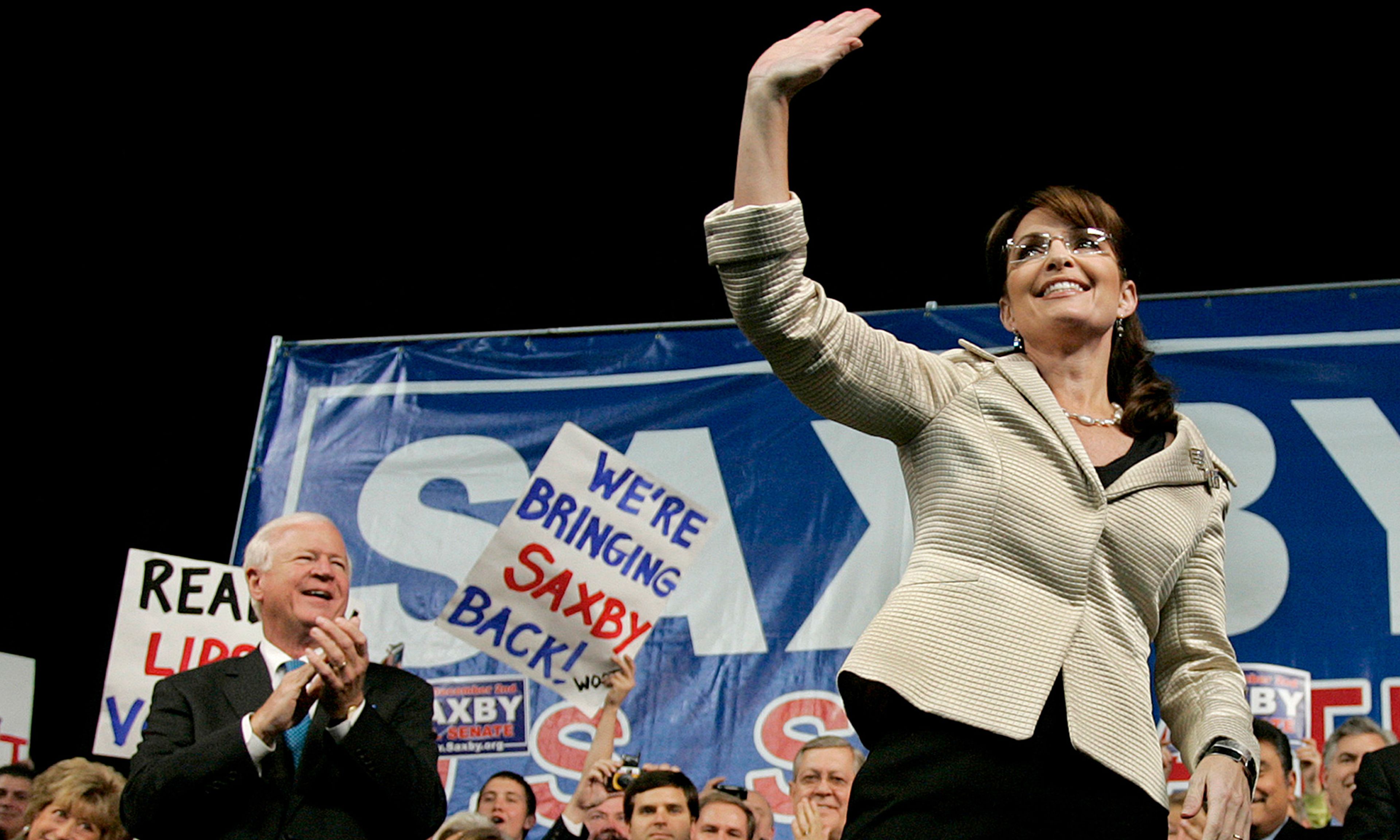
These are the things that can be said, with some degree of certainty, about the candidacy of Sarah Palin for vice president of the United States. First, that picking her as his running mate was the only thing John McCain did all year that shifted, however temporarily, an unfavorable electoral landscape to his favor. Second, that she gave one of the most successful debut speeches of any candidate for national office in American history, followed by one of the most disastrous prime-time interviews. Third, that the Gibson/Couric debacles, the broader hostility to her candidacy among the chattering classes, and the style in which she campaigned for McCain combined to gradually push her unfavorable numbers up toward levels that took Hillary Clinton and Newt Gingrich years to achieve. Fourth, that she leaves the campaign trail with the affection — even adoration — of many on the right, but lacking the crossover appeal she’ll need if she aspires to run for national office again.
Those are the knowns; the list of unknowns is considerably longer. Start with the big question: Did she ultimately help McCain or hurt him? Crunch one set of numbers — her high unfavorables, the polls showing a majority of Americans doubting her readiness to assume the presidency — and it seems that she almost certainly hurt him. But the majority of voters who cited Palin as a major factor in their decision voted for McCain, according to the exit polls, suggesting that she may have turned out more Mac-skeptic Republicans than she turned off independents.
And about those anti-Palin swing voters: Were they turned off mainly by Palin’s perceived inexperience and policy fumblings, or did they buy into the media’s narrative of the Alaska governor as a redneck Spiro Agnew, George Wallace in a dress? The McCain campaign reinforced this narrative by using Palin primarily as an attack dog and as a saleswoman for arguments McCain himself was too proud to make. How much of that was Palin’s doing, and how much of it reflected the folly of her handlers? This is what’s at issue, for instance, in the post-election feud about whether her famous reference to Barack Obama’s habit of “palling around with terrorists” was delivered on her own initiative or on orders from HQ.
All of this goes to the deeper question: Who is Sarah Palin, and what might she become now that she’s no longer tied to McCain’s campaign and message? Is she the center-Right pragmatist who racked up 80 percent approval ratings while governing Alaska or the polarizing red-meat-slinger who’s been embraced by the GOP’s activist base? What does she really think about immigration or the bailout, to pick two issues that just might come up in a future Republican primary campaign? And is she capable of reclaiming ownership of her image from her enemies in the press and from her conservative hagiographers alike?
How Palin answers these questions will, I suspect, depend in large part on the psychological impact of the purgatorio she endured during her two months on McCain’s ticket. In the heady days after the Republican convention, I remarked in these pages that the Alaska governor might be “the first conservative ever to benefit from a full-scale Borking and to emerge from the media gauntlet stronger than when she entered it.” That was premature, alas: The assault on Palin may have crested with the great Bristol brouhaha, but it continued apace throughout the campaign — and even now that their candidate has cruised to victory, the media still seem eager to circulate almost any nasty anti-Palin rumor or slander, no matter how implausible or thinly sourced.
Given this grueling, disillusioning experience, no one would blame Palin if she allowed her next political action to be informed primarily by the grievances she’s accumulated during this go-round. If the media have treated her as an enemy to be destroyed, then why shouldn’t she do the same to them? If the conservative base loves her while the N.Y./D.C. elite harbors doubts, then why shouldn’t she rally the base against the Beltway? The mood on the right at the moment is populist, anti-establishment, and ideological, so a woman who’s just been sneered at by elites, trashed by the media-political complex, and rejected by moderates has every reason to allow herself to become a vessel for these sentiments and a champion of the people who stood behind her in her hour of need.
Every reason, that is, save any ambition she may harbor to become president — as opposed to becoming a right-wing Walter Mondale, capable of taking her party’s nomination but destined to lose a general election in a landslide. Palin’s path to the Republican nomination in 2012 is easy enough to see, at least in theory: She has the potential to forge a potent primary-season coalition, uniting evangelicals who went for Mike Huckabee in 2008 and talk-radio conservatives who backed Fred Thompson and Mitt Romney. But parties do not live by primary-season coalitions alone, and there’s one statistic that ought to be plastered on every Republican politician’s wall, including that of the governor’s office in Juneau: When asked if the Bush administration was “too conservative” or “not conservative enough,” independents chose the former by a 20-point margin, while Republicans went for the latter by 11 points.
Polls change, of course, but this disconnect suggests that Republican politicians face a serious challenge going forward — how to woo conservatives and independents simultaneously when the two groups see the world in such different ways. Palin has an advantage in this regard, since her credibility with conservatives could offer her a freedom of movement that few Republican politicians enjoy. But any worthwhile plan of action will require her to swallow hard and make nice with those who disdained her.
This kind of Nixon-to-China strategy would require, for instance, that she meet and woo the foreign-policy hands who expressed doubts about her readiness and the columnists who criticized her — the George Wills and Peggy Noonans and David Frums, at least, if not the Christopher Buckleys and Kathleen Parkers. It would require her to become a regular on networks other than Fox News, a frequent guest (and good sport) on Saturday Night Live, and the sort of public figure who is as likely to show up on The View as on the Rush Limbaugh show. (Her post-election tour of mainstream media outlets wasn’t a bad start.) And it would require her to associate herself with explicitly non-partisan causes whenever possible — to appear alongside Bono, say, on some future trip to Africa, before she becomes a fixture of the GOP fundraising circuit.
Above all, it would require her to be patient. Palin’s more enthusiastic admirers have compared her to Ronald Reagan, but it was 16 years from Reagan’s electrifying endorsement of Barry Goldwater to his conquest of D.C. — time he spent doing the hard work of governing a state while tailoring and re-tailoring Goldwater’s message to match the changing times and the mood of middle America.
Given that Palin has been a governor for just two years, her only immediate ambition should be to govern her state successfully enough to win reelection in 2010. After that, she could afford to watch, and wait, and pick her moment. She’s young enough to imagine running for president in any of the next five campaigns, at least, and she’s popular enough to hang around the fringes of the next Republican primary season, and the one after that, hedging her bets until the right moment and going all-in only if it looks like the nomination is worth having. The only question is whether she’s savvy enough to recognize that the popularity she currently enjoys is not sufficient, that she needs to seduce skeptics rather than to crush them — and that, however long her list of enemies after this campaign, revenge is a dish best served cold.






Comments