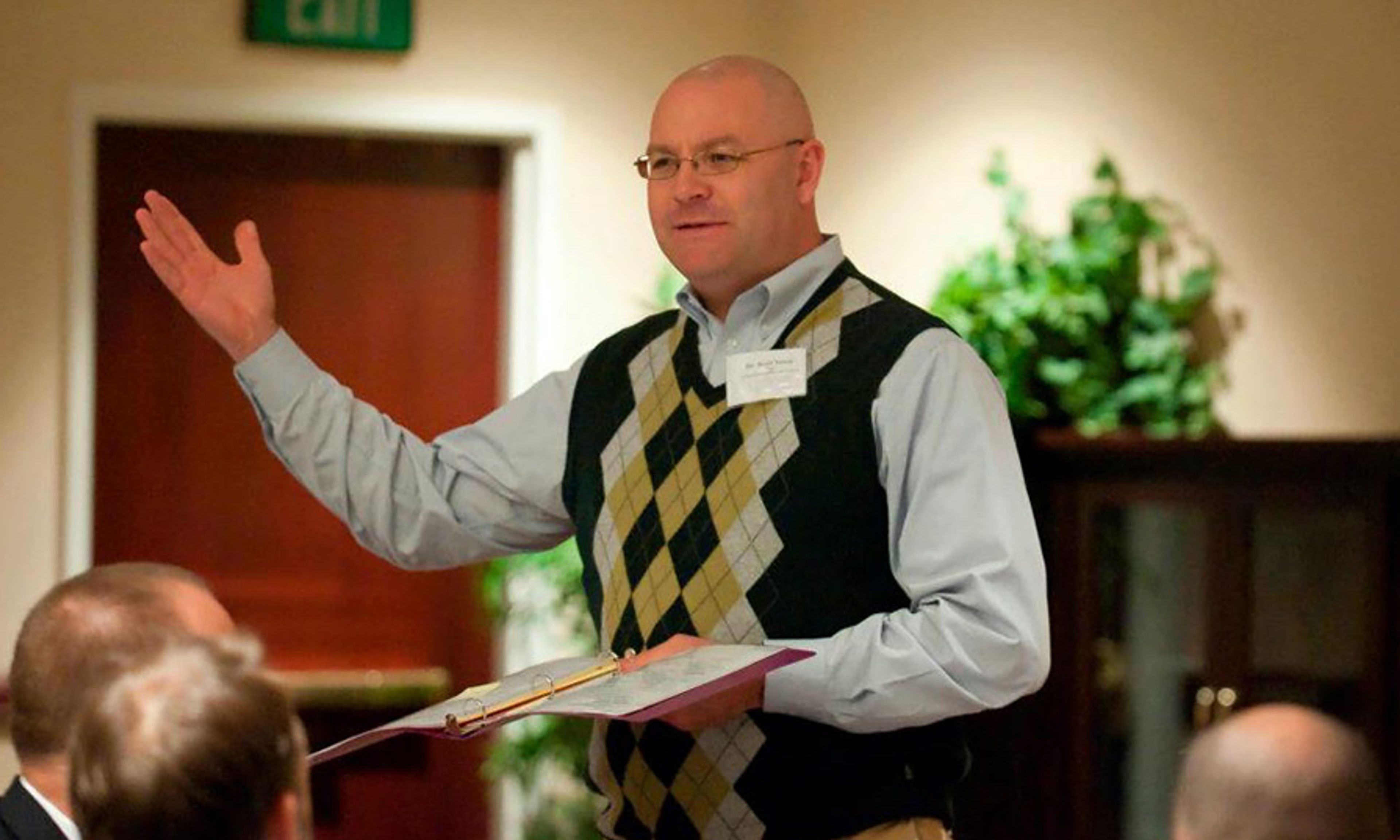
At Boise State University, in deep-red Idaho, a group of students is demanding that the university fire political scientist Scott Yenor for his scholarship on the intellectual history of feminism and the transgender movement. Even worse, some administrators are piling on.
The spark that lit the powder keg. On June 30, Yenor published a report for the Heritage Foundation: In “Sex, Gender, and the Origins of the Culture Wars: An Intellectual History,” he argues that today’s transgender movement arises logically out of the ideas of modern feminism. Both movements, he shows, insist that human identity need not be grounded in one’s body or one’s biological sex.
Several of the most important feminist thinkers thought that for women to be truly free, the family “must be abolished,” in the words of Simone de Beauvoir. Other feminists envisioned what Yenor calls a rolling revolution to ensure that, for women, anatomy would be not destiny. Among their goals were the erasure of all sexual taboos; the cultivation of the same temperament, status, and roles for men and women; and the achievement of economic and emotional independence of women and children from the natural family.
Yenor followed this report with an article on August 2 at the Daily Signal: In “Transgender Activists Seek to Undermine Parental Rights,” he describes how the transgender movement is in important respects a continuation of the goals of modern feminism as laid out by Beauvoir and others. Efforts to protect the authority of the family, Yenor urges, should therefore center on protecting parental rights, defending the current legal age of consent for adolescent sexual activity, and protecting childhood innocence from efforts to make public-school education ever more about modern sexual politics.
When Boise State’s School of Public Service posted Yenor’s article on its Facebook page, offended readers, including some students, demanded that it be taken down. The school’s dean, Corey Cook, then took to Facebook to defend Yenor’s academic freedom but also to criticize him personally.
Our core values as a School include the statement that “collegiality, caring, tolerance, civility and respect of faculty, staff, students and our external partners are ways of embracing diverse backgrounds, traditions, ideas and experiences.” As has been pointed out by several people in their communications with me, the particular language employed in the piece is inconsistent with that value.
Just how Yenor’s article violated the school’s core values is not made clear. The Daily Signal piece was the work of a scholar writing in a popular venue and making an argument about an important contemporary public-policy issue. That is a legitimate scholarly activity.
Connecting the dots. Francisco Salinas, Boise State’s new director of student diversity and inclusion, wrote a follow-up to the dean’s piece: “Connecting the Dots.” What dots? The dots between Yenor’s piece and Charlottesville, of course. “There is a reason that these things happened in succession,” Salinas asserts. And what precisely is the reason that Yenor’s article happened to be published before the neo-Nazi protests in Charlottesville? Well, language that does not affirm everyone’s identity is exclusionary, exclusionary rhetoric leads to hatred, and hatred leads to “bias motivated violence” and “build[s] to a genocidal end.”
They make no attempt to refute Yenor’s argument, wrestle with or consider the primary sources he is explicating, or otherwise engage in an intellectual back and forth.
Salinas’s explanation concludes with another leap: “Not every person who agrees with Yenor’s piece is likely to become an espoused Neo-Nazi, but likely every Neo-Nazi would agree with the substance of Yenor’s piece.” Note the pure demagoguery in the word “espoused.” The director of student diversity and inclusion insinuates that a Boise State professor and those who are persuaded by his descriptive account of the professed aims and principles of the feminist and transgender movements are Nazis, either closeted or avowed. The missing premise of Salinas’s statement, of course, is that social conservatives like Yenor share with Nazis a disregard for human dignity. That slanderous premise turns the truth on its head.
Salinas’s non sequitur provides the perfect illustration of a troubling trend: the effort by some students, administrators, and faculty to shut dissenting voices up through intimidation and name-calling. As of this writing, more than 2,000 have signed an online petition calling for Boise State to fire Yenor for his scholarship and related work as a public intellectual. Students have penned opinion pieces calling for his ouster, and a flyer headed “Fire Scott Yenor” is a circulating on campus. It includes an absurd bill of particulars and toward the bottom declares, in solid caps, “YOU HAVE BLOOD ON YOUR HANDS SCOTT YENOR.”
The rhetoric is over the top, but what Yenor’s detractors fail to do is even more troubling. They make no attempt to refute Yenor’s argument, wrestle with or consider the primary sources he is explicating, or otherwise engage in an intellectual back and forth. Denunciation now takes the place of discussion.
Bulverism arrives on campus. Before his untimely death in November 1963, C. S. Lewis intended to write the story of a fictional character named Ezekiel Bulver, a boy who learned by listening carefully to his parents quarrel that “refutation is no necessary part of argument.” Bulver’s unique insight was that he could avoid the rigorous demands of intellectual life by simply asserting that his opponent was wrong and then following that assertion with an ad hominem attack as supporting evidence. That, Lewis tells us, was “how Bulver became one of the makers of the Twentieth Century.”
Refutation requires engagement with ideas, and a striving to understand the truth. From it arise norms of civility, good faith among interlocutors, and a willingness to consider the merits of different arguments. It is easier to denounce without disputation, to assume someone is wrong without bothering to discover whether they are wrong or demonstrating how they are wrong.
The intellectual winds blowing in Idaho are ominous.





Comments