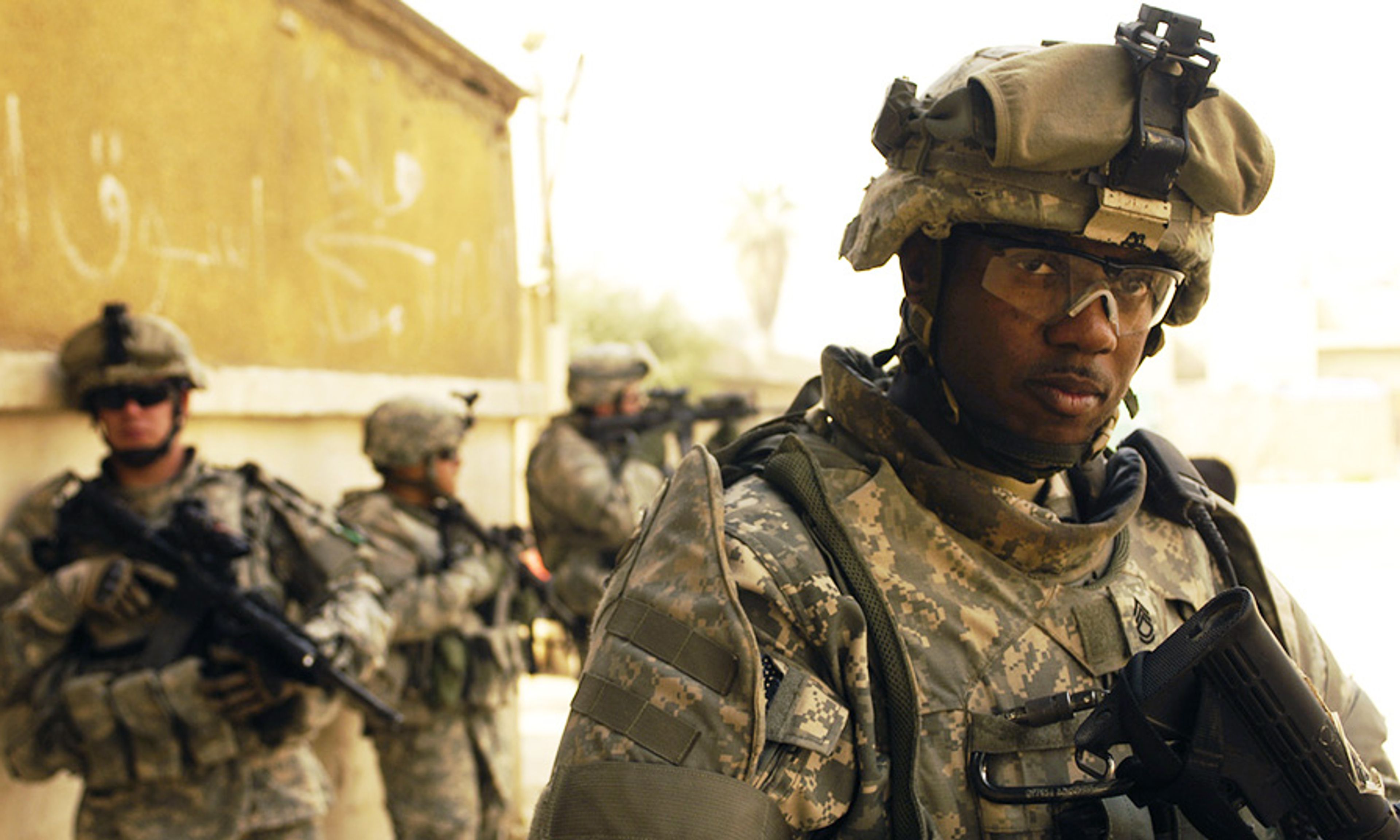
The 2003 invasion of Iraq traded one set of problems for another. Among the obvious new problems was that by toppling Saddam Hussein, we created a huge vacuum of power at the heart of the Middle East. It took five years of war for America to fill the vacuum.
Whatever your opinion of the initial invasion, one thing is clear: By 2008, a long-term U.S. presence in Iraq had become indispensable to the stability of the whole region. Thanks to the success of the 2007 surge, a long-term U.S. presence had also become a relatively low-cost proposition. Most of the troops could safely come home. The Pentagon hoped to keep only about 10,000 in Iraq — not to keep fighting, but so they wouldn’t have to fight again.
Yet at the end 2011, against the advice of the Pentagon, President Barack Obama recklessly withdrew the remaining U.S. forces. Just a few months ago, Obama was still dreaming that he had “brought a responsible end to the war in Iraq.” ISIS and other terrorists were just a “JV team.” The Syrian civil war was containable. The threat from Iran was waning.
Alas, those aspirations had already been doomed by the 2011 withdrawal. Now the resulting vacuum of power has become a vortex. Whole regions of Iraq have fallen to ISIS. Every week brings fresh news of another 100,000 refugees and hundreds or thousands of people killed. And that’s just what reaches the Western media. Our former allies among the Sunni tribes of Anbar province and northern Iraq — who fought and died with us in the battle against terrorism — are living in an untold reign of retribution and terror under ISIS, abandoned to their own desperate devices.
Americans remain largely opposed to the idea of U.S. forces’ going back to Iraq. But go they must, before the situation gets even worse. A mere 20,000 troops might be enough to defeat ISIS, contain the Syrian civil war, and stop Iran and its proxy militias from dominating Iraq. Without those troops, the region will continue to fall apart, threatening a much wider calamity. And far from averting that calamity, limited U.S.-led airstrikes may actually add fuel to the fire.
What we are witnessing in the Middle East is essentially a proxy war between the region’s Sunni and Shiite extremists, with tens of millions of innocent civilians caught in the crossfire. Saddam — a relic of secular Arab fascism — had been able to hold down the mounting tensions of the Islamist wave through sheer terror. After Saddam fell, those tensions boiled over, and Iraq became the principal theater of a terrifying new war.
That war began in 2004 with the fall of Fallujah to al-Qaeda and former Ba’athists. Drawing support from Qatar and Saudi Arabia, al-Qaeda murdered innocent Shiites by the hundreds. Supplied and often led by Iran, Shiite militias fought back with indiscriminate death squads. The U.S. heroically defeated both sides in this proxy war starting with the 2007 surge ordered by President Bush, which ended the spiral of violence. Iraq’s political factions united behind the country’s alliance with America. During Obama’s first term a tenuous stability held.
Not appreciating how essential American power had become to that stability, Obama at first ignored Iraq, hardly deigning to meet or even talk with Prime Minister Nouri al-Maliki, and then finally abandoned it at the end of 2011. The civil war started again in 2013, again with the capture of Fallujah by al-Qaeda forces, this time in the form of ISIS.
Incredibly, Obama seemed nonplussed. Hundreds of Americans had died fighting to liberate Fallujah from al-Qaeda the first time round, but that was under his predecessor’s “dumb war.” Terrorist advances around the world, the president assured us, were not necessarily “a direct threat to us or something that we have to wade into.” ISIS had already captured Fallujah, but it was just a “JV team.”
It soon became clear that, regardless of the prospects for democracy and reconciliation in Iraq, a U.S. military presence there had become necessary for a host of other reasons.
The start of the Syrian civil war in March 2011 should have put an end to any serious consideration of withdrawing from Iraq, especially given the decision not to intervene in Syria. Allowing the Syrian civil war to fester raised the specter that it might spread to other countries. That made keeping U.S. forces in Iraq vitally necessary, if only to control the Syrian border. With the Syrian civil war raging next door, Obama’s withdrawal from Iraq essentially restarted — or rather, let back in — the very war he thought he was ending.
Meanwhile, the U.S. withdrawal dramatically strengthened the hand of the Shiite extremists in the government of Iran. With U.S. forces present, Iran’s mullahs had been largely unable to extend their influence over Iraq’s Shiite-dominated government. But the U.S. withdrawal created a vacuum that Iran promptly filled. Iranian-backed militias such as the Asaib Ahl al-Haq increasingly dominate Iraqi politics, even under Iraq’s new government.
We are now seeing the discomfiting results in Obama’s war on ISIS. Americans are rightly skeptical that the strategy of “degrading and ultimately defeating” ISIS has much hope without U.S. “boots on the ground.” But the mission’s prospects are even dimmer than these skeptics realize. Now that Iran has replaced the U.S. as the preeminent power in Iraq, any success the U.S. has against ISIS will necessarily advance Iran’s interests more than America’s. Obama’s incoherent idea of supporting the Free Syrian Army against ISIS but not against the Syrian dictator Bashar Assad is another sign of the fatal contradictions in the administration’s strategy.
With no forces on the ground in Iraq, the U.S. is now unable to defeat both sides in the proxy war there simultaneously — something we had accomplished just a few years ago. Instead, with limited airstrikes, the U.S. has in effect entered that proxy war in a subordinate role on the side of the Shiite extremists: Iran, Syria, Hezbollah, and the Shiite militias of Iraq.
Our principal allies in the Middle East, namely Israel, Jordan, Egypt, and the Arab kingdoms, can only wonder how the U.S. will manage being allied simultaneously with them and with their mortal enemies. Don’t be fooled by the Arab states’ support for current operations against ISIS. Under these circumstances, and with this strategy, America’s already-troubled relations with its allies in the region can only worsen.
Meanwhile, in the absence of U.S. forces, Iranian-backed Shiite militias in Iraq are once again targeting innocent Sunni civilians on a large scale. The Sunnis of Iraq and Syria are ISIS’s principal base of support, but they are also its principal victims. Hence the Sunnis now find themselves once again caught in the crossfire, with perhaps 7 million of them trapped in the enormous territory controlled by ISIS.
Lest we forget, these are the same tribes that joined the American side in droves to defeat al-Qaeda during the Anbar Awakening. Without forces in Iraq, the U.S. can no longer protect them — or much of anyone else. In this light, Obama’s lack of concern over the capture of Fallujah in January of this year reveals an impressively callous disregard for the suffering of people who trusted us and fought with us — to make no mention of an awful disregard for the achievements of the Americans who fell in the Iraq War.
U.S. troops are urgently needed now not just to defeat ISIS, but also to stabilize the situation in Iraq generally and give its governing institutions the time they need to grow firm roots; to start containing the Syrian civil war; to put Iran and the Shiite militias back in their box; to reassure our allies; and to protect the millions who flocked to our side just a few years ago and whom only we can protect. In short, the U.S. won’t be able to accomplish virtually any of its goals in the region without a dominant long-term presence in Iraq.
President Obama has led himself into a trap of his own making. The war he thought he was ending by withdrawing U.S. troops has started again as a direct result of his withdrawal, and it will continue unless he sends them back.
— NR contributing editor Mario Loyola is a former counselor for foreign and defense policy to the U.S. Senate Republican Policy Committee.





Comments