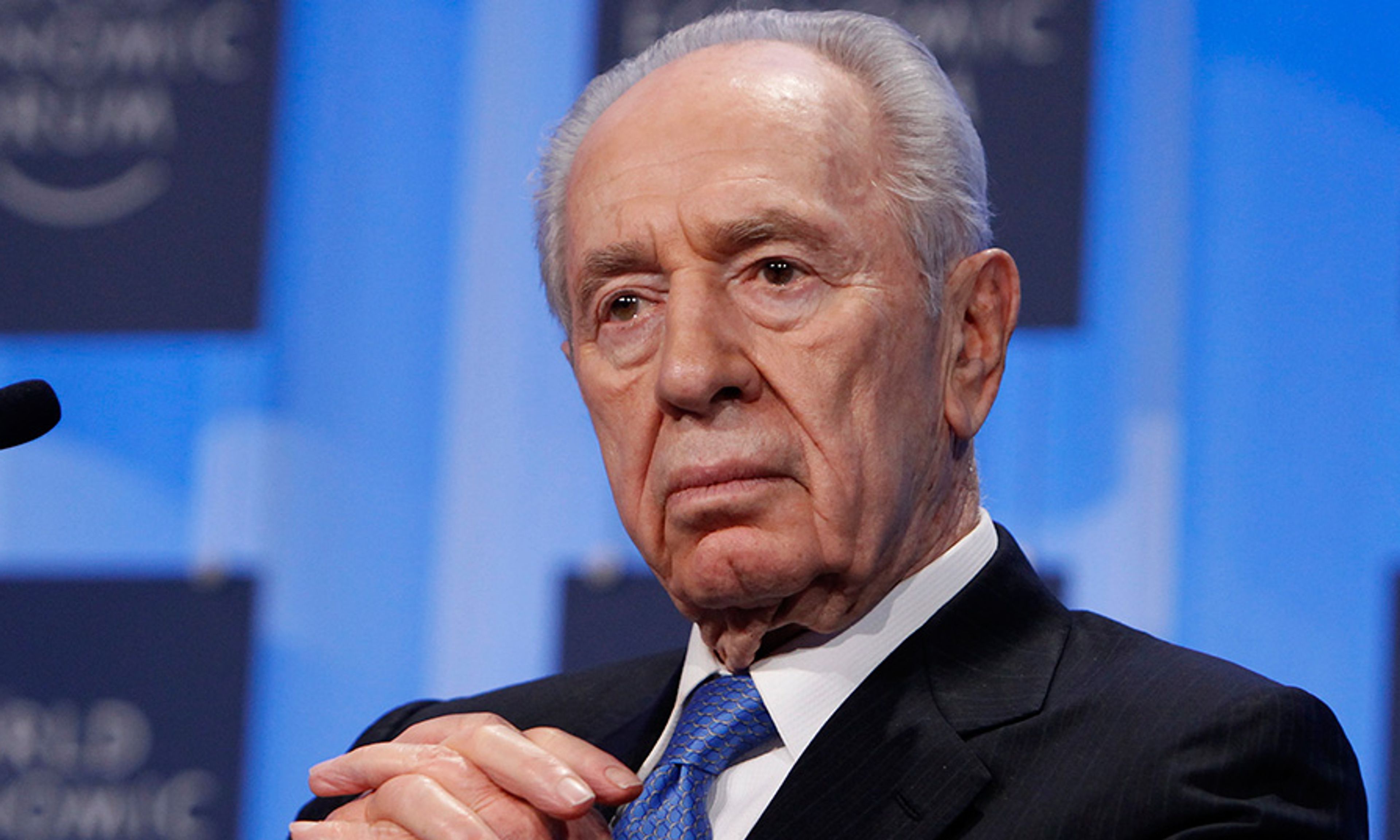
This is what happens when a longtime public figure dies: Journalists trot out their pieces about him, and experiences with him. This week, it’s Shimon Peres’s turn. Forgive me for adding to the pile.
I saw him at Davos several times. (The annual meeting of the World Economic Forum in Davos, Switzerland, high in the Alps.) I took part in “media coffees” with him. He was more impressive in person than he was in news articles and on television. Sharper. Deeper. More personable. Handsomer, too. I could see why he had succeeded in politics for so long.
He was on the left, yes, but he was sensible. (Lefties will love that “but”!) And, like other Israeli politicians, he was not all that partisan. For instance, he had regular meals with Ariel Sharon. From what I can tell, Israel is too small a community to allow for all-out, 24/7 partisanship.
In 2009 — again at Davos — Peres gave probably the most thrilling and most gratifying forensic performance I have ever witnessed in my life. He was in a hostile room. And he was on a hostile panel. His co-panelists were Ban Ki-moon, the secretary-general of the U.N.; Recep Tayyip Erdogan, the prime minister of Turkey; and Amr Moussa, the secretary-general of the Arab League.
They heaped scorn on Israel, for its defense of itself against Hamas. They heaped lies on Israel as well. Through it all, Peres just took it and took it. He sat serenely. And then it was his time to speak.
He defended his country with tremendous passion — and tremendous truthfulness. He cleared the air. Cleared it of all those lies. He was an old man, shouting — literally shouting — for his country and its legitimacy. I tell you, it was so thrilling, and so gratifying.
I certainly can’t do justice to the experience in these few notes. I wrote it up in a magazine piece, here. I hope some justice is done in that piece.
Frankly, I had never thought very much of Peres. He was a lefty and dove; I was a righty and hawk. I thought that he was naive, to the point of dangerousness. But I became a fan, certainly a respecter.
The truth is, even the doves in Israel aren’t very dovish. Dovishness and hawkishness are relative in that country. Virtually everyone in Israel is security-minded, for life has forced them to be.
Not long after that experience in Davos, I researched and wrote a history of the Nobel Peace Prize. Peres shared the prize in 1994, when he was Israel’s foreign minister. His two co-laureates were the prime minister, Yitzhak Rabin, and Yasser Arafat, the PLO head. They won for the Oslo Peace Accords (ill fated, of course — Arafat saw to that).
I wish to quote from my book:
Naturally, there was a storm of reaction to the 1994 prize — a storm that began even before the announcement, when the prize was expected to go to Arafat and Rabin, the two sides’ chiefs. When a triumvirate was announced — two Israelis and one Palestinian — there was complaint about lopsidedness: Why two versus one? Why this advantage to the Israelis? Chairman Sejersted explained that half the prize was for the Israeli contribution and half for the Palestinian; it was just that the Israeli half was being shared, by two men who deserved equal credit. . . .
Rabin and Peres were old Labor lions, and old rivals. Each was claiming credit for the breakthrough with the Palestinians. It seemed sure that the prime minister would have a part of the Nobel, because he was, after all, prime minister. But Peres’s friends campaigned for the foreign minister’s inclusion in the prize. After the announcement, a Washington Post report noted with some slyness, “Last month, on the anniversary of the accords, Peres managed to spend the day in Oslo, where he met with Norwegian legislators.” The Nobel committee reached its final decision only on October 7, a week before the announcement: The peace prize would, for the first time, be three-way. . . .
Peres gave an address of really arresting beauty.
Yes, he did. Not all of it was that way, but some of it was. Read the speech here. I will quote a bit:
I was born in a small Jewish town in White Russia. Nothing Jewish now remains of it. From my youngest childhood, I related to my place of birth as a mere way-station. My family’s dream, and my own, was to live in Israel, and our eventual voyage to the port of Jaffa was like making a dream come true. Had it not been for this dream and this voyage, I would probably have perished in the flames, as did so many of my people, among them most of my own family.
Embedded in Peres’s speech was a tribute:
For two decades, at the Ministry of Defense, I was privileged to work closely with a man who was and remains, to my mind, the greatest Jew of our time. From him I learned that the vision of the future should shape the agenda for the present; that one can overcome obstacles by dint of faith; that one may feel disappointment — but never despair. And above all, I learned that the wisest consideration is the moral one. David Ben-Gurion has passed away, yet his vision continues to flourish: to be a singular people, to live at peace with our neighbors.
And I think the following is my favorite passage of all:
The wars we fought were forced upon us. Thanks to the Israel Defense Forces, we won them all, but we did not win the greatest victory that we aspired to: release from the need to win victories.
Mr. Peres always declined to be interviewed by me, one on one. I think I made two requests — maybe three. Some people around him recommended that he accept. I have my suspicions about his demurring — maybe I’m completely wrong. But I think he was a little embarrassed about the Oslo accords, and therefore about the Nobel. And I think that his Davos performance, which I loved and admired, and had praised to the skies, left him a little bruised.
Anyway, this is Shimon Peres Week, and I wanted to contribute my mite.






Comments