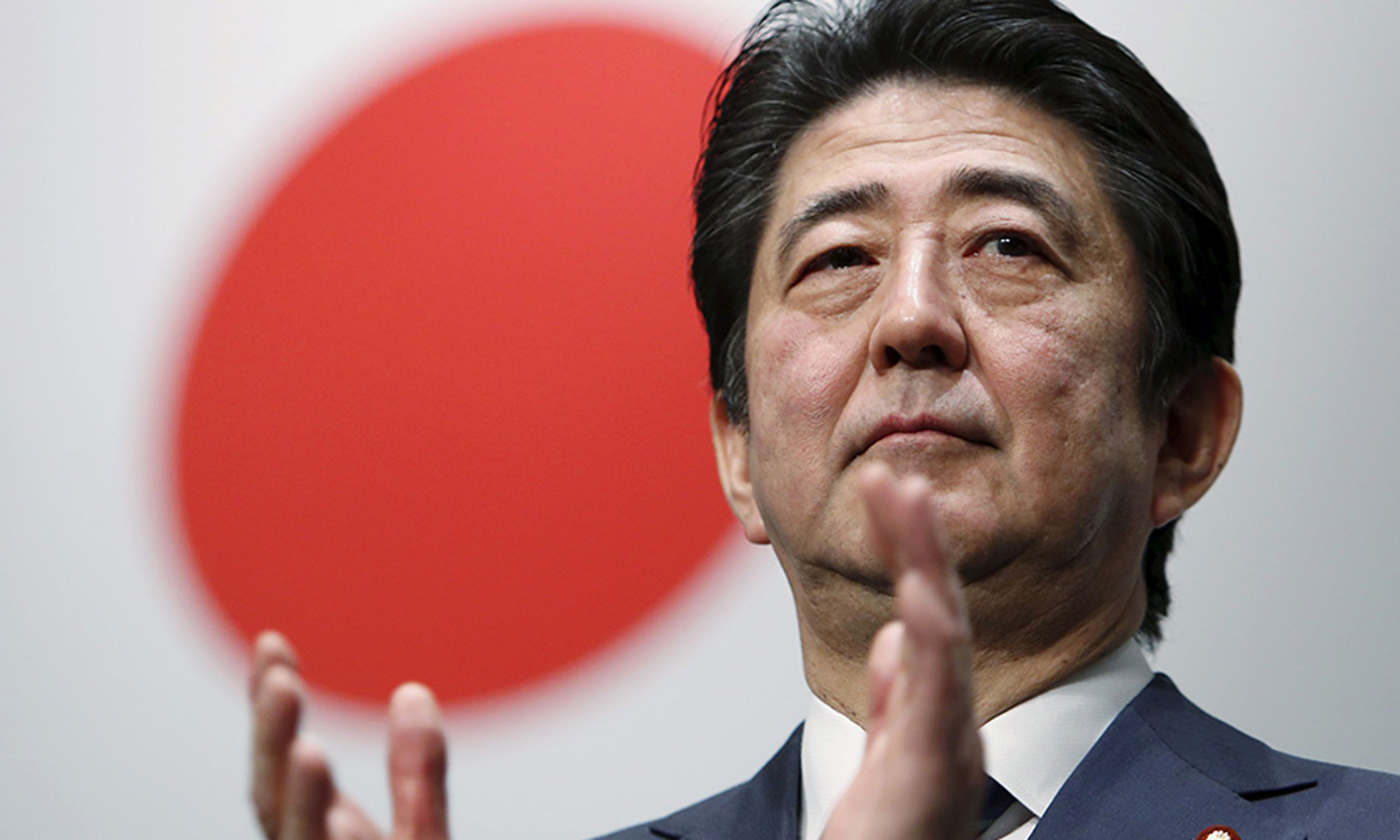
Japanese prime minister Shinzo Abe is in Europe this week, holding discussions with European leaders in advance of the G7 summit, which Japan is hosting at the end of this month. Tightening Japan’s ties with Western states has long been a key part of Abe’s foreign policy. By visiting Italy, France, Belgium, Germany, and the U.K., he hopes to broaden the scope of Tokyo’s partnerships and make Japan the Asian political and security partner of choice for European nations.
The last time Japan had as full an agenda with the G7 was during the Cold War. Then, Tokyo played a vital role in holding the line against Soviet expansion in Asia, partnering with the United States on maritime and aerial security and providing a base for crucial surveillance operations. Now, Abe is attempting to secure a role for Japan as the key Asian state in the fight to maintain global order. The strengths he brings to the table, including a coherent vision, are matched by the limitations of Japan’s position.
The business of setting the G7 agenda is at the top of Abe’s to-do list in Europe. Abe will be discussing the state of the world economy in the light of China’s slowdown, global counterterrorism strategy, and Asian issues with his European counterparts. His goal for the G7 has been to focus on regional stability, which is all the more pressing in light of the tense, ongoing territorial conflicts in Asia’s seas. Here, he has found some traction with his European partners, particularly the British, who have begun expressing their concern over Chinese coercion in the South China Sea. That may not seem like much, but Abe appears to be patiently building a coalition to rhetorically and materially support enforcement of the global rules-based order. With a decision looming in The Hague on the Philippines’ arbitration case against China’s claims in the South China Sea, Abe’s efforts have already drawn warnings from Beijing.
Not all of Abe’s energy will be spent on the G7. While in Brussels, he will discuss ongoing negotiations over a Japan-EU economic-partnership agreement. As he prepares to ratify the Trans-Pacific Partnership (TPP) this fall, Abe is moving ahead on a European pact partly to give Japan an economic hedge against the Chinese, who are close to completing their own investment agreement with the EU.
Bilateral security issues will also be high on the agenda. Since he took office in late 2012, Abe has increased 2+2 meetings with top diplomatic and defense officials from the UK and France. On this trip, he is likely to push for further cooperation on defense equipment, including joint production and sales. Abe’s decision to eliminate Japan’s restrictions on arms exports in 2014 has allowed Tokyo to slowly begin using defense agreements as a means of forging tighter political relations. To that end, he plans to raise the possibility of signing acquisition and cross-servicing agreements (ACSAs) with London and Paris, which would allow the exchange of logistics support, supplies, and services. This would complement existing Japanese ACSAs with the United States and Australia, making future security cooperation easier.
Japan’s defense cooperation with the European Union will likely also be a focus of Abe’s talks. Tokyo has attempted to become the top Asian partner for the EU, in part by facilitating the EU’s Common Security and Defense Policy mission. In the Gulf of Aden, for example, Japan’s Maritime Self-Defense Force has already held five joint exercises with the EU’s Naval Force Atalanta on counter-piracy measures. The passage last year of reforms that allow Japan’s Self-Defense Forces to participate in collective self-defense activities gives Abe an opening to discuss further security cooperation with the EU.
The most controversial stop on Abe’s trip will be the last: Moscow, where he’s scheduled to meet with Vladimir Putin. After ignoring Barack Obama’s request not to meet the Russian leader, Abe will head to the Kremlin with a focus on resolving the seven decades-old Kurile Islands dispute. He hopes to secure the return of the four small islands, which sit just off the northern tip of Hokkaido and were captured by the Red Army in the closing days of World War II.
Abe is attempting to secure a role for Japan as the key Asian state in the fight to maintain global order.
The decades-long attempt to entice the Russians into surrendering the islands, the significance of is both strategic and economic (mainly fisheries), has led the Japanese into a twilight relationship with Moscow, with successive Japanese leaders offering Russia ever-more economic aid to no avail. With Putin having announced an increase in defense spending on the Kuriles and Russia building a new base on one of the islands, it seems unlikely that Abe stands much of a chance to succeed where his predecessors failed.
In going to Moscow, Abe risks angering the European partners he will have just seen. Their focus, not surprisingly, remains on Russian aggression in Ukraine and intervention in Syria. But Japan has always had a different geopolitical calculus when it comes to Russia. Maintaining the balance of power in Asia often means engaging with Moscow. And China’s rise combined with the emergence of North Korea as a nuclear power makes such engagement even more important for Tokyo. Russia’s capacity to influence Asian relations may be reduced, but it continues as a crucial supplier of oil and natural gas, and retains a potential ability to control strategic Arctic passageways. Given the Chinese and North Korean challenge, Japan will consider its own regional interests above the global community’s, condemning Russian actions in Ukraine even as it attempts to keep bilateral relations open.
The complexity of Japan’s relationship with Russia limits how close it can get to Europe, at a time when the latter relationship could be critical. Neither Japan nor Europe is directly involved in the other’s major security issues. Japan has played no role in the Ukrainian and Syrian conflicts, while Europe has stayed out of the Senkaku Islands dispute. There are no Japanese forces fighting the Islamic State or Royal Navy ships patrolling in the East China Sea. No European nation will help with a war on the Korean peninsula. A community of interests is a laudable goal, but will likely do little to change either Chinese, North Korea, or Russian policies.
Yet under Shinzo Abe, Japan is again bidding to become a central player on the world stage. It remains an attractive partner for technology cooperation, and the potential for defense-industrial ties could help the economies of both Japan and Europe. By staking his foreign policy on the maintenance of global order, Abe has created the biggest opportunity for Japanese engagement with Europe since Yasuhiro Nakasone was prime minister in the 1980s. The next U.S. president should welcome closer cooperation and partnership among European and Asian democracies, and figure out how to get America engaged in the process. Tensions over ties with Russia, which Tokyo is unlikely to cut, are all the more reason to take advantage of the outstretched hand that a more activist Japanese premier is offering.
— Michael Auslin is a frequent contributor to National Review, and the author of The End of the Asian Century.





Comments